Facts
The Petitioner company provides engineering services to foreign airlines.
Source reference: no citationThe Respondent was employed as a technician and later executed a bond/agreement on 7 November 2022 to undergo specialized training for Boeing B777 aircraft
Source reference: p. 2Under the agreement, the Respondent committed to serving the company for three years post-training or paying ₹10 lakhs in liquidated damages and providing a 60-day notice
Source reference: p. 2-3, 6After becoming a certified Aircraft Maintenance Engineer, the Respondent resigned via email on 9 April 2024, without serving the notice period or paying damages
Source reference: p. 3, 7When the Petitioner withheld his Relieving Letter and Service Certificate, the Respondent filed a complaint (ULP No. 450 of 2024) under the MRTU & PULP Act, 1971.
Source reference: no citationThe Industrial Court, via an interlocutory order dated 13 January 2025, directed the Petitioner to issue the documents
Source reference: p. 3The Petitioner challenged this interim order in the High Court.
Source reference: no citationIssues
1. Whether the Industrial Court can direct an employer to issue a relieving letter/service certificate to an employee who breaches a service bond before the completion of the agreed tenure
Source reference: p. 1, para. 12. Whether the grant of final relief (issuance of documents) at an interlocutory stage is sustainable when contractual obligations remain unfulfilled
Source reference: p. 4, para. 6Law Applied
The court applied the principles of contractual obligations under the Indian Contract Act, 1872, and the MRTU & PULP Act, 1971.
Source reference: no citationIt relied on Amrit Pal Singh v. Pawan Hans Helicopters Ltd., which established that an employer is not required to relieve an employee until contractual conditions (notice period and bond payment) are satisfied
Source reference: p. 9-11It further applied the Apex Court's ruling in Vijaya Bank v. Prashant B. Narnaware, which held that restrictive covenants for minimum service tenures (even without training costs) are not unconscionable or in restraint of trade under Section 27 of the Contract Act, provided they aim to reduce attrition and improve efficiency
Source reference: p. 11-13Reasoning
The Court observed that the Respondent prima facie breached the agreement by failing to provide 60 days’ notice and refusing to pay liquidated damages
Source reference: p. 8It noted that the Respondent's resignation was a unilateral act and, since the Petitioner had not accepted it due to the breach, the issuance of a relieving letter—a consequential act of acceptance—could not be forced
Source reference: p. 15-16The Court reasoned that if employees are allowed to secure specialized training at the employer’s expense and then jump to competitors without consequences, it would foster "unhealthy competition" and "poaching"
Source reference: p. 15The Court held that while the employer can sue for damages, it is also justified in withholding documents to enforce the bond.
Source reference: no citationThe Industrial Court erred by granting final relief at the interim stage without considering that the Petitioner’s refusal was a legitimate exercise of contractual rights
Source reference: p. 14, 16Holding
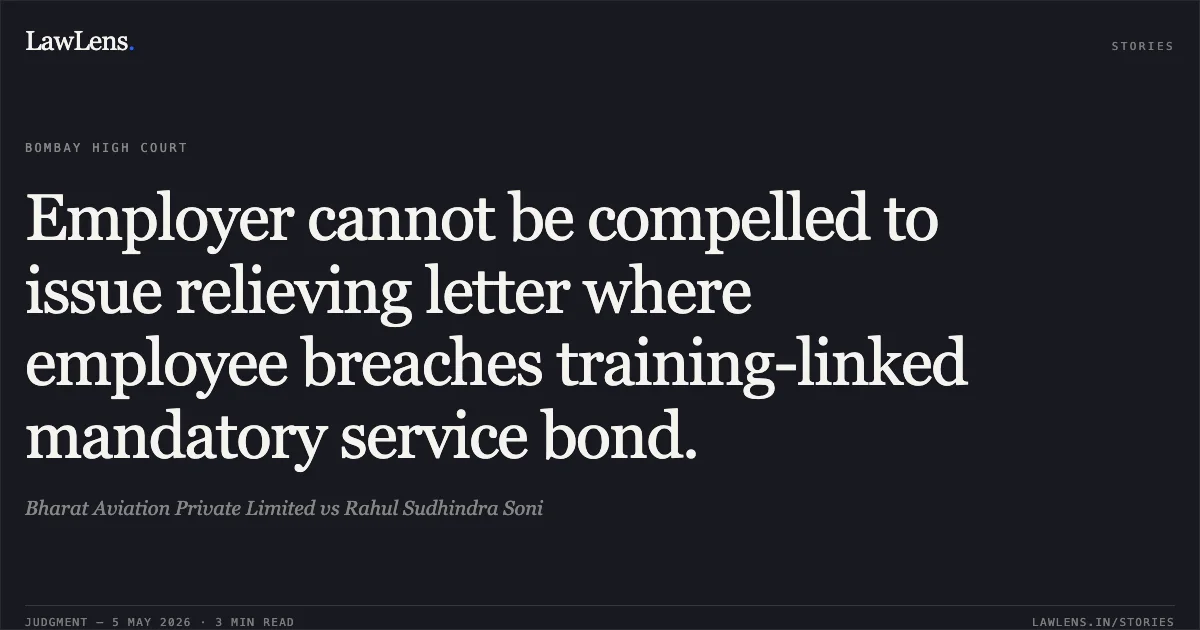
The Court held that an employee who breaches a valid service bond cannot insist on a relieving letter at an interim stage
The High Court allowed the Writ Petition and set aside the Industrial Court’s order dated 13 January 2025
Source reference: p. 16The Court clarified that findings are prima facie and directed the Industrial Court to decide the main complaint within six months, while suggesting the Respondent may offer a pro-rata amount of damages to settle the dispute
Source reference: p. 16-17Acts & Sections Cited
1 provisions across 1 statute referred to in this judgment. Each provision opens on LawLens.
Maharashtra Recognition of Trade Unions and Prevention of Unfair Labour Practices Act, 19711
Original Court PDF
Bharat Aviation Private LimitedvsRahul Sudhindra Soni
Click to open original judgment
Original judgment, available to read, download and summarize on LawLens.in