Facts
The petitioner, enrolled as a Constable/GD in the Indo-Tibetan Border Police Force on 20 November 1986, was promoted to Havaldar and was subsequently approved for promotion as Assistant Sub-Inspector/GD with effect from 7 July 2011, subject to, inter alia, being in medical category SHAPE-I.
Source reference: para. 2At the relevant time, he was in temporary low medical category T-24. Although his review medical board was due after 24 weeks, in October 2010, it was not conducted within the prescribed period despite his requests.
Source reference: para. 5On 7 May 2012, a medical board examined the petitioner and recommended his upgradation to SHAPE-I with effect from that date.
Source reference: para. 3However, a purported special medical board dated 23 May 2012 allegedly declared him permanently medically unfit and recommended that he be boarded out.
Source reference: para. 3The petitioner contended that he was neither informed of nor examined by that board.
Source reference: para. 3The petitioner was initially placed at Serial No. 81 in the ASI/GD seniority list dated 13 January 2015, but was later shifted to Serial No. 1768 in the revised seniority list dated 18 January 2016.
Source reference: para. 1His representations were rejected by order dated 29 August 2016, on the ground that he had assumed the post only on 9 July 2013.
Source reference: para. 3Issues
Whether the medical board proceedings dated 23 May 2012, allegedly conducted without informing or examining the petitioner, were valid and could lawfully be relied upon to deny him promotion and seniority.
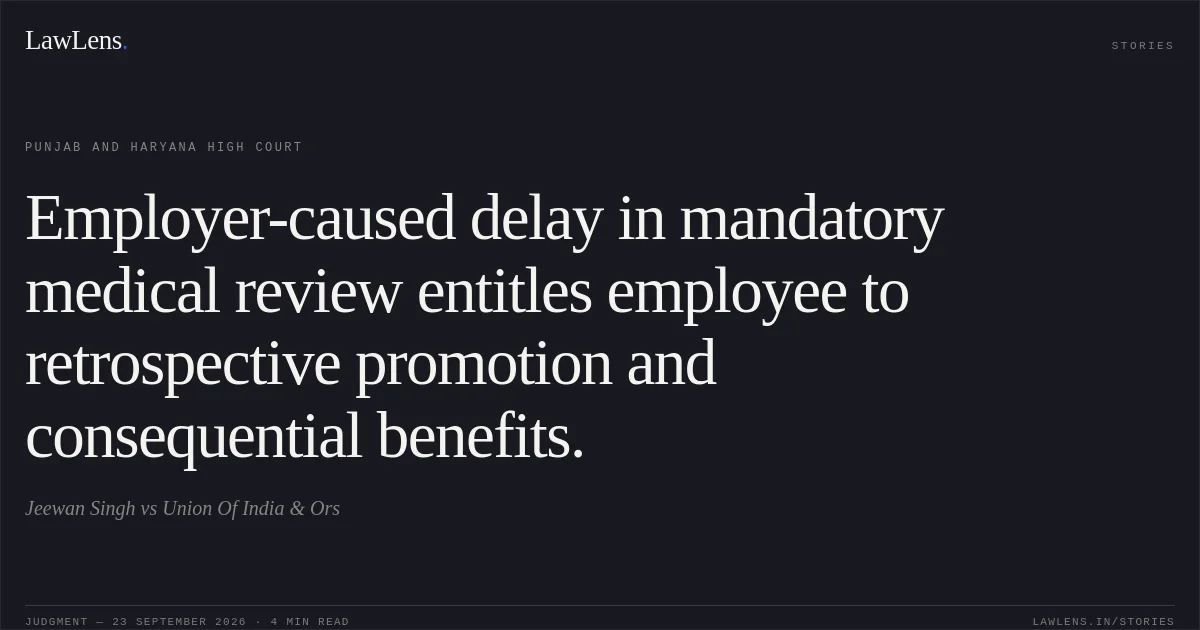
Source reference: paras. 11–18Whether the respondents’ failure to conduct the petitioner’s review medical examination within the prescribed 24-week period justified granting him retrospective promotion and seniority as ASI/GD from 7 July 2011.
Source reference: paras. 5, 8–9, 18–19Whether the petitioner was entitled to actual monetary and other consequential benefits upon being granted retrospective promotion, or whether the principle of “no work no pay” applied.
Source reference: paras. 20–22Law Applied
The Court applied Standing Order No. 02/2004, particularly clauses 12 and 13, under which personnel in temporary medical category may participate in promotion tests and, upon upgradation to SHAPE-I within one year of qualifying the approved-list test, retain their original seniority; if upgraded thereafter, seniority is determined from the date of medical upgradation.
Source reference: para. 8It also relied on the applicable medical-examination instructions requiring review of temporary low medical category personnel after 24 weeks and placing responsibility on the unit or establishment to ensure that the individual is duly informed and produced before the medical board.
Source reference: paras. 12–13The Court held that a medical board must give a medical opinion within its jurisdiction and cannot substitute personal comments regarding an employee’s conduct for a medical assessment.
Source reference: paras. 15–17On monetary benefits, it relied on Ramesh Kumar v. Union of India, 2015 AIR SC 2904, and State of Kerala v. E.K. Bhaskaran Pillai, (2007) 6 SCC 524, for the principle that “no work no pay” is not an inflexible rule and does not apply where the employee was prevented from working on the promotional post due to the employer’s fault.
Source reference: paras. 21–22Reasoning
The Court found that the respondents’ own affidavit confirmed that a temporary low medical category employee was required to undergo review after 24 weeks and that the unit was responsible for ensuring the employee’s appearance before the board.
Source reference: para. 12The petitioner’s review was due in October 2010 but was delayed until 7 May 2012, and the respondents failed to explain how he had been notified of the alleged board dated 23 May 2012.
Source reference: paras. 13, 18The Court also rejected the contention that the 7 May 2012 proceedings were incomplete merely because they bore the signatures of the Presiding Officer and one member, since the proceedings dated 23 May 2012 had the same composition.
Source reference: para. 14The later report was considered inherently unreliable because it contained disparaging observations about alcoholism, pay, perks, and alleged loss to the Government rather than a proper medical assessment; the respondents also admitted that the petitioner had not signed the proceedings.
Source reference: paras. 10, 15–16Accordingly, the Court treated the 23 May 2012 report as manipulated and invalid, accepted the 7 May 2012 SHAPE-I assessment, and held that the petitioner’s non-promotion in 2011 resulted from the respondents’ failure to conduct the timely review examination.
Source reference: paras. 18–19Since the denial of promotion was attributable to the respondents and not the petitioner, the Court held that “no work no pay” could not defeat his claim for actual consequential monetary benefits.
Source reference: paras. 20–22Holding
The writ petition was allowed.
The Court set aside the order dated 29 August 2016, the revised seniority list dated 18 January 2016 insofar as it related to the petitioner, and the purported special medical board proceedings dated 23 May 2012.
Source reference: para. 19The respondents were directed to grant the petitioner promotion as ASI/GD with effect from 7 July 2011, taking into account the medical board report dated 7 May 2012, and to restore his seniority at Serial No. 81 in the ASI/GD seniority list of 2015.
Source reference: para. 19He was held entitled to all consequential benefits, including actual monetary benefits—not merely notional benefits—from 7 July 2011, to be paid within three months.
Source reference: paras. 20, 22–23Acts & Sections Cited
1 provisions across 1 statute referred to in this judgment. Linked provisions open on LawLens.
Industrial Disputes Act, 19471
Original Court PDF
Jeewan SinghvsUnion Of India & Ors
Click to open original judgment
Original judgment, available to read, download and summarize on LawLens.in