Facts
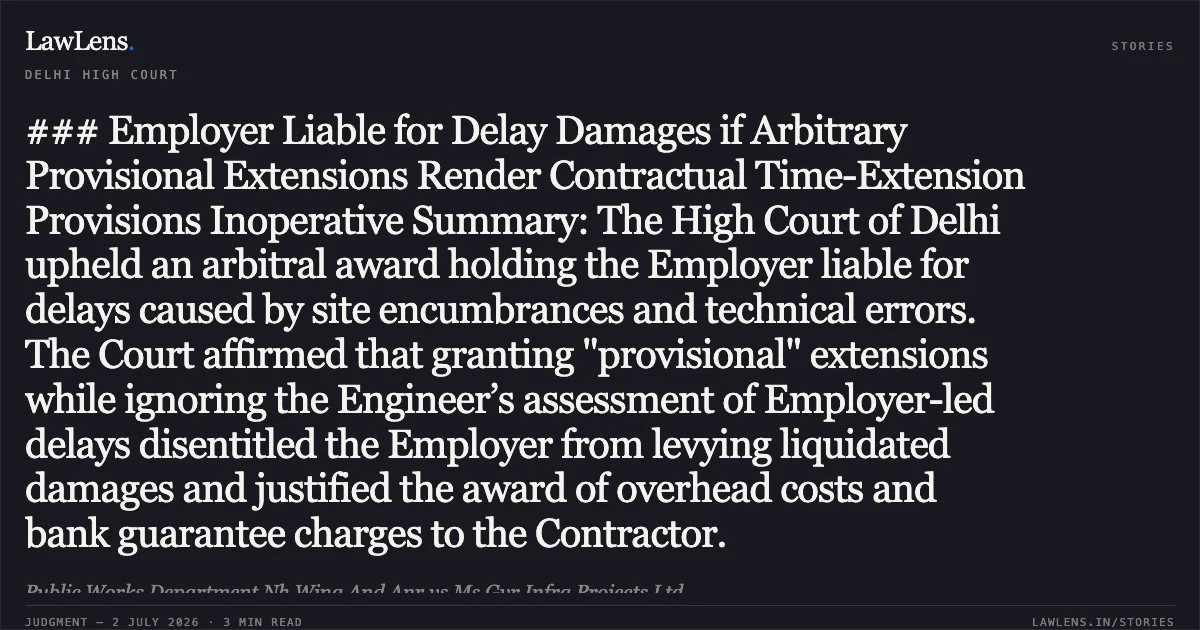
The Petitioner (MORT&H/PWD) invited bids for the rehabilitation and upgradation of a section of NH-217 in Odisha. An agreement was signed on March 21, 2014, with a 730-day completion period.
Source reference: p. 2The project faced significant delays from the outset due to discrepancies in benchmarks (TBM values) and failure to hand over encumbrance-free land.
Source reference: p. 28-30Despite granting several extensions of time (EOT) without liquidated damages (LD) until March 31, 2022, the Petitioner prematurely closed the contract effective May 31, 2022.
Source reference: p. 5, 31Post-closure, the Petitioner imposed LD and recovered the amount by invoking Performance Bank Guarantees (PBG).
Source reference: p. 5The Respondent (contractor) had also undergone Corporate Insolvency Resolution Process (CIRP) between 2018 and 2021.
Source reference: p. 5, 34A three-member Arbitral Tribunal awarded the Respondent ₹48.57 Crores, finding the Petitioner responsible for the delays. The Petitioner challenged the award under Section 34 of the Arbitration and Conciliation Act, 1996.
Source reference: p. 1-2Issues
Whether the invocation of arbitration was barred by limitation, specifically considering the impact of CIRP proceedings and the COVID-19 pandemic.
Source reference: p. 33-34 / para. 21Whether the imposition of Liquidated Damages (LD) and the subsequent foreclosure of the contract by the Petitioner were legal and valid.
Source reference: p. 31-33 / para. 17-19Whether the Arbitral Tribunal’s findings on the attributability of delay and the grant of claims for overheads and machinery costs were perverse or patently illegal.
Source reference: p. 36-38 / para. 26-28Law Applied
The court primarily applied Section 34 of the Arbitration and Conciliation Act, 1996, which restricts judicial interference to "patent illegality" or "conflict with public policy," excluding re-appreciation of evidence.
Source reference: p. 12, 17, 21It relied on Associate Builders v. DDA and Ssangyong Engg. & Construction Co. Ltd. v. NHAI regarding the limited scope of review and the definition of perversity.
Source reference: p. 15, 21Section 60(6) of the Insolvency and Bankruptcy Code (IBC), 2016, was applied to exclude the moratorium period for limitation purposes.
Source reference: p. 34The court also invoked Section 55 of the Indian Contract Act, 1872, regarding the effect of accepting performance at a time other than agreed upon, and and the Cognizance for Extension of Limitation, In re (Supreme Court) regarding COVID-19 limitation tolling.
Source reference: p. 33, 34Reasoning
The court found that the Arbitral Tribunal’s decision was based on a thorough examination of evidence, including the Engineer’s own letters which admitted that delays—such as land encumbrances and TBM discrepancies—were beyond the contractor's control.
Source reference: p. 28-31Regarding limitation, the court affirmed that the period during which the Respondent was under CIRP must be excluded under Section 60(6) of the IBC, and additional relief was provided by the Supreme Court’s COVID-19 tolling orders; thus, the 2023 invocation for a 2022 closure was timely.
Source reference: p. 34-35On the merits of LD, the court upheld the view that once an employer grants extensions without reserving the right to claim damages or by leading the contractor to believe no LD would be levied, they cannot retrospectively impose penalties after performance is accepted.
Source reference: p. 32-33The court also noted that the Petitioner failed to file its claims before the Resolution Professional during the CIRP, thereby extinguishing their counter-claims under the principle of Ghanshyam Mishra v. Edelweiss.
Source reference: p. 35Holding
The court held that the Tribunal's interpretation of the contract and the attribution of delay to the Petitioner were "possible" and "reasonable" views.
The court dismissed the Section 34 petition and upheld the Arbitral Award in its entirety, affirmed the refund of encashed PBGs (Claim 1) and the compensation for overheads, machinery, and GST (Claims 2, 3, 4, 6, and 7) while maintaining that the Petitioner’s counter-claims stood extinguished. The Petition and all pending applications were dismissed.
Source reference: p. 35-40, para. 37Acts & Sections Cited
10 provisions across 3 statutes referred to in this judgment. Each provision opens on LawLens.
Arbitration and Conciliation Act, 19964
Indian Contract Act, 18725
Insolvency and Bankruptcy Code, 2016.1
Original Court PDF
Public Works Department Nh Wing And AnrvsMs Gvr Infra Projects Ltd
Click to open original judgment
Original judgment, available to read, download and summarize on LawLens.in