Facts
The appellant is the owner of an agricultural field where the deceased, Sanjay Koli, was hired for digging a well at a daily wage of Rs. 150/-
Source reference: p. 2On January 26, 2005, while performing this work under the appellant’s instructions, the deceased suffered a fatal electric shock from a leaking wire attached to a bulb
Source reference: p. 2He passed away during treatment on January 27, 2005
Source reference: p. 2The dependents filed a claim under the Workmen’s Compensation Act. Despite being granted sufficient time, the appellant failed to file a written statement or lead evidence to contest the claim
Source reference: p. 2, 5The Workmen Compensation Commissioner, Amreli, awarded Rs. 4,48,000/- with 12% interest to the dependents
Source reference: p. 1-2The appellant challenged this on the ground that the deceased was hired by a contractor (Opponent No. 2) and not the appellant directly
Source reference: p. 3Issues
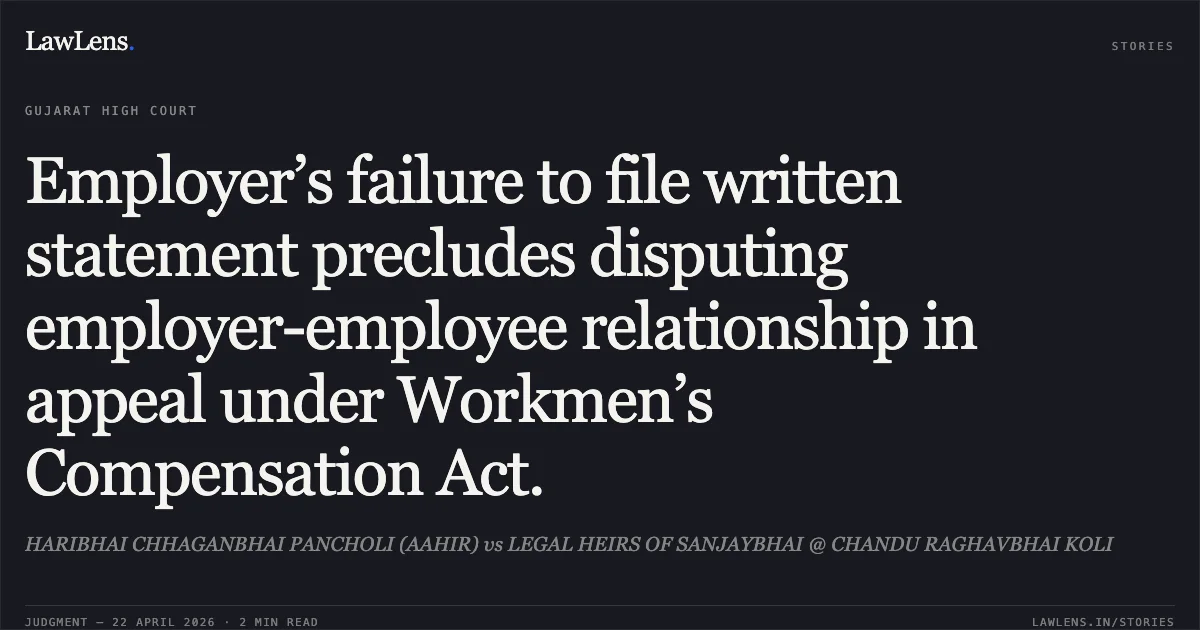
1. Whether the appellant can challenge the employer-employee relationship in the absence of a written statement and evidence before the lower tribunal?
Source reference: p. 52. Whether the appeal involves a "substantial question of law" as required under Section 30 of the Workmen’s Compensation Act, 1923?
Source reference: p. 4-5Law Applied
The court applied Section 30(1) of the Workmen’s Compensation Act, 1923, which mandates that an appeal to the High Court lies only if a "substantial question of law" is involved
Source reference: p. 3-4The court defined "substantial" as something essential, real, or of sound worth, rather than merely academic or technical
Source reference: p. 5It also relied on the principle of pleadings, noting that a party cannot raise factual defenses on appeal that were not raised via a written statement in the original proceedings
Source reference: p. 5-6Reasoning
The court found that the appellant’s primary contention—that the deceased was hired by a third-party contractor (Opponent No. 2)—was a factual dispute that required evidence
Source reference: p. 3, 5However, because the appellant failed to file a written statement or produce any evidence before the Commissioner, these claims remained unsubstantiated and could not be entertained for the first time in an appeal
Source reference: p. 5-6The court noted there was no record to prove the work was subcontracted
Source reference: p. 5Consequently, the appellant failed to demonstrate any "substantial question of law," as the grievance was rooted in contested facts that the appellant had previously waived the right to defend
Source reference: p. 5-6Holding
The High Court dismissed the appeal, holding that in the absence of a written statement and evidence at the trial stage, the appellant cannot challenge the finding of employment
The court affirmed the award of Rs. 4,48,000/- with 12% interest and ordered the Commissioner to release the funds, including accrued interest, to the claimants immediately. Any interim relief previously granted was vacated
Source reference: p. 6Acts & Sections Cited
1 provisions across 1 statute referred to in this judgment. Each provision opens on LawLens.
Code of Civil Procedure, 19081
Original Court PDF
HARIBHAI CHHAGANBHAI PANCHOLI (AAHIR)vsLEGAL HEIRS OF SANJAYBHAI @ CHANDU RAGHAVBHAI KOLI
Click to open original judgment
Original judgment, available to read, download and summarize on LawLens.in