Facts
The Petitioner-employees resigned from the Respondent-company (M/s. Aplab Ltd.) at various times, with some employees having served over 15 years.
Source reference: p. 5, 11The Company admitted a liability for gratuity based on 15 days' wages per year but failed to pay promptly due to financial difficulties.
Source reference: p. 6The employees approached the Controlling Authority under the Payment of Gratuity Act, 1972, after a delay of nearly six years.
Source reference: p. 8The employer challenged the maintainability of these applications due to the absence of a delay condonation application and contested the inclusion of "Special Allowance" in the definition of "wages".
Source reference: p. 9The Controlling Authority and Appellate Authority partially allowed the employees' claims, leading to cross-writ petitions by both the employer and employees.
Source reference: p. 8, 9Issues
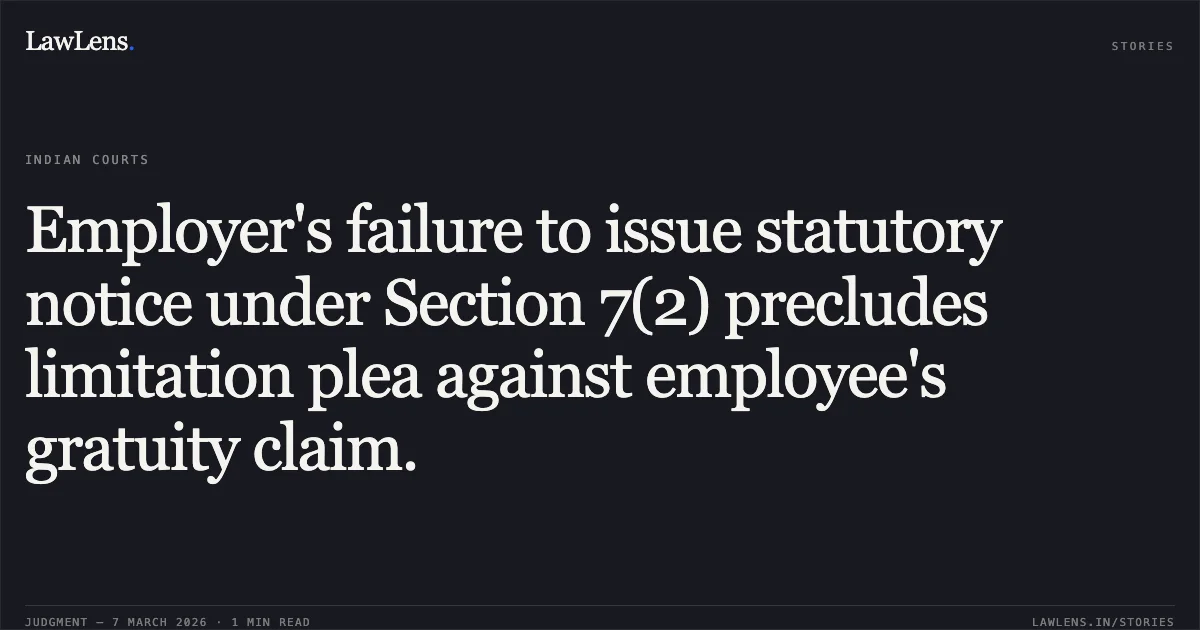
Whether an employee's claim for gratuity is barred by limitation if the employer fails to comply with the statutory duty to determine and notify the gratuity amount under Section 7(2).
Source reference: p. 13Whether the employer is liable to pay interest under Section 7(3A) when the payment is delayed, even if part of the amount was later deposited during litigation.
Source reference: p. 17Whether "Special Allowance" falls within the definition of "wages" under Section 2(s) of the Act for the purpose of calculating gratuity.
Source reference: p. 20Whether the employees are entitled to gratuity at the rate of 26 days per year based on alleged company policy for long-term service.
Source reference: p. 11Law Applied
The court applied Section 7(2) of the Payment of Gratuity Act, which mandates the employer to determine and notify the gratuity amount regardless of whether an application is made.
Source reference: p. 14It relied on the second proviso to Rule 10 of the Maharashtra Rules, which stipulates that no limitation applies if the employer fails to issue the Section 7(2) notice.
Source reference: p. 15The definition of "wages" under Section 2(s) was analyzed, which includes dearness allowance but excludes various other allowances.
Source reference: p. 10, 20Section 7(3A) and its proviso were applied to determine liability for simple interest on delayed payments, noting that interest is mandatory unless the delay is the employee's fault and the employer obtained written permission from the Authority.
Source reference: p. 17, 18Reasoning
The Court observed that the employer’s failure to fulfill its proactive duty under Section 7(2) to determine gratuity meant the plea of limitation was unavailable per Rule 10.
Source reference: p. 15Regarding interest, the Court held that since the employer did not obtain written permission for delayed payment, interest was mandatory under Section 7(3A); however, interest would stop accruing on the specific portions of the amount once deposited with the Authority.
Source reference: p. 18, 19On the substantive issue of "Special Allowance," the Court found that the lower authorities failed to conduct a "nature of payment" test; they did not determine if the allowance was a disguised dearness allowance or an excluded independent benefit.
Source reference: p. 21, 23Furthermore, the claim for 26 days' gratuity was based on photocopied documents whose authenticity and evidentiary value as secondary evidence were never properly adjudicated.
Source reference: p. 22Holding
The High Court partly allowed the petitions and remanded the matter to the Appellate Authority for a limited fresh consideration.
The claims were not barred by limitation due to the employer's statutory default.
Source reference: p. 16Interest is payable on the unpaid/enhanced portion from the due date until actual payment, but not on the already deposited amounts from the date of deposit.
Source reference: p. 25The Appellate Authority must determine if "Special Allowance" constitutes "wages" under Section 2(s) and whether the 26-day calculation policy is proved via original/valid secondary evidence.
Source reference: p. 25The parties were directed to appear before the Appellate Authority on March 23, 2026.
Source reference: p. 25Acts & Sections Cited
2 provisions across 1 statute referred to in this judgment. Linked provisions open on LawLens.
PAYMENT OF GRATUITY ACT, 19722
Original Court PDF
Gundu Daji Desai v. M/s. Aplab Ltd. (with connected petitions), Writ Petition No. 2875 of 2025, 2026:BHC-AS:11226
Click to open original judgment
Original judgment, available to read, download and summarize on LawLens.in