Facts
The Petitioners, primarily teachers and government employees, challenged a series of Government Resolutions (GRs) and circulars (notably GR dated 16.06.2025 and 09.10.2025) which mandated the re-verification, re-assessment, and medical re-examination of Persons with Disabilities (PwDs) in government service.
Source reference: p.31-73The State initiated this exercise following large-scale complaints of bogus disability certificates being used to secure employment or service benefits.
Source reference: p.59-60Many Petitioners, holding valid disability certificates and Unique Disability ID (UDID) cards for decades, sought to quash the re-examination orders and stay consequential disciplinary actions/suspensions initiated after initial re-assessments showed disability percentages below the 40% benchmark.
Source reference: p.73-77Issues
1. Whether the State Government/Employer has the power to direct employees to undergo medical re-assessment of disability after their initial appointment.
Source reference: p.50/para.52. Whether the re-verification process violates the Rights of Persons with Disabilities (RPwD) Act, 2016 or its associated Rules.
Source reference: p.54/para.F3. Whether an employee found to have a disability below the 40% benchmark or 0% during re-assessment can be subjected to disciplinary action or termination.
Source reference: p.52/para.BLaw Applied
Rights of Persons with Disabilities Act, 2016, specifically Section 2(r) (Benchmark Disability), Section 56 (Guidelines for assessment), and Section 91 (Punishment for fraudulently availing benefits).
Source reference: p.93-96Rights of Persons with Disabilities Rules, 2017, and the Maharashtra State Rights of Persons with Disabilities Rules, 2024, which empower authorities to refer "suspicious" cases for re-assessment.
Source reference: p.67-68The doctrine from Chairman and MD, FCI v. Jagdish Balaram Bahira (2017), holding that benefits obtained through fraud are void ab initio.
Source reference: p.64/77State of U.P. v. Ravindra Kumar Sharma (2016), which allows re-verification in cases of large-scale suspicion.
Source reference: p.123Reasoning
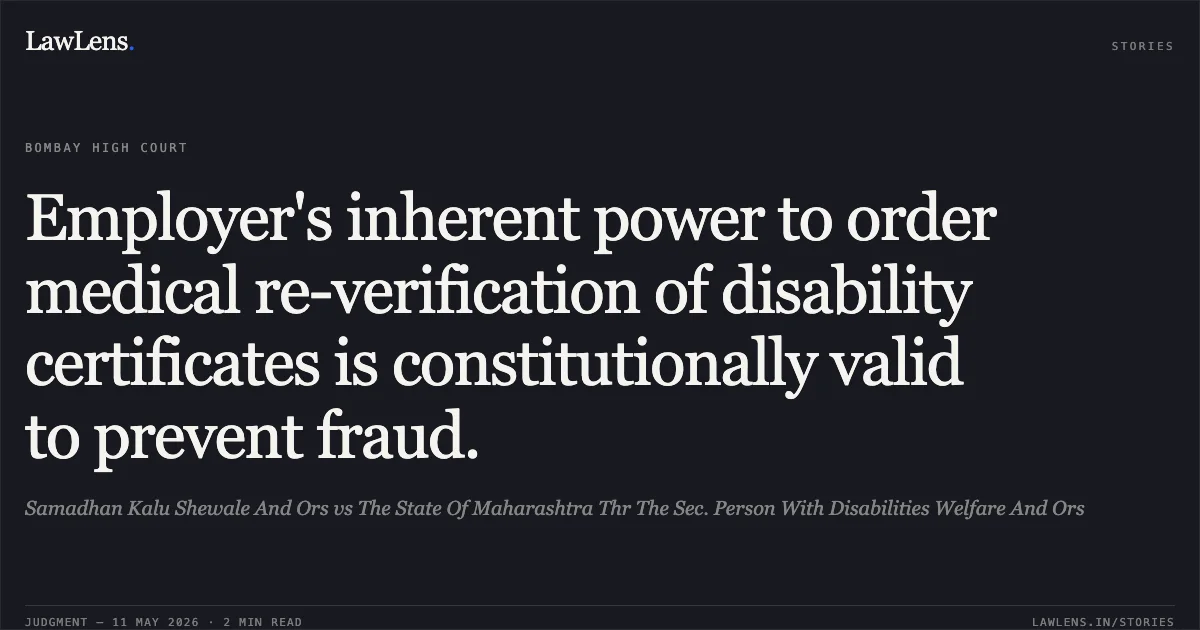
The Court reasoned that while the RPwD Act serves to protect genuine PwDs, the State has a constitutional obligation under Articles 14 and 16 to prevent the usurpation of those benefits by fraudulent claimants.
Source reference: p.125-126By analyzing current data (Annexure 'X'), the Court observed a "sudden surge" of in-service disabilities (notably hearing impairment) and found that many reassessed employees had 0% or negligible disability.
Source reference: p.75-76/122The Court rejected the argument that a UDID card is sacrosanct, holding that physical examination by a Medical Board is the only reliable method to unmask fraud.
Source reference: p.121The court emphasized that medical science identifies sensorineural hearing loss as irreversible; thus, a drastic drop in percentage (e.g., from 60% to 0%) strongly indicates original fraud rather than medical improvement.
Source reference: p.101/122Holding
The High Court upheld the State’s authority to conduct a "one-time" policy-driven medical re-verification to identify fraudulent claimants.
The Court partly allowed the petitions by quashing immediate suspensions but mandated that all employees must undergo re-examination, establishing four categories for action depending on the re-assessment results, including compulsory retirement for those with 0-10% disability.
Source reference: p.133-135The State was directed to complete the exercise within 120 days using special Medical Boards.
Source reference: p.136Acts & Sections Cited
13 provisions across 1 statute referred to in this judgment. Each provision opens on LawLens.
Rights of Persons with Disabilities Act, 2016.
Original Court PDF
Samadhan Kalu Shewale And OrsvsThe State Of Maharashtra Thr The Sec. Person With Disabilities Welfare And Ors
Click to open original judgment
Original judgment, available to read, download and summarize on LawLens.in