Facts
The Opposite Party-Workman was engaged as a daily wager by the Petitioner-Management in 1984 and later appointed as a Watchman on a consolidated salary in 1993
Source reference: p. 2In 1999, the Workman approached the Labour Authority regarding non-payment of arrears and bonus, during which the Management alleged his services had been terminated
Source reference: p. 2The Workman claimed he was refused employment effective 14.02.1999 without notice or compensation
Source reference: p. 3Following a failed conciliation, the State Government referred the dispute to the Labour Court, Bhubaneswar
Source reference: p. 3The Management contested the reference, denying the existence of an employer-employee relationship and alleging the Workman’s documents were forged
Source reference: p. 3-4The Labour Court, vide award dated 31.03.2018, found the termination illegal and, noting the factory's closure and the Workman's age, awarded a lump sum compensation of ₹4,00,000
Source reference: p. 2, 6The Management challenged this award via the present writ petition
Source reference: p. 1Issues
1. Whether an employer-employee relationship existed between the Management and the Workman so as to attract the Industrial Disputes Act, 1947
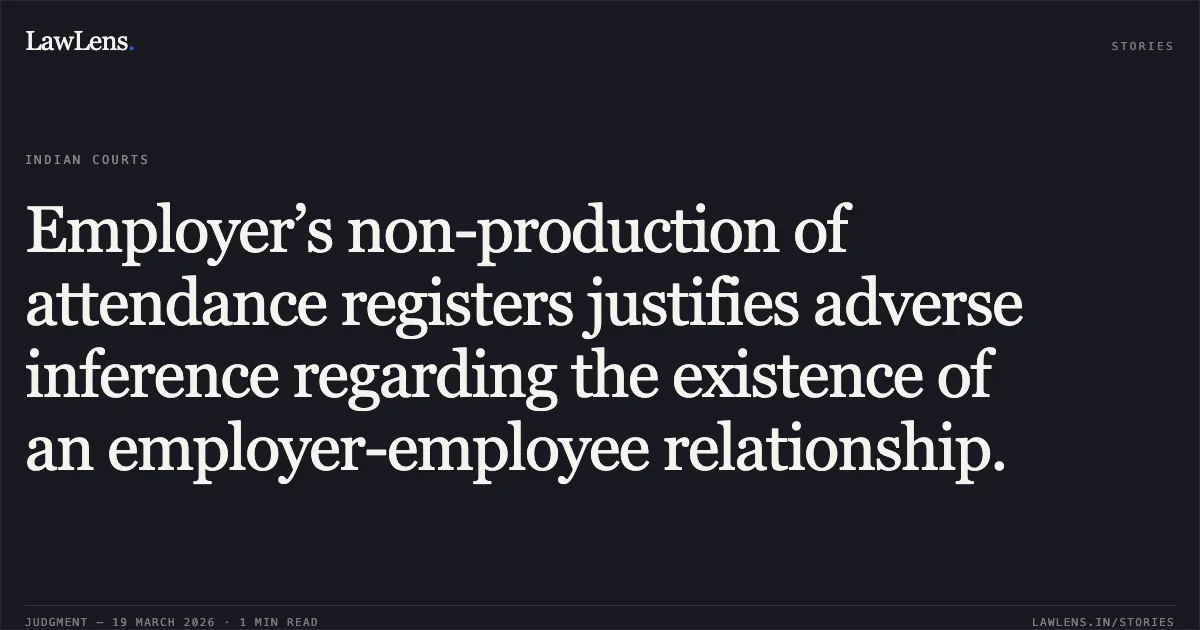
Source reference: p. 5, 152. Whether the Labour Court was justified in drawing an adverse inference against the Management for the non-production of attendance and wage registers
Source reference: p. 8, 163. Whether the reference made by the State Government was invalid because the initial complaint allegedly did not mention "refusal of employment"
Source reference: p. 6-7, 224. Whether the High Court, in its supervisory jurisdiction under Article 227, can re-appreciate the findings of fact recorded by the Labour Court
Source reference: p. 19-21Law Applied
The court applied Section 2(s) of the Industrial Disputes Act, 1947, defining a "Workman"
Source reference: p. 3Regarding the burden of proof and adverse inference, the court relied on Sita Ram & Ors. v. Moti Lal (2008 LLR SC), which allows adverse inference when an employer withholds records in their exclusive custody
Source reference: p. 16-17Director Fisheries and Terminal Division v. Bhikubhai (AIR 2010 SC 1236)
Source reference: p. 5, 19On the scope of judicial review, the court applied the principles from Sayed Yakub v. K.S. Radha Krishna (AIR 1964 SC 477), establishing that a writ of certiorari cannot be used to correct errors of fact unless they are perverse or based on no evidence
Source reference: p. 13, 19-21per National Engineering Industries Ltd. v. State of Rajasthan (2000) 1 SCC 371, an industrial adjudicator cannot decide upon the legality of the reference made to it
Source reference: p. 23Reasoning
The High Court observed that the Management’s own witness (MW-1) admitted that while registers were maintained and inspected, they were not produced before the Labour Court
Source reference: para. 21-22Consequently, the Labour Court’s decision to draw an adverse inference was legally sound, as the Management withheld the best evidence regarding the Workman's employment
Source reference: para. 21Furthermore, the Management failed to prove its allegation of forgery, having taken no steps to verify the documents with the purported signatories or file an FIR
Source reference: para. 22Regarding the challenge to the reference, the Court noted that the Management had not raised this issue before the Labour Court and could not challenge the validity of the reference for the first time in a writ proceeding
Source reference: para. 30-31Even otherwise, the industrial adjudicator is a creature of statute and lacks the jurisdiction to invalidate a reference
Source reference: para. 31The Court found that the Labour Court’s findings were based on a thorough appreciation of oral and documentary evidence (Exhibits 1-6), and since no gross illegality or perversity was demonstrated, the findings of fact were immune from interference under Article 227
Source reference: para. 25-29Holding
The High Court dismissed the writ petition, holding that the Labour Court’s award was reasoned and based on the evidence on record
The Court upheld the finding that the termination was illegal and the award of ₹4,00,000 compensation was justified
Source reference: para. 2, 35Due to the Workman’s advanced age (72 years) and the 26-year duration of the litigation, the Court directed the Petitioner-Management to implement the award and pay the compensation with 6% accrued interest within one month
Source reference: para. 35Acts & Sections Cited
1 provisions across 1 statute referred to in this judgment. Linked provisions open on LawLens.
Industrial Disputes Act, 19471
Original Court PDF
M/S.ORIENT PAPER MILLSvsABHIMANYU BEHERA
Click to open original judgment
Original judgment, available to read, download and summarize on LawLens.in