Facts
The Petitioner (husband) and Respondent (wife) married in July 2021; both were divorcees.
Source reference: p. 3The Respondent left the matrimonial home in May 2022 and subsequently filed maintenance proceedings under Section 125 of the CrPC, seeking Rs. 70,000 per month.
Source reference: p. 4By an order dated 04.08.2025, the IV Addl. Principal Family Judge, Bengaluru, awarded interim maintenance of Rs. 20,000 per month.
Source reference: p. 2The Petitioner challenged this order via a Writ Petition under Article 227 of the Constitution, contending he is currently unemployed due to organizational restructuring and that the Respondent earns over Rs. 40,000 per month as an administrative professional.
Source reference: p. 3-4The Respondent submitted evidence (TDS records) showing the Petitioner’s past annual income exceeded Rs. 66 lakhs and that he owns multiple properties.
Source reference: p. 5Issues
1. Whether the interim maintenance of Rs. 20,000 per month awarded by the Family Court is just and reasonable.
Source reference: p. 6Law Applied
The Court primarily applied the principles governing maintenance as articulated by the Supreme Court in Rajnesh v. Neha (2021) 2 SCC 324.
Source reference: p. 6This precedent establishes that an able-bodied husband is presumed to have the capacity to earn and cannot shirk his legal obligation to support his spouse by citing unemployment.
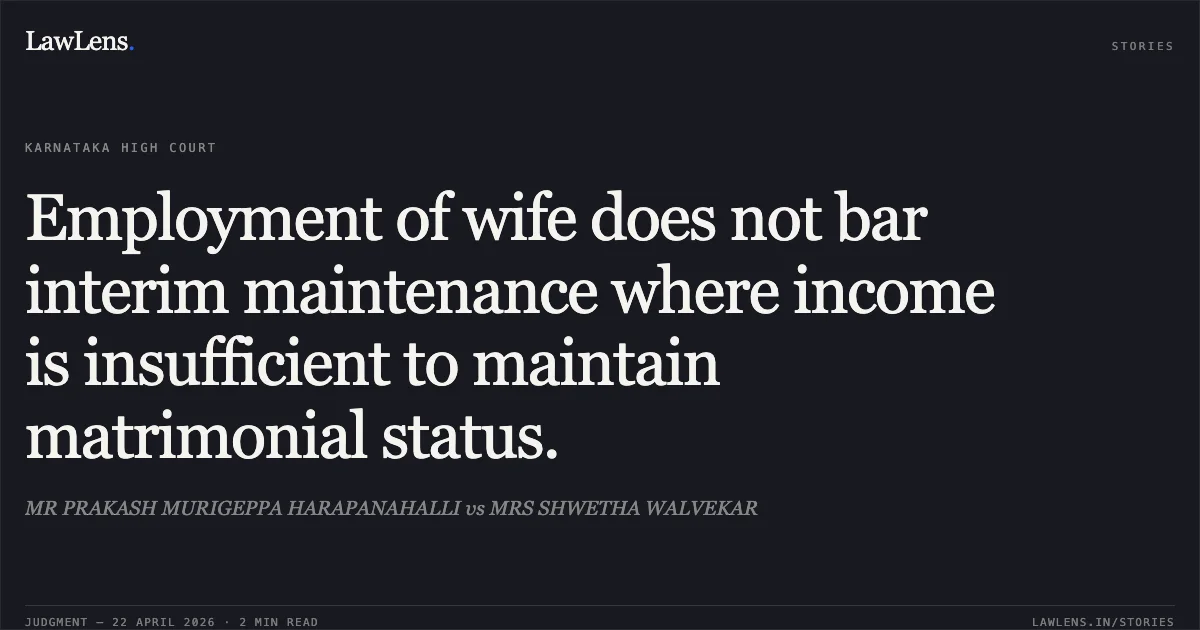
Source reference: p. 6Furthermore, the law stipulates that the mere fact that a wife is gainfully employed does not automatically disentitle her from receiving maintenance; the court must ensure the maintenance allows her to live a lifestyle commensurate with that enjoyed in the matrimonial home.
Source reference: p. 6-7Reasoning
The Court observed that while the Petitioner claimed unemployment, his TDS records for 2022-2024 revealed a substantial earning history (Rs. 45.5 lakhs and Rs. 66.2 lakhs respectively), indicating a high earning capacity as a software engineer.
Source reference: p. 5-6Applying the Rajnesh v. Neha standard, the Court held that the Petitioner's professional qualifications signify a continued capacity to meet matrimonial obligations despite his claim of current job loss.
Source reference: p. 6Regarding the Respondent’s income, the Court noted that her salary of Rs. 40,000 is "modest" compared to the Petitioner’s documented high-income status during the marriage.
Source reference: p. 7The Court reasoned that the Family Court’s reduction of the claim from Rs. 70,000 to Rs. 20,000 was a conservative approach intended to prevent destitution and bridge the "status gap" between the parties.
Source reference: p. 7Consequently, the Court found no jurisdictional error or patent illegality in the lower court's exercise of discretion.
Source reference: p. 7Holding
The High Court held that the interim maintenance of Rs. 20,000 per month was just and reasonable given the Petitioner's earning capacity.
The High Court dismissed the Writ Petition and upheld the Family Court’s order dated 04.08.2025.
Source reference: p. 8The Petitioner was further directed to clear all arrears of interim maintenance within three months from the date of the order.
Source reference: p. 8Acts & Sections Cited
1 provisions across 1 statute referred to in this judgment. Linked provisions open on LawLens.
Code of Criminal Procedure1
Original Court PDF
MR PRAKASH MURIGEPPA HARAPANAHALLIvsMRS SHWETHA WALVEKAR
Click to open original judgment
Original judgment, available to read, download and summarize on LawLens.in