Facts
The petitioners (Accused No. 1, a former MLA, and Accused No. 2, a former Municipal Commissioner) sought to quash FIR No. 4/2017 involving sections 13(1)(c) and (d) of the Prevention of Corruption Act, 1988, and Section 447 r/w 34 of the IPC
Source reference: para 1Revenue records from 1965 to 2026 classified Survey No. 11 as "Hullu Banni Kharab" (Government land)
Source reference: para 12It was alleged that Accused No. 1 and his sons encroached upon this land, converted it into residential sites alongside their private lands (Sy. Nos. 12 and 13), and sold them to third parties
Source reference: para 14-15Accused No. 1 had previously admitted to possible encroachment in a letter to the Deputy Commissioner but later pleaded "adverse possession" in response to a show-cause notice
Source reference: para 17-18Accused No. 2 was the Commissioner who allegedly facilitated illegal khata registrations
Source reference: para 21Issues
1. Whether the investigation into the alleged land grabbing and corruption should be quashed at the threshold under Section 482 of the Cr.P.C.
Source reference: para 112. Whether a former public servant can be prosecuted for acts of corruption committed while in office despite no longer holding that specific position
Source reference: para 5.23. Whether "B Kharab" land can be converted for private residential use or claimed via adverse possession against the State
Source reference: para 22Law Applied
The court primarily applied Section 13(1) of the Prevention of Corruption Act, 1988, regarding criminal misconduct by public servants
Source reference: para 1Rule 21(2)(b) of the Karnataka Land Revenue Rules, which classifies "B Kharab" land as unarable land reserved for public purposes, making it ineligible for private ownership
Source reference: para 7.2, 22The court followed the precedent in Neeharika Infrastructure (P) Ltd. v. State of Maharashtra, holding that an FIR is not an encyclopedia and police must be allowed to investigate cognizable offenses
Source reference: para 25The court further applied the principles from The Agricultural Produce Market Committee v. Executive Officer, affirming that Government ‘B Kharab’ land cannot be appropriated by individuals
Source reference: para 23-24Reasoning
The court found that despite the immutable status of Survey No. 11 as Government land in revenue records, the petitioners treated it as ancestral property through a partition deed and subsequent sales
Source reference: para 12, 14-15The court rejected the argument of "adverse possession," noting that such a plea itself constitutes a tacit admission of possessing Government land
Source reference: para 18Regarding the claim of political rivalry, the court observed that the existence of detailed preliminary enquiry reports and admitted encroachment footprints made the allegations triable
Source reference: para 19-20The court reasoned that since the land had been fragmented and sold, Accused No. 1's offer to "return" the land was legally and factually hollow
Source reference: para 17For Accused No. 2, the court held that his role in issuing khatas during his tenure required investigation to determine criminal connivance under the Act
Source reference: para 21Holding
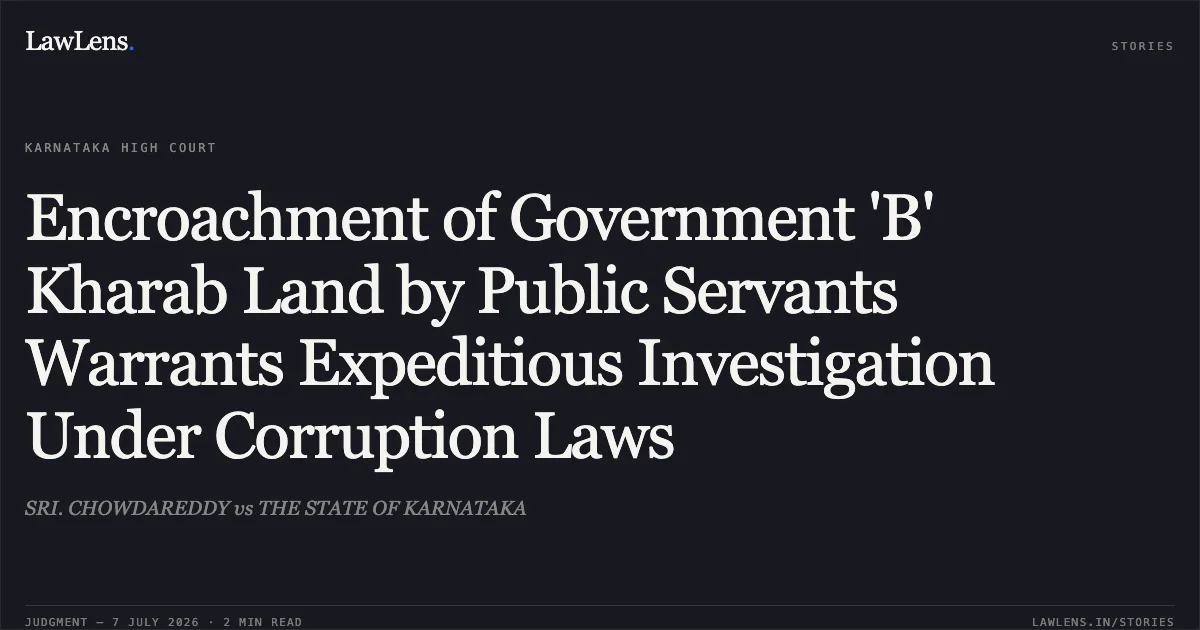
The Court dismissed the writ petitions, holding that the allegations disclosed serious triable issues regarding the grabbing of public land by those in political power
The court ruled that "B Kharab" land is incapable of private appropriation
Source reference: para 22The court vacated all interim stays and directed the investigating agency (Lokayukta) to conclude the investigation with "utmost expedition" within an outer limit of six months
Source reference: para 27Acts & Sections Cited
6 provisions across 3 statutes referred to in this judgment. Each provision opens on LawLens.
Code of Criminal Procedure, 19731
Prevention of Corruption Act, 19882
Indian Penal Code, 18603
Original Court PDF
SRI. CHOWDAREDDYvsTHE STATE OF KARNATAKA
Click to open original judgment
Original judgment, available to read, download and summarize on LawLens.in