Facts
The matters arose from the same FIR, C.R. No. I-110 of 2008 registered at Sayajiganj Police Station, Vadodara City, alleging offences under Sections 406, 420, 467, 468 and 471 of the IPC.
Source reference: para. 2; p. 2The principal accused, Mukesh Mahendrabhai Darji, allegedly obtained an LIC policy for a sum assured of ₹5 lakh by misrepresenting his identity, producing another person’s School Leaving Certificate and subsequently submitting a forged death certificate to claim the policy proceeds.
Source reference: para. 2; p. 2Investigation indicated that the policy had been issued in the name of a non-existent person, Yagnesh Mahendrabhai Darji; statements of the Talati-cum-Mantri and Sarpanch supported this conclusion.
Source reference: para. 8.1; p. 11The petitioner in Special Criminal Application No. 9928 of 2016 was the LIC agent who had allegedly supplied a stamped and signed proposal form and had endorsed that he had explained the proposal questions to and recorded the answers of the proposer. The applicant in Criminal Misc. Application No. 10345 of 2017 was the LIC Development Officer who endorsed that he was satisfied with the proposer’s identity after making independent inquiries.
Source reference: paras. 9.1–9.3, 10.1–10.2; pp. 12–13Both applicants sought quashing of the FIR and consequential proceedings, or discharge. The trial court rejected the agent’s discharge application on 15 July 2016, and the revisional court affirmed that order on 9 September 2016. The Development Officer separately sought quashing under Section 482 of the CrPC.
Source reference: para. 2; p. 2Issues
Whether the FIR and charge-sheet disclosed sufficient prima facie material against the LIC agent to justify continuation of the criminal proceedings and refusal of discharge.
Source reference: paras. 9.1–9.4; pp. 12–13Whether the Development Officer’s endorsement verifying the identity of the proposer constituted prima facie material warranting his trial for the alleged offences.
Source reference: paras. 10.1–10.6; pp. 13–15Whether the High Court should exercise its inherent jurisdiction under Section 482 of the CrPC or writ jurisdiction under Article 226 of the Constitution to quash the FIR, charge-sheet or the concurrent orders refusing discharge.
Source reference: paras. 7.1–8; pp. 8–11Whether the absence of express allegations or charges under Sections 34, 114 or 120B of the IPC excluded the applicants’ possible complicity in the alleged fraud.
Source reference: para. 10.4; p. 14Law Applied
The Court applied Section 482 of the CrPC and Article 226 of the Constitution, holding that their exceptional jurisdiction is to be exercised sparingly to prevent abuse of process or secure the ends of justice.
Source reference: para. 7.1; pp. 8–10It relied on State of Haryana v. Bhajan Lal, AIR 1992 SC 604, particularly the illustrative categories permitting quashing where the allegations, even if accepted in full, do not disclose an offence or where continuation would amount to abuse of process.
Source reference: para. 7.1; pp. 8–10The Court considered the ingredients of Sections 406, 420, 467, 468 and 471 IPC concerning criminal breach of trust, cheating, forgery and use of forged documents.
Source reference: paras. 7.2–7.3; p. 10At the discharge stage under Section 227 CrPC, the court must sift the prosecution material to determine whether a prima facie case or strong suspicion exists, without conducting a mini-trial; the Court relied on Central Bureau of Investigation v. Aryan Singh, 2023 (0) AIJEL-SC 70780, and Kanchan Kumar v. State of Bihar, (2022) 9 SCC 577.
Source reference: paras. 10.7–10.8; pp. 15–16The Court also noted that charges may be altered or added at any stage under Section 216 CrPC.
Source reference: para. 10.4; p. 14Reasoning
The Court held that the agent’s written endorsement represented that he had personally explained the proposal and recorded the proposer’s answers, despite the prosecution material indicating that the named proposer was non-existent.
Source reference: paras. 9.2–9.4; pp. 12–13His claim that he had merely trusted the principal accused, together with the latter’s exculpatory affidavit and LIC’s internal vigilance report, raised disputed questions of fact that could not be conclusively determined in proceedings under Section 482 or at the discharge stage.
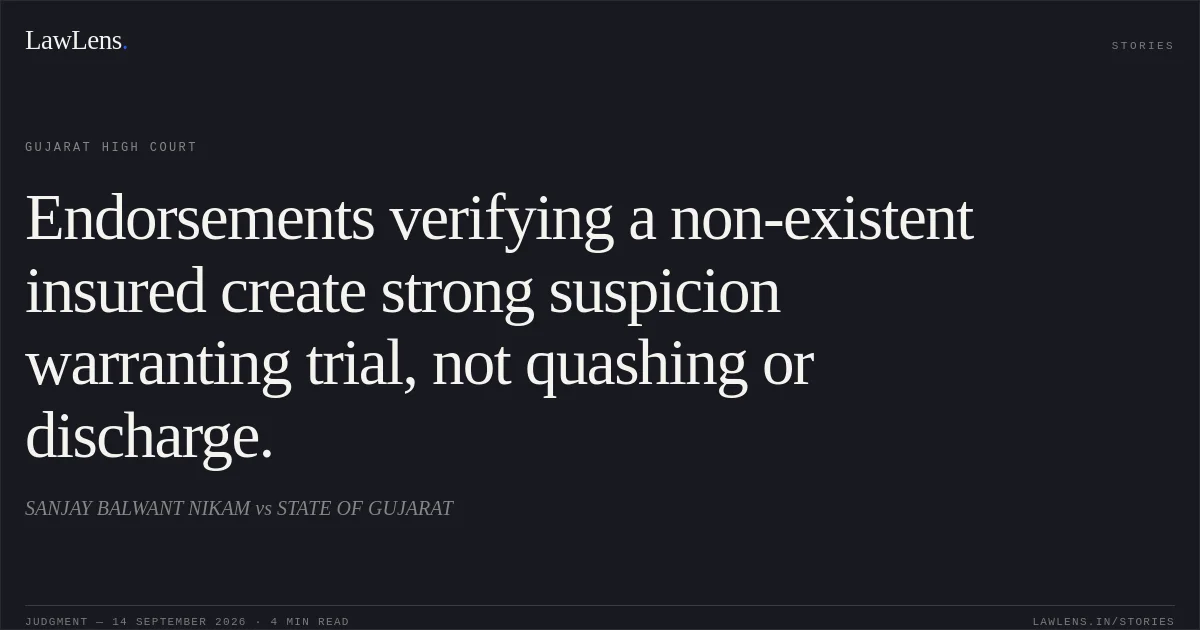
Source reference: paras. 9.2–9.4; pp. 12–13Similarly, the Development Officer expressly certified that he was satisfied with the proposer’s identity on the basis of independent inquiries. Since the policy was allegedly issued in the name of a fictitious person, this endorsement furnished prima facie material and generated a strong suspicion of involvement.
Source reference: paras. 10.2–10.3, 10.8; pp. 13–16The Court further held that the omission of Sections 34, 114 or 120B IPC from the FIR or charge-sheet did not by itself exclude liability, since the trial court could alter or add charges under Section 216 CrPC if the evidence so warranted.
Source reference: para. 10.4; p. 14In view of the completed investigation, filed charge-sheet and concurrent orders refusing discharge, and absent any perversity, illegality or jurisdictional error, the Court declined to conduct a mini-trial or reassess the evidentiary merits.
Source reference: paras. 8, 10.5, 10.7; pp. 11, 14–16Holding
The High Court answered the issues against both applicants. It held that the charge-sheet contained sufficient prima facie material, particularly the applicants’ written endorsements concerning the identity of a non-existent person, to justify continuation of the prosecution.
Criminal Misc. Application No. 10345 of 2017 and Special Criminal Application No. 9928 of 2016 were rejected; the trial court’s order dated 15 July 2016 and the revisional order dated 9 September 2016 were upheld.
Source reference: paras. 10.9–11.1; pp. 16–17Rule was discharged, interim relief stood vacated, and the trial court was directed to proceed with Criminal Case No. 38896 of 2008 in accordance with law, uninfluenced by the observations in the judgment.
Source reference: paras. 10.9–11.1; pp. 16–17Acts & Sections Cited
13 provisions across 2 statutes referred to in this judgment. Each provision opens on LawLens.
Code of Criminal Procedure, 19735
Indian Penal Code, 18608
Original Court PDF
SANJAY BALWANT NIKAMvsSTATE OF GUJARAT
Click to open original judgment
Original judgment, available to read, download and summarize on LawLens.in