Facts
The plaintiff filed a suit for specific performance based on a sale agreement dated 15.02.1988 for 5 guntas of land.
Source reference: p. 8The plaintiff claimed to be in possession since 1984 under a previous agreement with the original owner.
Source reference: p. 8The defendant denied the agreement, asserting he purchased the property via a registered sale deed on 12.08.1987.
Source reference: p. 9The Trial Court granted specific performance, finding the agreement and full payment of consideration proved.
Source reference: p. 10The First Appellate Court reversed this, holding that although the agreement was valid, it was unenforceable because the Karnataka Prevention of Fragmentation and Consolidation of Holdings Act, 1966 ("Fragmentation Act") was in force at the time of the agreement, prohibiting the sale of such a small fragment.
Source reference: p. 10-12The plaintiff appealed (RSA) for specific performance, and the defendant filed cross-objections challenging the finding that the agreement ever existed.
Source reference: p. 8Issues
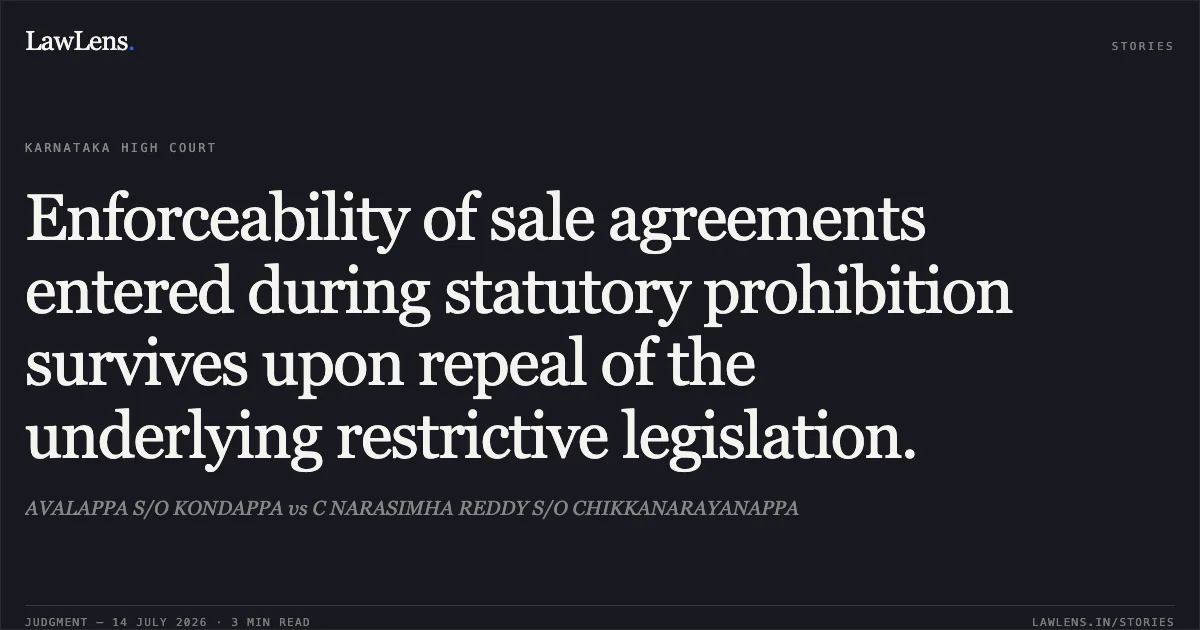
1. Whether the Appellate Judge was justified in refusing specific performance and ordering a refund of consideration despite the repeal of the Fragmentation Act prior to the filing of the suit.
Source reference: p. 23-242. Whether an agreement to sell a fragment of land is void ab initio under the Fragmentation Act if the suit for performance is filed after the Act's repeal.
Source reference: p. 243. Whether the plaintiff established readiness and willingness and the factum of the agreement to warrant the restoration of the Trial Court's decree.
Source reference: p. 24Law Applied
The Court primarily applied the principle that an "Agreement to Sell" is not a conveyance and does not transfer ownership or title, but merely creates a right to obtain a sale deed; therefore, it is not hit by statutory bars against "transfer" or "sale" until the deed is actually executed.
Source reference: p. 29It relied on the Supreme Court precedent in Munisharmappa v. M. Ramareddy, which established that if the Fragmentation Act is repealed during the subsistence of an agreement, there is no legal bar to decreeing specific performance.
Source reference: p. 15-16, 28The Court also applied Section 20 of the Specific Relief Act regarding discretionary relief and Section 23 of the Indian Contract Act regarding lawful consideration.
Source reference: p. 20Reasoning
The Court reasoned that both the Trial Court and the First Appellate Court had concurrently found that the defendant executed the agreement and received the entire sale consideration.
Source reference: p. 25-26The Appellate Court's refusal to grant specific performance was based solely on the statutory bar of the Fragmentation Act existing in 1988. However, the High Court noted that the Fragmentation Act was repealed in 1991, while the suit was filed in 1993.
Source reference: p. 27Applying the Munisharmappa ratio, the Court held that since an agreement to sell is not a "conveyance," it did not violate the Act's prohibition on transfers at the time of execution. Once the statutory impediment (the Act) was removed by the legislature, the contract became fully enforceable.
Source reference: p. 29The Court further noted the defendant's inequitable conduct in denying the agreement despite his own witnesses (D.W.2 and D.W.3) admitting its execution, and emphasized that since full consideration was paid, refund of money would be an inadequate remedy.
Source reference: p. 26, 32Holding
The High Court held that the repeal of the Fragmentation Act removed any legal obstacle to the execution of the sale deed, and the plaintiff was entitled to the land as the agreement and full payment were proven.
The High Court allowed RSA No. 203/2010 and dismissed Cross Objection No. 7/2013, set aside the First Appellate Court’s judgment, and restored the Trial Court's decree granting specific performance.
Source reference: p. 33, 34Acts & Sections Cited
6 provisions across 5 statutes referred to in this judgment. Each provision opens on LawLens.
Code of Civil Procedure, 19082
KARNATAKA STATE CIVIL SERVICES PREVENTION OF STRIKES ACT, 19661
Specific Relief Act, 19631
Indian Contract Act, 18721
Limitation Act, 19631
Original Court PDF
AVALAPPA S/O KONDAPPAvsC NARASIMHA REDDY S/O CHIKKANARAYANAPPA
Click to open original judgment
Original judgment, available to read, download and summarize on LawLens.in