Facts
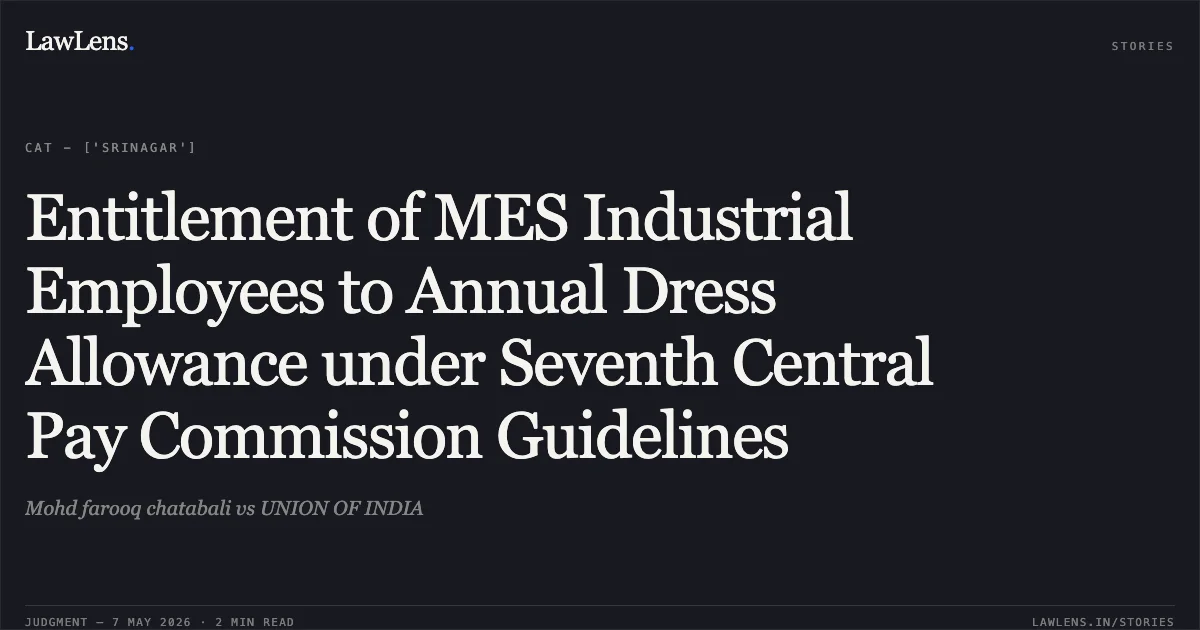
The ninety-eight (98) applicants are industrial employees (Group C & D) working in various technical roles (e.g., Filter General Mechanic, Master Craftsman) within the Military Engineering Services (MES).
Source reference: para. 1, 3Prior to the 7th Central Pay Commission (CPC), they received 'Dangri' (dress) and washing allowances.
Source reference: para. 4Following the 7th CPC and subsequent Government of India Office Memoranda (OM) dated 02-08-2017 and 31-08-2017, the applicants claimed entitlement to a consolidated Dress Allowance of ₹5,000 per annum effective from 01-07-2017.
Source reference: para. 2, 4They contended that despite clarifications from the PCDA Chandigarh in 2018 extending these benefits to MES industrial personnel, the payments were not released or, in similar cases, were subjected to recovery.
Source reference: para. 5, 6The applicants approached the Tribunal seeking the implementation of these OMs and relevant judicial precedents.
Source reference: para. 2Issues
1. Whether the applicants, as industrial employees of the MES, are entitled to the Dress Allowance of ₹5,000 per annum w.e.f. 01-07-2017 in terms of the MoF OM dated 02-08-2017 and DoPT OM dated 31-08-2017.
Source reference: para. 2a2. Whether the benefits granted to similarly situated employees by the Chandigarh and Lucknow Benches of the CAT should be extended to the present applicants.
Source reference: para. 2bLaw Applied
Government of India, Ministry of Finance (Department of Expenditure) Office Memorandum dated 02-08-2017, and the Ministry of Personnel, Public Grievances and Pensions OM dated 31-08-2017, which revised and consolidated dress-related allowances under the 7th CPC.
Source reference: para. 2a, 4Rule 4(5)(a) of the CAT (Procedure) Rules, 1987, regarding joint applications.
Source reference: para. 1Judicial principle of parity based on Sh. Naseer Ahmad Dar v. Union of India & Ors. (O.A. 651/2024), which prohibited the withdrawal/recovery of dress allowances from similarly situated employees.
Source reference: para. 6Reasoning
The Tribunal observed that the cause of action and reliefs sought by all 98 applicants were identical, thereby allowing a joint application.
Source reference: para. 1The Court did not adjudicate on the merits of the statutory entitlement but noted the applicants' reliance on the 2017 OMs and subsequent clarifications issued by PCDA Chandigarh in 2018.
Source reference: para. 4, 5By citing the precedent of the Chandigarh Bench (O.A. 060/1228/2019) and the coordinated Bench at Srinagar (O.A. 651/2024), the Tribunal identified a settled legal trend protecting these allowances for industrial personnel.
Source reference: para. 6Consequently, rather than a full trial, the Tribunal deemed it appropriate to direct the respondents to evaluate the applicants' eligibility against these existing administrative instructions and judicial rulings.
Source reference: para. 9Holding
The Tribunal disposed of the O.A. at the admission stage without expressing an opinion on the merits.
It directed the respondents to treat the O.A. as a formal representation and decide the case by passing a speaking order within eight weeks of receiving the judgment. The respondents were ordered to grant the relief if no legal impediments exist and if the applicants are squarely covered by the cited OMs and case law.
Source reference: para. 9Joint application (M.A.) was allowed and no costs were awarded.
Source reference: para. 1, 11Original Court PDF
Mohd farooq chatabalivsUNION OF INDIA
Click to open original judgment
Original judgment, available to read, download and summarize on LawLens.in