Facts
The respondent, a driver appointed by the Delhi Transport Corporation (DTC) in 1984, underwent cancer surgery in 2015 and was assigned light duty.
Source reference: paras. 1, 3Although DTC regulations allowed retirement age enhancement from 58 to 60 subject to medical fitness, the DTC retired him at age 55 after its Medical Board declared him unfit, ignoring a contrary "fit" certificate from his treating hospital.
Source reference: paras. 2, 4-5Following a direction from the Central Administrative Tribunal (CAT) in OA 3848/2015 and subsequent contempt proceedings, a second Medical Board declared him fit on September 2, 2016.
Source reference: paras. 6-7The DTC only allowed him to resume duty on March 30, 2017, via an order that continuity of service would be granted but back wages would be denied.
Source reference: para. 7The respondent challenged this denial and sought his third MACP financial upgradation in OA 20/2018.
Source reference: paras. 9-11The CAT allowed the OA, granting back wages with interest and directing consideration for MACP.
Source reference: paras. 12-13The DTC challenged this order before the High Court.
Source reference: para. 14Issues
1. Whether an employee is entitled to back wages when the delay in resuming duty is solely attributable to the employer’s dilatory tactics despite a fitness certification.
Source reference: para. 172. Whether the burden of proving "non-gainful employment" shifts to the employee in cases of administrative delay as opposed to long-term industrial litigation.
Source reference: para. 183. Whether the Tribunal’s direction regarding the grant of the 3rd MACP was legally sustainable without addressing specific adverse ACR entries.
Source reference: para. 25Law Applied
The Court primarily applied the principles of restitution in service law as articulated in Dinesh Chandra Sharma v. Bhartiya Paryatan Vikas Nigam Ltd. (2025) and Deepali Gundu Surwase v. Kranti Junior Adhyapak Mahavidyalaya (2013), which establish that if an employer seeks to deny back wages for an illegal act, the employer must prove gainful employment.
Source reference: para. 17It distinguished Rajasthan State Road Transport Corporation v. Phool Chand (2018), noting that the requirement for an employee to prove they were not gainfully employed is specific to long-term industrial disputes where such an inference is reasonable, rather than cases of executive delay.
Source reference: para. 18The Court also referenced the Modified Assurance Career Progression (MACP) scheme guidelines regarding the impact of adverse Annual Confidential Reports (ACRs) on financial upgradation.
Source reference: para. 26Reasoning
The Court found that the DTC's conduct left "much to be desired," as the respondent was forced to file two contempt petitions to secure compliance with judicial orders.
Source reference: paras. 19-21The Court reasoned that the burden of proof regarding gainful employment did not rest on the respondent because the delay was entirely attributable to the DTC’s failure to constitute a Medical Board within the court-mandated four-week window and its subsequent delay in acting upon the "fit" report.
Source reference: paras. 20-22Consequently, the DTC's attempt to deny back wages while granting continuity of service was deemed "adding insult to injury".
Source reference: para. 22Regarding the MACP issue, the Court observed that the CAT failed to provide a reasoned analysis of how the respondent met the criteria despite the DTC's allegations of adverse ACR entries for 2012-14.
Source reference: paras. 25-26Holding
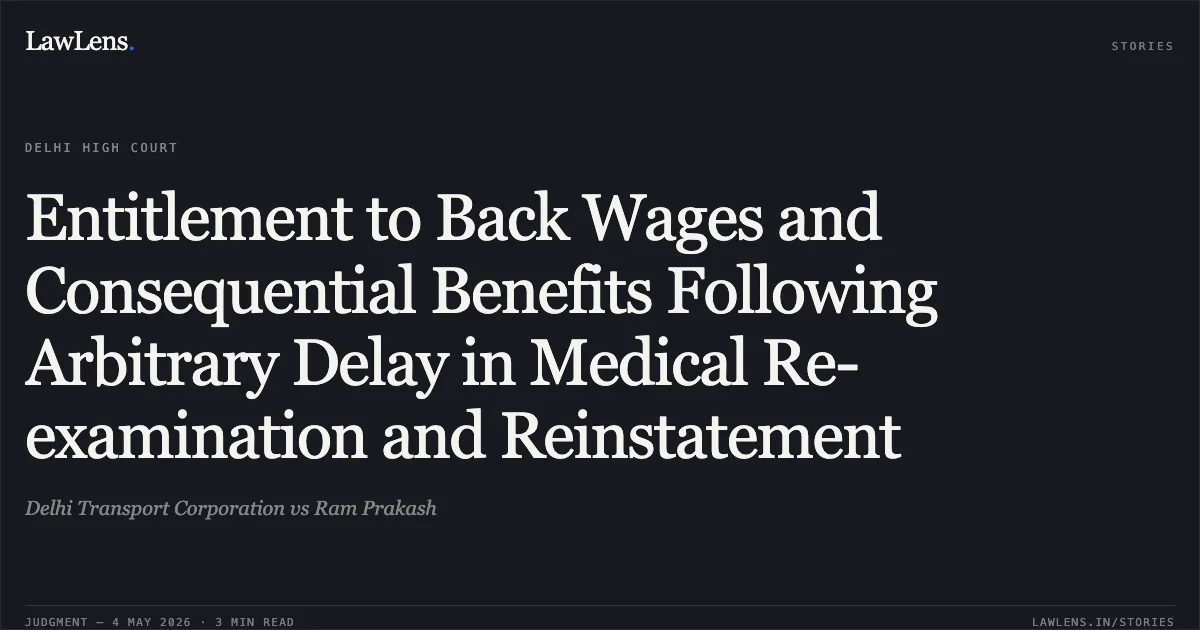
The High Court affirmed the respondent’s entitlement to back wages but modified the period to commence from November 30, 2015 (expiry of the four-week deadline for the first Medical Board) until March 30, 2017.
The DTC was directed to pay these wages with interest within six weeks.
Source reference: para. 29The Court set aside the direction regarding the 3rd MACP and remanded that specific issue back to the CAT for a detailed and speaking order after considering the adverse ACRs.
Source reference: paras. 26-28The writ petition was disposed of with no order as to costs.
Source reference: para. 30Original Court PDF
Delhi Transport CorporationvsRam Prakash
Click to open original judgment
Original judgment, available to read, download and summarize on LawLens.in