Facts
The petitioner challenged proceedings initiated by the Provident Fund authorities under Section 7A of the Employees’ Provident Funds and Miscellaneous Provisions Act, 1952 (“EPF Act”) in respect of its Kolkata establishment, Establishment Code WB/33419.
Source reference: para. 2The proceedings covered an indefinite period commencing from June 1996 and included the proceedings conducted pursuant to summons issued in Diary No. 395/2017.
Source reference: para. 2By order dated 30 April 2026, the Regional Provident Fund Commissioner-II held that the Section 7A proceedings were maintainable.
Source reference: para. 3The authority found that the petitioner had failed to establish that the allowances excluded from provident-fund calculations were variable or not paid uniformly, and alleged that the salary structure had been camouflaged to avoid provident-fund contributions.
Source reference: para. 3Issues
Whether the Section 7A proceedings initiated against the petitioner for the period commencing from June 1996 were maintainable in light of the Supreme Court’s decision in Assistant Provident Fund Commissioner v. M/s. G4S Security Services (India) Ltd. & Anr.
Source reference: paras. 16–18Whether the Provident Fund authority could treat the petitioner’s separate allowances as part of “basic wages” by relying on the concept of minimum wages under the Minimum Wages Act, 1948.
Source reference: paras. 3, 8, 12Whether the order dated 30 April 2026, holding the Section 7A proceedings maintainable, was legally sustainable.
Source reference: paras. 16–18Law Applied
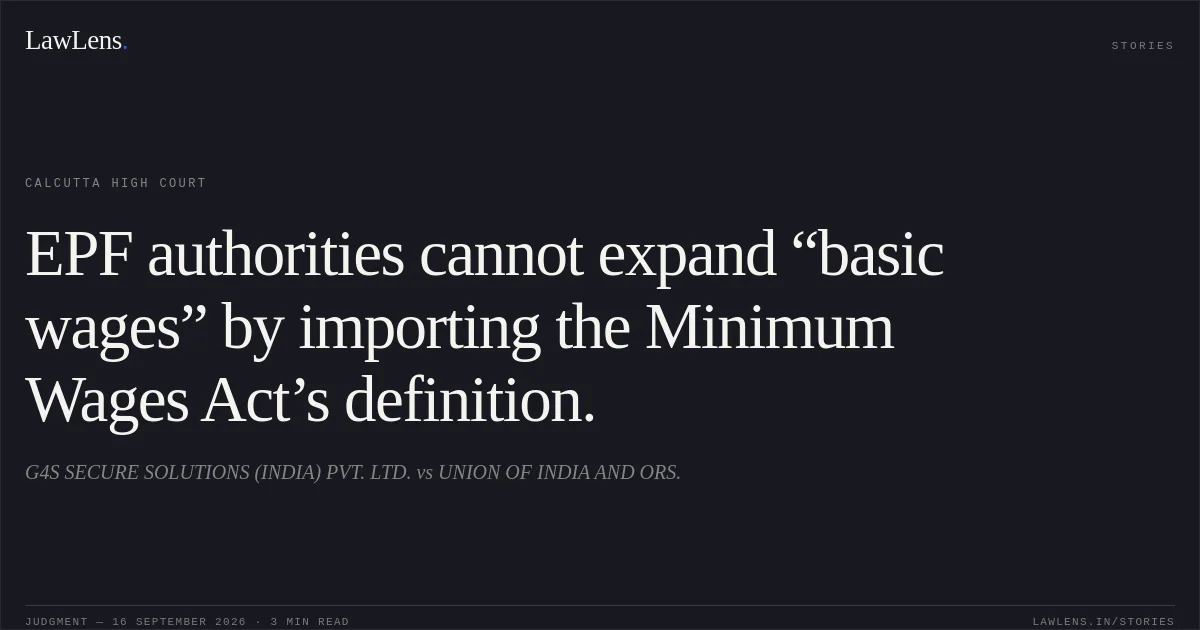
Section 2(b) of the EPF Act specifically defines “basic wages”; therefore, the definition cannot be expanded or altered by importing the definition of “minimum rate of wages” under the Minimum Wages Act, 1948.
Source reference: para. 8The Supreme Court in Assistant Provident Fund Commissioner v. M/s. G4S Security Services (India) Ltd. & Anr., Civil Appeal No. 9284 of 2013, held that where the EPF Act contains a specific definition of “basic wage”, there is no occasion to resort to the Minimum Wages Act to give it a different or broader meaning.
Source reference: para. 8The Court also relied on the earlier Section 7A order dated 23 May 2002, accepted by the Provident Fund department, which held that HRA, fixed conveyance allowance and washing allowance were not liable to provident-fund contributions in the circumstances of that case.
Source reference: para. 9The Provident Fund authority is bound to act consistently with the Supreme Court’s interpretation of “basic wages” and cannot disregard it while determining liability under Section 7A.
Source reference: para. 16Reasoning
The High Court found that the impugned order substantially repeated the Provident Fund authority’s contention that the petitioner had artificially split minimum wages into separate allowances to evade contributions.
Source reference: paras. 3, 15However, the Supreme Court had already rejected the legal premise that “basic wages” under the EPF Act could be equated with or enlarged by reference to “minimum wages” under the Minimum Wages Act.
Source reference: para. 8Since the authority relied on precisely that impermissible approach and failed to give effect to the binding Supreme Court ruling, the High Court held that the order dated 30 April 2026 had been passed in total disregard of the applicable law.
Source reference: para. 16On that basis, the Court concluded that the petitioner was not liable for the alleged default period from 1996 onwards and that the Section 7A proceedings were not maintainable.
Source reference: para. 17Holding
The High Court held that the petitioner was not liable for the provident-fund default alleged for the period commencing from 1996 and that the Section 7A proceedings before the Regional Provident Fund Commissioner-II, EPFO, Kolkata, were not maintainable.
The order dated 30 April 2026 was quashed and set aside as contrary to the Supreme Court’s judgment dated 17 August 2023.
Source reference: para. 18WPA 12466 of 2026 was accordingly allowed; connected applications were disposed of, and any interim order was vacated.
Source reference: paras. 19–21Acts & Sections Cited
4 provisions across 2 statutes referred to in this judgment. Linked provisions open on LawLens.
Employees’ Provident Funds And Miscellaneous Provisions Act, 19523
Minimum Wages Act, 19481
Original Court PDF
G4S SECURE SOLUTIONS (INDIA) PVT. LTD.vsUNION OF INDIA AND ORS.
Click to open original judgment
Original judgment, available to read, download and summarize on LawLens.in