Facts
The petitioner was appointed as a Clerk in the respondent department on May 2, 1986, under the Scheduled Tribe (ST) category, based on a caste certificate identifying him as belonging to the 'Raikwar' community.
Source reference: para. 2Following a show-cause notice and subsequent scrutiny, the High Power Committee (HPC), by an order dated January 7, 2005, declared the petitioner's caste certificate forged and invalid, asserting it was not issued by a competent authority.
Source reference: para. 2Consequently, the petitioner was removed from service on December 5, 2006.
Source reference: para. 2The petitioner challenged the removal and the HPC's findings, contending that 'Raikwar' is a sub-caste of 'Manjhi,' which is a recognized ST under the Presidential Order, 1950.
Source reference: para. 3He further sought protection based on his long tenure of service.
Source reference: para. 3Issues
1. Whether the High Level Caste Scrutiny Committee erred in concluding that the 'Raikwar' caste is not a recognized Scheduled Tribe and that the petitioner's certificate was invalid.
Source reference: para. 82. Whether the petitioner is entitled to equitable relief or the benefit of his long service despite the invalidation of his caste certificate.
Source reference: para. 8-9Law Applied
The court primarily applied the principles established in Ku. Madhuri Patil v. Additional Commissioner, Tribal Development (1994) 6 SCC 241, which mandates the formation of High-Level Scrutiny Committees to verify caste claims and limits the scope of judicial review over their findings of fact.
Source reference: para. 4, 9The court also distinguished State of Maharashtra v. Milind (2001) 1 SCC 4, which held that in specific circumstances (such as medical professionals), completed education or long-practicing careers might be protected despite an invalid certificate, provided there was no fraud.
Source reference: para. 3, 8Furthermore, the court adhered to the principle that a High Court cannot exercise legislative powers to declare a particular caste as a sub-caste of a recognized tribe.
Source reference: para. 8Reasoning
The Court observed that the HPC specifically found 'Raikwar' to be listed under Other Backward Classes (OBC), not Scheduled Tribes.
Source reference: para. 8It held that it is beyond the jurisdiction of the High Court to determine whether 'Raikwar' is a sub-caste of 'Manjhi,' as such classifications are strictly governed by the Presidential Order.
Source reference: para. 8In applying Madhuri Patil, the Court emphasized that findings of fact by a specialized committee must prevail unless found to be perverse or vitiated by an error of law.
Source reference: para. 9The Court distinguished the Milind precedent, noting that while the Supreme Court protected a doctor due to the public interest and resources spent on medical education, such logic does not extend to the petitioner who held the post of a 'Clerk'.
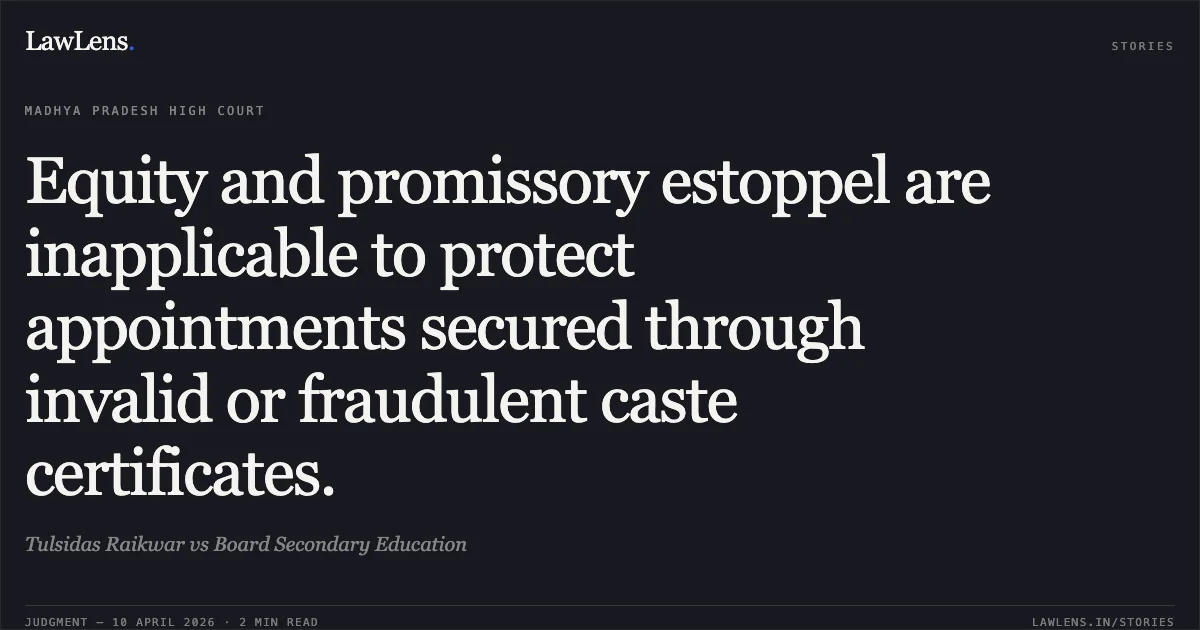
Source reference: para. 8Finally, the Court noted that a party seeking equity must come with clean hands; since the petitioner obtained employment on a false social status, the principles of promissory estoppel or equity cannot be invoked to rescue a claim rooted in fraud.
Source reference: para. 9Holding
The Court dismissed the writ petition, holding that the High Level Scrutiny Committee committed no error in invalidating the petitioner’s caste certificate.
The Court affirmed that the subsequent orders of removal from service and the appellate order were passed in consonance with the evidence on record.
Source reference: para. 10No interference with the impugned orders was warranted.
Source reference: para. 10Original Court PDF
Tulsidas RaikwarvsBoard Secondary Education
Click to open original judgment
Original judgment, available to read, download and summarize on LawLens.in