Facts
On 29.06.2021, A. Kumar died in a motor-vehicle accident when a lorry allegedly driven rashly and negligently collided with his two-wheeler on the Wallajabad–Vandalur Road.
Source reference: paras. 3–4(i)His wife, daughters and parents filed a claim under Section 166 of the Motor Vehicles Act, 1988 (“MV Act”) against the lorry owner and insurer.
Source reference: paras. 3–4(i)The insurer contended that Kumar was covered under the Employees’ State Insurance (“ESI”) Scheme and that the claimants had received ESI benefits, thereby attracting the bar under Sections 53 and 61 of the Employees’ State Insurance Act, 1948 (“ESI Act”).
Source reference: para. 4(ii)The Motor Accident Claims Tribunal found the lorry driver negligent and assessed compensation at ₹29,25,000, but directed that the amounts received under the ESI Scheme be deducted from the compensation.
Source reference: paras. 4(iii)–(vi)The claimants challenged only the deduction of ESI benefits.
Source reference: no citationIssues
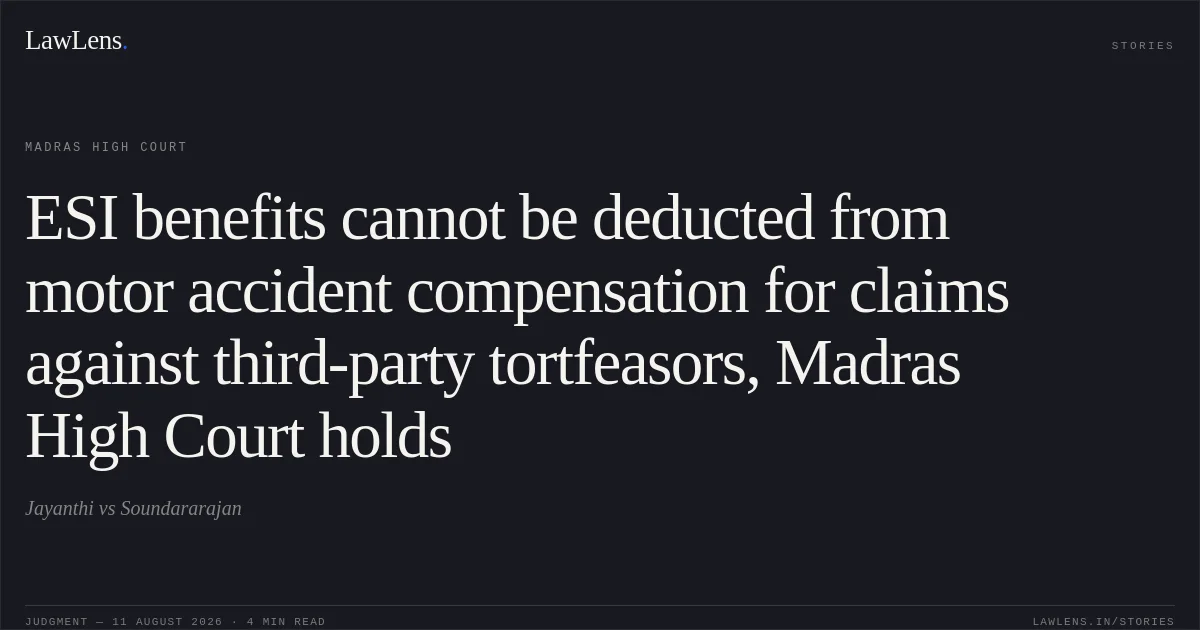
Whether benefits received under the ESI Act could be deducted from compensation awarded under Section 166 of the MV Act where the claim was made against an independent third-party tortfeasor and not against the deceased’s employer
Source reference: paras. 17–20, 24Whether Sections 53 and 61 of the ESI Act barred the claimants from receiving the full compensation awarded under the MV Act in addition to ESI benefits
Source reference: paras. 17–23, 25–29Whether the reference to a larger Bench in Rajkumar Agrawal v. Vehicle Tata Venture required the High Court to adopt an interim deduction or “via media” arrangement
Source reference: paras. 25–27Law Applied
The Court considered Section 166 of the MV Act, which permits a claim for compensation arising from the negligence of a motor-vehicle tortfeasor, and Section 167, which requires an election where the same death or injury gives rise to claims under the MV Act and the Workmen’s Compensation Act.
Source reference: para. 10Section 53 of the ESI Act bars an insured person or dependant from recovering compensation or damages under another law “in respect of an employment injury sustained by the insured person as an employee under” the ESI Act; the Court held that the statutory ingredients must be read cumulatively, with the employment injury and the claim in the employee’s capacity being central to the bar.
Source reference: paras. 18–20Section 61, concerning similar benefits under other enactments, was considered in the context of the ESI Act’s scheme, under which ESI benefits may be independent of compensation arising from a third-party tort.
Source reference: paras. 17, 21–23The Court relied on Regional Director, ESI Corporation v. Francis De Costa , Western India Plywood Ltd. v. P. Ashokan , National Insurance Co. Ltd. v. Hamida Khatoon , Royal Sundaram Alliance Insurance Co. Ltd. v. S. Ajantha , Rajkumar Agrawal , and National Insurance Co. Ltd. v. Rekhaben .
Source reference: paras. 10–16, 30–32In particular, S. Ajantha supported the proposition that the ESI bar does not prevent a claim against a third-party tortfeasor, while Rekhaben affirmed that benefits arising from an independent source, such as compassionate employment, are not deductible from MV Act compensation.
Source reference: paras. 10–16, 30–32Reasoning
The Court distinguished an employment injury claim against an employer from a tort claim arising from an accident caused by an independent third party.
Source reference: no citationKumar’s death occurred in a public-place road accident caused by the alleged negligence of the lorry driver; the claim was directed against the lorry owner and his insurer, not against Kumar’s employer, and the claimants proceeded in their capacity as legal heirs rather than as claimants enforcing an employment-related remedy.
Source reference: para. 24Consequently, the accident could not be treated as an “employment injury” for purposes of the Section 53 bar.
Source reference: no citationThe ESI benefits were statutory benefits arising under a separate scheme, whereas the MV Act compensation represented liability for the tort committed by the lorry driver and owner.
Source reference: no citationPermitting the tortfeasor or insurer to deduct ESI benefits would improperly confer a benefit on the party responsible for the accident.
Source reference: paras. 23, 28–29The Court further held that the larger-Bench reference in Rajkumar Agrawal concerned the broader operation of Sections 53 and 61 where a claimant proceeds in the capacity of an employee, and did not govern claims against an independent third-party vehicle tortfeasor.
Source reference: paras. 25–27The earlier “via media” approach adopted in C. Alliammal was treated as an interim arrangement and not as the controlling ratio for the present facts.
Source reference: paras. 16, 25–27Holding
The appeal was allowed.
The High Court held that the claimants were entitled to receive the entire compensation of ₹29,25,000 awarded under the MV Act, without deduction of the ESI benefits received by them.
Source reference: para. 33The award was modified accordingly, and the insurer was directed to deposit the full compensation amount with interest at 7.5% per annum from the date of the claim petition until realization, after giving credit for amounts already deposited, within six weeks.
Source reference: para. 34The claimants were permitted to withdraw their respective shares in accordance with the Tribunal’s apportionment; the fifth appellant was also permitted to withdraw the share of her deceased husband, the sixth claimant.
Source reference: para. 34Acts & Sections Cited
4 provisions across 1 statute referred to in this judgment. Each provision opens on LawLens.
Motor Vehicles Act, 19884
Original Court PDF
JayanthivsSoundararajan
Click to open original judgment
Original judgment, available to read, download and summarize on LawLens.in