Facts
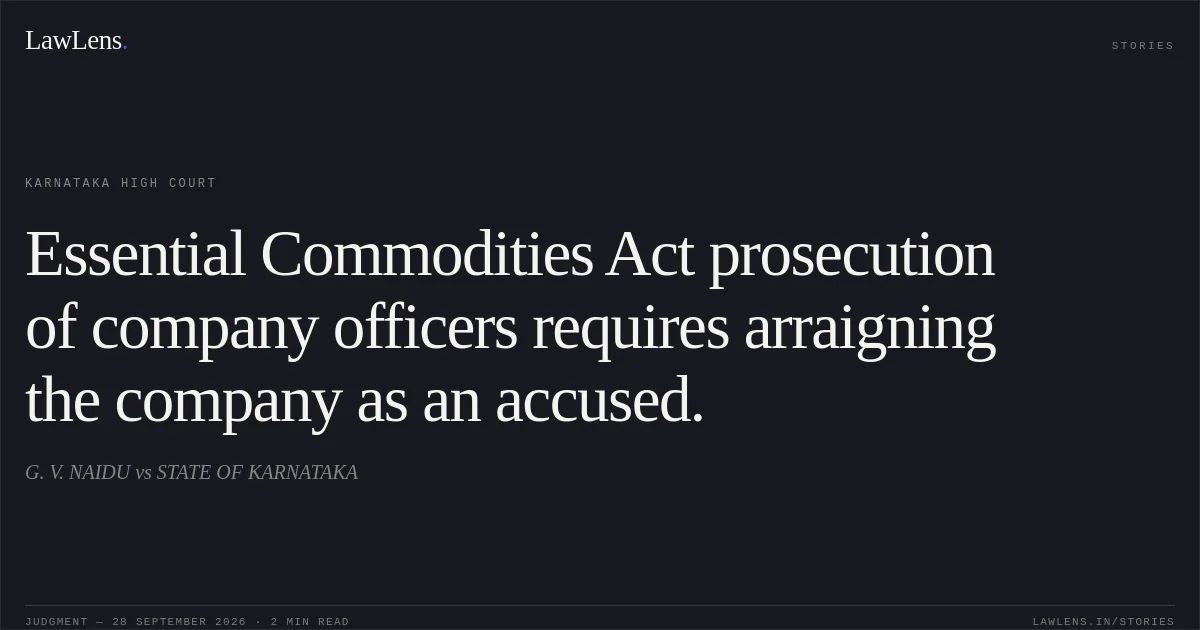
The petitioners sought to quash proceedings in C.C. No. 813/2021, arising from a private complaint alleging an offence under Section 19(3) of the Fertilizer (Inorganic, Organic or Mixed) (Control) Order, 1985, read with Section 7(1)(a)(ii) of the Essential Commodities Act, 1955.
Source reference: paras. 1–2The complaint alleged that a fertilizer sample collected from petitioner No. 2’s shop was found, on laboratory testing, not to conform to specifications.
Source reference: paras. 1–2The petitioners argued, among other things, that the company had not been made an accused; the State contended that it could be added later under Section 319 Cr.P.C.
Source reference: paras. 4–5Petitioner No. 1’s residence in Mumbai and the jurisdictional court’s alleged failure to proceed under Section 203 Cr.P.C. were also raised.
Source reference: para. 4Issues
1. Whether proceedings against the petitioners could continue when the company allegedly responsible for the contravention had not been arraigned as an accused.
Source reference: paras. 7, 11–122. Whether the omission to arraign the company warranted quashing the pending proceedings against the petitioners.
Source reference: paras. 11–13Law Applied
Section 10(1) of the Essential Commodities Act provides for liability of both a company and persons who, at the relevant time, were in charge of and responsible for its business; Section 10(2) addresses liability of officers where the offence is attributable to their consent, connivance, or neglect.
Source reference: pp. 5–7The Court referred to Anil Hada v. Indian Acrylic Ltd., (2000) 1 SCC 1, Dayle De Souza v. Government of India, SLP (CrL) No. 3913 of 2020, and M/s. Cheminova India Limited v. State of Punjab, Crl.A. No. 750/2021, and concluded that, where the alleged offence is by a company, the company must be made a party before proceedings are initiated against the other accused.
Source reference: paras. 8–11Reasoning
The Court found that the complaint alleged a fertilizer-related contravention but had not arraigned the company as a party.
Source reference: paras. 6–7, 12Applying Section 10 and the cited authorities, it held that the company’s omission was material: proceedings against the petitioners, described as a responsible officer and proprietor, could not properly continue without the company being made an accused.
Source reference: paras. 11–12The Court did not separately determine the petitioners’ argument concerning Section 203 Cr.P.C.
Source reference: para. 4Holding
The petition was allowed, and the proceedings in C.C. No. 813/2021 arising from PCR No. 46/2021 were quashed.
The Court clarified that the order would not prevent the complainant from initiating fresh proceedings in accordance with law, subject to limitation.
Source reference: para. 13(iii)Acts & Sections Cited
7 provisions across 3 statutes referred to in this judgment. Each provision opens on LawLens.
Bharatiya Nagarik Suraksha Sanhita, 20231
Code of Criminal Procedure, 19733
Essential Commodities Act, 19553
Original Court PDF
G. V. NAIDUvsSTATE OF KARNATAKA
Click to open original judgment
Original judgment, available to read, download and summarize on LawLens.in