Facts
The Appellant (wife) challenged a Family Court judgment dated 21.12.2024, which dismissed her petition for annulment of marriage under Section 12(1)(c) of the Hindu Marriage Act, 1955
Source reference: p. 2The Appellant alleged that the Respondent (husband) coerced her into a marriage via threats of suicide and misrepresentation of his background
Source reference: p. 2She contended that no essential ceremonies, such as Saptapadi, were performed and the marriage was never consummated
Source reference: p. 2-3During the trial, the Respondent failed to submit to cross-examination, leading the Family Court to close his evidence; however, the lower court still relied on his written defense to dismiss the Appellant's petition
Source reference: p. 3, 5During the pendency of the appeal, the parties entered into a Settlement Agreement at the Delhi High Court Mediation Centre on 16.04.2026
Source reference: p. 3-4Issues
1. Whether the alleged marriage was validly solemnized in accordance with the mandatory requirements of the Hindu Marriage Act, 1955
Source reference: p. 5, para. 172. Whether the Appellant established grounds for annulment under Section 12(1)(c) of the Act based on fraud and coercion
Source reference: p. 6, para. 173. Whether the Family Court erred in relying upon the untested testimony/written statement of a Respondent who failed to appear for cross-examination
Source reference: p. 8, para. 28Law Applied
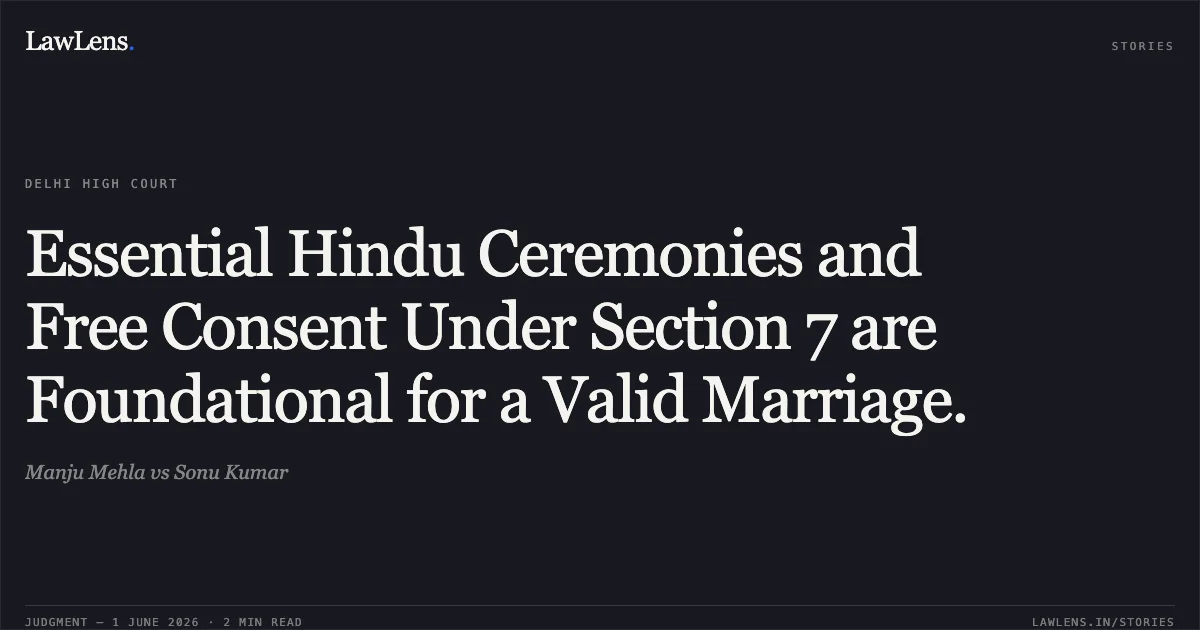
The court applied Section 5 of the Hindu Marriage Act, 1955, regarding conditions for marriage, and Section 7, which mandates the performance of customary rites—specifically Saptapadi—for a marriage to be "complete and binding"
Source reference: p. 6, para. 19-20The court relied on Bhaurao Shankar Lokhande v. State of Maharashtra, establishing that without essential ceremonies, no marriage exists in the eye of law
Source reference: p. 7, para. 23Priya Bala Ghosh v. Suresh Chandra Ghosh, which requires affirmative proof of such ceremonies
Source reference: p. 8, para. 24Regarding evidence, the court followed Geeta Pandey v. Shekar Pandey, holding that a witness's examination-in-chief cannot be read into evidence if they fail to subject themselves to cross-examination
Source reference: p. 8, para. 26Reasoning
The High Court found the Family Court’s approach legally unsustainable because it relied on the Respondent’s written defense despite his failure to undergo cross-examination, which rendered his evidence inadmissible
Source reference: p. 9, para. 28The Court noted that mere issuance of a certificate by an Arya Samaj institution does not dispense with the requirement to prove the performance of essential ceremonies under Section 7
Source reference: p. 8, para. 25The Court observed that the Respondent produced no independent witnesses (like a priest) to prove solemnization
Source reference: p. 9, para. 30Furthermore, the subsequent Settlement Agreement—where both parties admitted that Saptapadi were never performed and they never cohabited—corroborated the Appellant's claim that the marriage was a legal nullity from inception
Source reference: p. 10, para. 31-32Holding
The High Court allowed the appeal and set aside the Family Court’s judgment
The Court declared the marriage purportedly solemnized on 16.01.2019 null and void
Source reference: p. 11, para. 36In accordance with the settlement, the Appellant paid the Respondent ₹2,00,000 as full and final settlement
Source reference: p. 11, para. 37The Court further directed that the identities of the parties be anonymized as "X vs. Y" to protect their privacy
Source reference: p. 12, para. 40Acts & Sections Cited
5 provisions across 3 statutes referred to in this judgment. Each provision opens on LawLens.
Limitation Act, 19631
Family Courts Act, 19841
Hindu Marriage Act, 19553
Original Court PDF
Manju MehlavsSonu Kumar
Click to open original judgment
Original judgment, available to read, download and summarize on LawLens.in