Facts
The petitioner, a Patwari substantively posted at Tehsil Gramin, Morena, Halka Piparkheda, was additionally assigned charge of Halka Bindwakuwari.
Source reference: para. 2He claimed that he was unable to properly discharge the additional duties and submitted an application dated 5 December 2025 to the concerned authorities, followed by a representation to the Sub-Divisional Magistrate.
Source reference: para. 2His request was accepted, and by order dated 31 December 2025 the additional charge was assigned to another Patwari, Geetaram Pal.
Source reference: para. 2On the same day, the petitioner was served with a show-cause notice alleging misconduct. He submitted a detailed reply dated 2 January 2026 denying the allegations.
Source reference: paras. 2, 5Thereafter, the Sub-Divisional Officer, Morena, passed order dated 9 January 2026 imposing the minor penalty of withholding two increments with cumulative effect.
Source reference: para. 2The petitioner challenged the order under Article 226, contending that it was non-speaking and that no departmental inquiry had been conducted despite his factual denial of the charges.
Source reference: paras. 2, 4–7Issues
1. Whether the disciplinary authority’s order imposing the penalty of withholding two increments with cumulative effect was invalid for being non-speaking, unreasoned, and for failing to consider the petitioner’s reply to the show-cause notice?
Source reference: paras. 5–82. Whether a regular departmental inquiry was required before imposing a minor penalty where the factual charges were denied by the delinquent employee?
Source reference: paras. 13–143. Whether reasons supplied, if any, in an appellate order could cure the absence of reasons in the original disciplinary order?
Source reference: para. 12Law Applied
Article 226 of the Constitution empowers the High Court to judicially review disciplinary action for illegality, arbitrariness, violation of natural justice, and failure to apply the mind.
Source reference: para. 2Under the Madhya Pradesh Civil Services (Classification, Control and Appeal) Rules, 1966, withholding increments with or without cumulative effect constitutes a minor penalty.
Source reference: para. 13Under O.K. Bhardwaj v. Union of India, (2001) 9 SCC 180, the employee must be given an opportunity to respond, and where factual charges are denied, an inquiry must ordinarily be held as a minimum requirement of natural justice.
Source reference: para. 13The Court relied on State of Punjab v. Bandip Singh, (2016) 1 SCC 724, for the principle that administrative or executive decisions must be composite, self-contained, and supported by reasons.
Source reference: paras. 9–10It further relied on Kranti Associates Pvt. Ltd. v. Masood Ahmed Khan, (2010) 9 SCC 496, and Oryx Fisheries Pvt. Ltd. v. Union of India, (2010) 13 SCC 427, for the rule that quasi-judicial orders affecting rights must record clear, cogent, and intelligible reasons; the absence of reasons in the original order cannot be cured by reasons subsequently stated in appeal.
Source reference: paras. 11–12Reasoning
The disciplinary order merely recorded that the petitioner’s reply was not satisfactory and imposed the penalty, without addressing the specific factual defence raised in the reply dated 2 January 2026.
Source reference: paras. 5–7Because the order affected the petitioner’s service and financial rights, the disciplinary authority was exercising quasi-judicial power and was required to demonstrate that it had considered the relevant facts and the petitioner’s explanation.
Source reference: paras. 7–12Its failure to provide reasons rendered the order non-speaking and contrary to the requirement of fairness and reasoned decision-making.
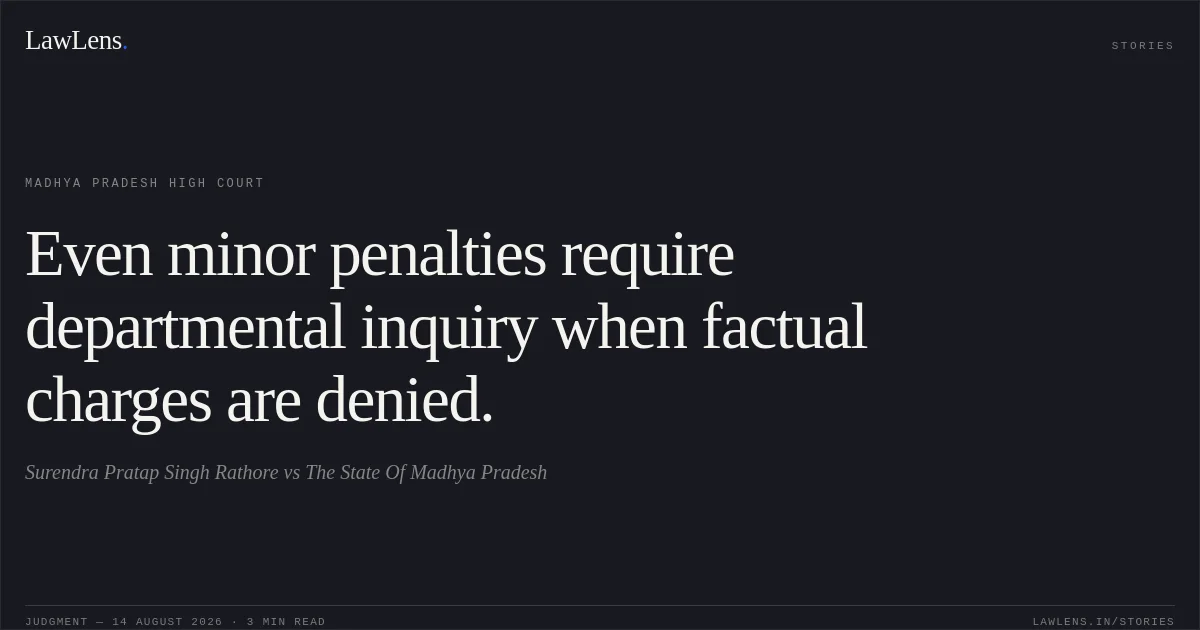
Source reference: paras. 7–12Further, the allegations were factual and had been denied by the petitioner. Applying O.K. Bhardwaj, the Court held that an inquiry was required even though the proposed punishment was classified as a minor penalty.
Source reference: paras. 12–14No regular departmental inquiry had been conducted.
Source reference: paras. 12–14The Court also held that any reasoning offered in an appellate order could not retrospectively validate the defective original punishment order.
Source reference: paras. 12–14Holding
The High Court held that the punishment order dated 9 January 2026 was non-speaking, unreasoned, and passed in breach of the minimum requirements of natural justice, particularly because the petitioner had denied the factual charges and no departmental inquiry had been held.
The order was accordingly quashed.
Source reference: para. 15The respondents were directed to grant the petitioner all consequential benefits within three months of receiving the certified copy of the judgment.
Source reference: para. 15The respondents were, however, granted liberty to take fresh action against the petitioner in accordance with law.
Source reference: para. 15The writ petition and pending interlocutory applications were disposed of.
Source reference: paras. 16–17Original Court PDF
Surendra Pratap Singh RathorevsThe State Of Madhya Pradesh
Click to open original judgment
Original judgment, available to read, download and summarize on LawLens.in