01Facts
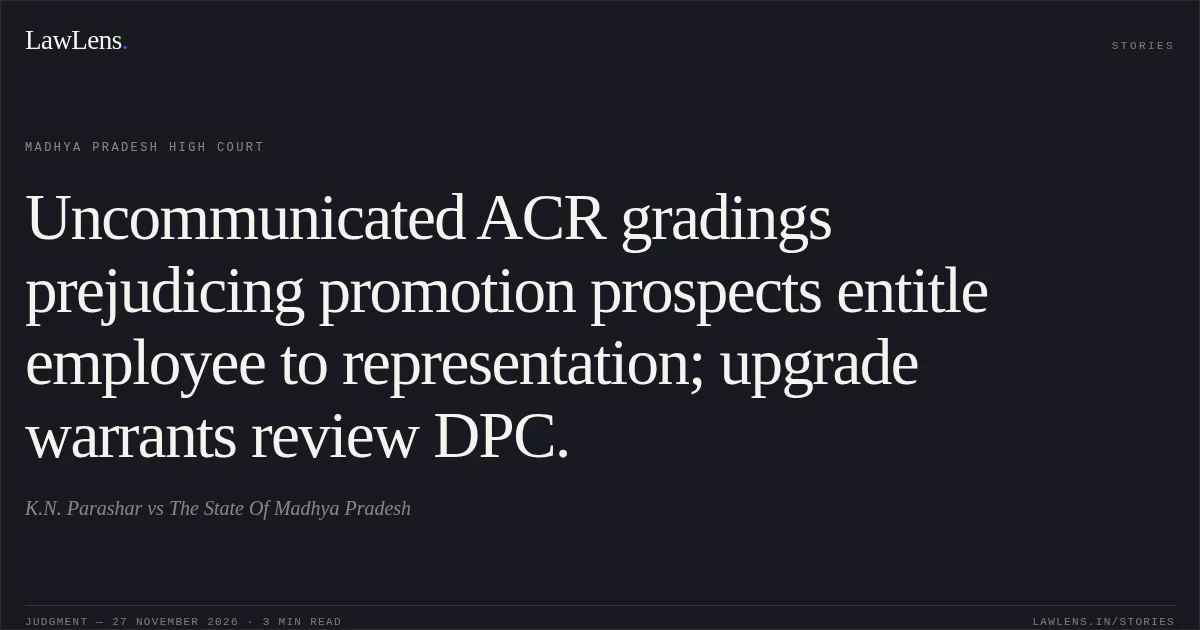
The Central Administrative Tribunal, Jabalpur, expunged adverse ACR entries for 1997–98 and 1998–99 and directed a review DPC to reconsider Dr. Balgir’s promotion, with consequential benefits if found fit.
¶ 1The Union of India challenged that order, arguing that two DPCs had found him below the “Very Good” benchmark and that his ACR challenge was delayed.
¶ 2–7Dr. Balgir contended that relevant ACRs were not communicated, or were communicated belatedly, and that the 1998–99 assessment adversely affected his promotion without a fair opportunity to respond or improve.
¶ 8–14The High Court considered whether the Tribunal’s order warranted interference.
¶ 15–1602Issues
i.1. Whether ACR entries that adversely affect an employee’s promotion must be communicated within a reasonable period, even if they are not expressly adverse.
¶ 17–20ii.2. Whether the Tribunal erred in expunging the relevant ACR entries and directing a review DPC, having regard to the DPC assessments, alleged delay, and limits on judicial review of DPC decisions.
¶ 20–2403Law Applied
In Dev Dutt v. Union of India, (2008) 8 SCC 725, the Supreme Court held that every ACR entry—whether poor, fair, average, good, or very good—must be communicated within a reasonable period where it may affect the employee’s service prospects; non-communication denies an opportunity to improve or make a representation and may be arbitrary and violative of Article 14.
¶ 17The Constitution Bench affirmed this principle in Sukhdev Singh v. Union of India, (2013) 9 SCC 566.
¶ 18The Court also considered the limitation objection under Section 21 of the Administrative Tribunals Act, 1985, but found no sufficient error in the Tribunal’s decision to entertain the claim.
¶ 22Judicial review did not permit substitution of the Court’s assessment for that of the DPC; however, the fairness and legality of the ACR material underlying the DPC’s consideration remained reviewable.
¶ 21Provisions in the judgment · 1 · Linked ones open on LawLens
Administrative Tribunals Act, 1985 Section 21
04Reasoning
The Court found that the relevant ACRs had not been communicated within a prescribed or reasonable period, that the shortcomings underlying the adverse assessments had not been brought to Dr. Balgir’s attention in advance, and that the 1998–99 assessment affected his promotion prospects.
¶ 19Applying Dev Dutt and Sukhdev Singh, it held that an entry’s effect—not whether it was labelled “adverse”—determined whether communication was required; a “Good” entry could prejudice an employee where the promotion benchmark was “Very Good”.
¶ 17–20The defect concerned the fairness of the material before the DPC, not a judicial reassessment of comparative merit.
¶ 21The Court also declined to interfere with the Tribunal’s treatment of delay and held that a review DPC was reconsideration, not an automatic grant of promotion.
¶ 22–2305Holding
The High Court held that the Tribunal’s order disclosed no perversity, jurisdictional error, or patent illegality and dismissed the writ petition.
¶ 24–25It affirmed expunction of the adverse ACR entries and directed that the review DPC consider Dr. Balgir’s case in accordance with law, granting consequential benefits only if he was otherwise found fit for promotion; there was no order as to costs.
¶ 25Original Court PDF
The Union Of India & Ors.vsDr.A.S.Balgir & Ors
Click to open original judgment
Original judgment, available to read, download and summarize on LawLens.in