01Facts
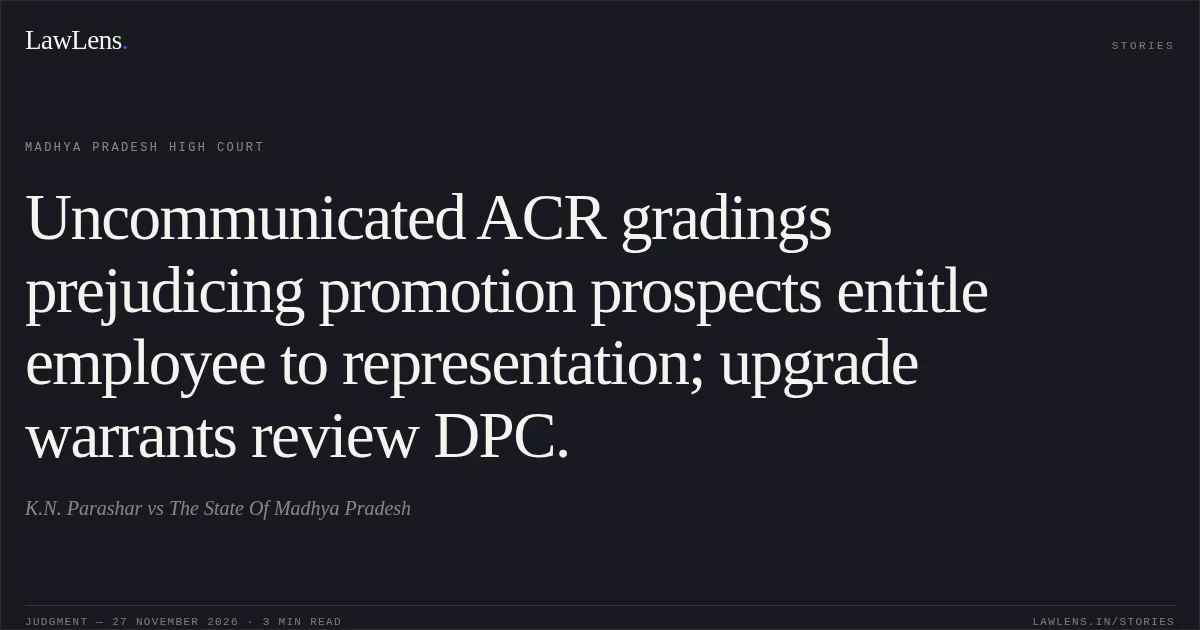
The petitioner challenged the order dated 04.02.2020 (Annexure P/3) passed by the Commissioner, M.P. Housing and Infrastructure Development Board, denying him promotion.
¶ 1–2, 6In 2005, juniors were promoted while the petitioner was not.
¶ 6His earlier challenge (WP No. 7105/2005) was disposed of on 12.08.2016, directing a review DPC that applies seniority subject to fitness.
¶ 6The review DPC met on 04.10.2019, fixed a minimum benchmark of 10 marks, and found the petitioner had secured 9 marks and was not fit.
¶ 4, 6The petitioner had "Very Good" in 1999–2000 but "Good" in 2000–01, 2001–02 and 2002–03.
¶ 3, 6These ACRs were never communicated to the petitioner.
¶ 3, 6The petitioner argued that the "Good" gradings adversely affected his promotion prospects and, being uncommunicated, could not be relied upon.
¶ 3, 6The respondents argued that the DPC acted scientifically, that the petitioner fell short of the benchmark, and that a DPC may rely on uncommunicated ACRs if they were not changed.
¶ 4The respondents also relied on the limitation principle in P.S. Sadasivaswamy and on Dr. Indira Saranath.
¶ 602Issues
i.1. Whether ACR gradings of "Good" that were never communicated to the employee, and that adversely affected his promotion prospects, can be relied upon by the DPC.
¶ 3, 4, 6, 7ii.2. Whether the petitioner's challenge to the non-promotion of 2005 is barred by delay, in light of the rule in P.S. Sadasivaswamy v. State of Tamil Nadu.
¶ 6iii.3. Whether the petitioner is entitled to relief, and if so, what form that relief should take.
¶ 7, 803Law Applied
The Court relied on Dev Dutt v. Union of India (2008) 8 SCC 725, which holds that non-communication of adverse entries in an ACR has civil consequences and that such entries must be communicated so the employee can seek redressal.
¶ 3, 6The Court considered P.S. Sadasivaswamy v. State of Tamil Nadu (AIR 1974 SC 2271), which holds that a person aggrieved by non-promotion must approach the Court within a reasonable period, generally six months to one year, and that a long-delayed challenge is not entertained.
¶ 6Dr. Indira Saranath v. Union of India (Civil Appeal No. 2536/2011), paras. 17–18, holds that prejudice from non-communication of ACRs is assessed cumulatively, considering non-supply of ACRs, weeding out of service records, and unexplained fractional scoring. Where prejudice is shown, the relief may be re-fixation of pension, not automatic arrears.
¶ 6The Court's reasoning rests on the principle that uncommunicated adverse remarks deprive the employee of the opportunity to make a representation, so the remedy is a representation followed by a review DPC if the ACRs are upgraded.
¶ 704Reasoning
The Court treated the core defect as the denial of an opportunity to make a representation against the "Good" gradings for 2000–01 to 2002–03, which were never communicated.
¶ 7Because the petitioner was deprived of that opportunity, the Court did not decide the merits of whether the DPC's reliance on those ACRs was legally sustainable.
¶ 7The Court noted that the Supreme Court and High Courts interfere where uncommunicated ACRs have prejudiced an employee, and framed the appropriate course as first giving the employee a chance to challenge the entries.
¶ 7The respondents' limitation argument under Sadasivaswamy and the cumulative-prejudice analysis under Indira Saranath were recorded as submissions. The judgment does not expressly rule on either, and the Court's disposal does not depend on them.
¶ 6The Court granted a remedy that preserves the petitioner's right to challenge the ACRs before the competent authority, and makes any review DPC conditional on the outcome of that representation.
¶ 7–805Holding
The Court did not quash the 04.02.2020 order on the merits.
¶ 7The Court held that the petitioner was prejudiced by the non-communication of his ACRs for 2000–01, 2001–02 and 2002–03, in which he received "Good" grading, and that he was therefore deprived of an opportunity to make a representation against them.
¶ 7The writ petition was disposed of with liberty to the petitioner to file a representation before the competent authority against those three ACRs.
¶ 7, 8If the representation succeeds and the ACRs are upgraded, the petitioner may approach the competent authority for a review DPC in accordance with law.
¶ 7, 8No monetary or promotional relief was granted directly.
¶ 7, 8Original Court PDF
K.N. ParasharvsThe State Of Madhya Pradesh
Click to open original judgment
Original judgment, available to read, download and summarize on LawLens.in