01Facts
The petitioners sought quashing under Section 482 CrPC of FIR No. 269/2023, registered at Police Station Mahila Thana, Bhopal, for offences under Sections 498-A, 506 and 34 IPC, read with Sections 3 and 4 of the Dowry Prohibition Act, 1961.
¶ 1The marriage was solemnised on 11.09.2017, and the parties have lived separately since 17.10.2019.
¶ 2The parties obtained a mutual-consent divorce under Section 10-A of the Indian Divorce Act, 1869 from the competent court at Pune (Marriage Petition No. 9/2021). The decree of divorce is dated 11.12.2023. The settlement terms provide for full and final resolution of matrimonial disputes, including withdrawal of the present complaint.
¶ 3Pursuant to the Court's direction, a police report dated 29.03.2026 and the statement of respondent No. 2's father were placed on record. These state that respondent No. 2 has remarried and resides in the United Kingdom, and that she does not wish to pursue the criminal proceedings in India.
¶ 402Issues
i.1. Whether the High Court's inherent jurisdiction under Section 482 CrPC may be exercised to quash non-compoundable offences under Sections 498-A IPC and the Dowry Prohibition Act, 1961, despite the absence of statutory compounding under Section 320 CrPC.
¶ 6ii.2. Whether, on the facts, continuation of the FIR and consequential proceedings amounts to an abuse of the process of law such that quashing is necessary to secure the ends of justice.
¶ 5, 7, 803Law Applied
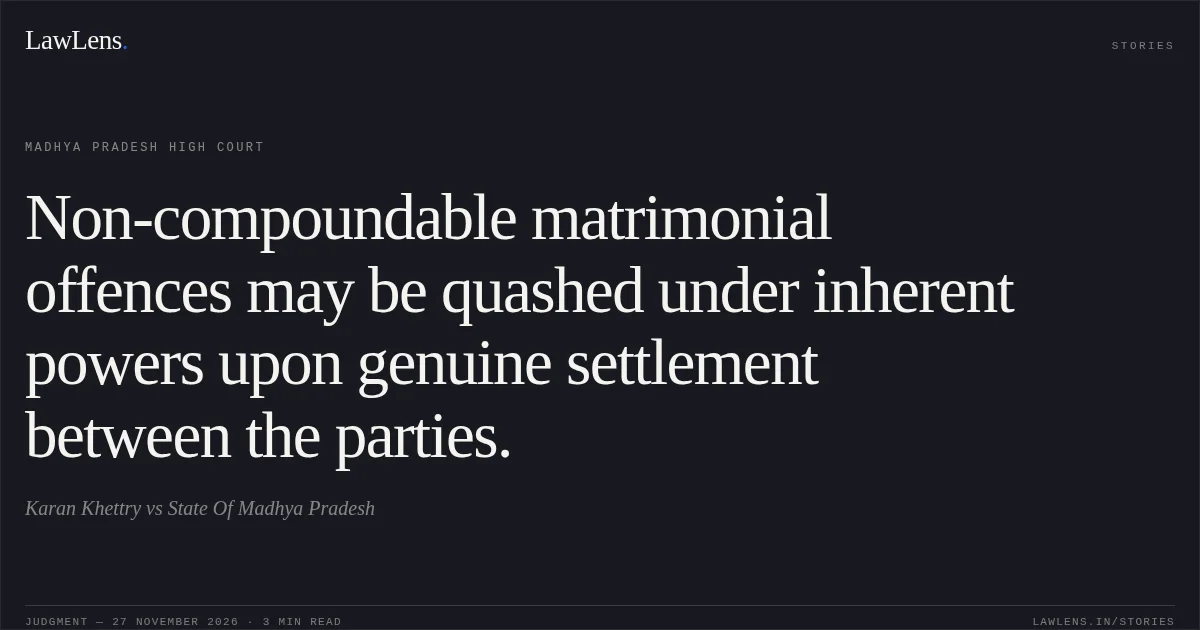
The Court applied Section 482 CrPC, which preserves the High Court's inherent power to prevent abuse of process and to secure the ends of justice. It held that this power is not restricted by the compounding provisions of the CrPC, so non-compoundable offences may be quashed where the dispute is predominantly matrimonial and the parties have genuinely resolved their differences, provided continuation would amount to abuse of process and quashing would serve the ends of justice.
¶ 6The offences in question are Section 498-A IPC, Section 506 IPC (read with Section 34), and Sections 3 and 4 of the Dowry Prohibition Act, 1961.
¶ 1The Court also took note of the finality of the mutual-consent divorce under Section 10-A of the Indian Divorce Act, 1869.
¶ 3The judgment cites no binding precedent.
Provisions in the judgment · 5 · Linked ones open on LawLens
Code of Criminal Procedure, 1973 Section 482
Indian Penal Code, 1860 Section 506Section 34
04Reasoning
The Court first found that the marriage had been dissolved by a consensual decree and that the parties' financial and matrimonial claims had been settled. It then relied on the respondent's remarriage and settlement abroad, together with her father's statement that she has no wish to pursue the case, to conclude that the complainant had no inclination to prosecute.
¶ 3, 4, 5Applying the test in para. 6, the Court reasoned that the dispute was predominantly matrimonial and had been genuinely resolved, so no fruitful outcome could be expected from a trial. Continuing the proceedings would only prolong a discord that had already reached finality.
¶ 7The Court therefore held that continuation would be an abuse of process and that quashing was warranted to secure the ends of justice. The non-compoundable character of the offences was not treated as a bar, because the inherent power is independent of Section 320 CrPC.
¶ 6, 805Holding
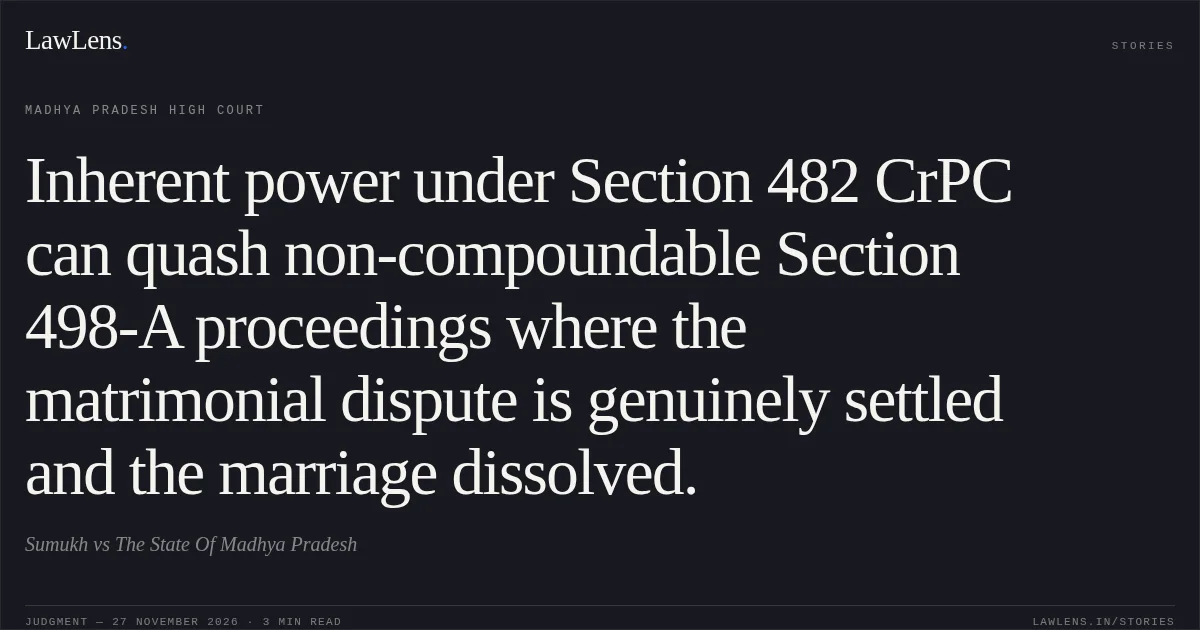
The High Court held that the non-compoundable offences under Section 498-A IPC and the Dowry Prohibition Act could be quashed under Section 482 CrPC, because continuation of the proceedings, in view of the mutual-consent divorce, the settlement and the complainant's remarriage and stated disinterest, would be an abuse of process.
¶ 6, 7, 8The petition was allowed. FIR No. 269/2023 at Police Station Mahila Thana, Bhopal, for offences under Sections 498-A, 506 and 34 IPC read with Sections 3 and 4 of the Dowry Prohibition Act, 1961, and all consequential criminal proceedings were quashed qua the petitioners, and the petition was disposed of.
¶ 9, 10Original Court PDF
SumukhvsThe State Of Madhya Pradesh
Click to open original judgment
Original judgment, available to read, download and summarize on LawLens.in