01Facts
The petitioners, the children of Smt. Razia Sultan, sought quashing under Section 482 CrPC of (i) the order dated 24.07.2018 of the JMFC, Bhopal, directing registration of an FIR under Section 156(3) CrPC against them and a Patwari, (ii) the consequential FIR, Crime No. 506/2018, P.S. Koh-e-Fiza, for offences under Sections 420, 467, 468, 471/34 and 120-B IPC, and (iii) the order dated 03.08.2018 of the 21st Additional Sessions Judge, Bhopal, dismissing the revision.
¶ 1The dispute concerned agricultural land at Village Maholi, originally recorded in Razia Sultan's name. The petitioners claimed mutation in their favour under the Tahsildar's order dated 22.06.2016.
¶ 2Respondents 2 and 3, Anil Saini Mali and Narayan Singh Dhakad, alleged that their signatures were forged on Panchnama (P/4), prepared by the Patwari.
¶ 3The petitioners contended that they were not executants or parties to the Panchnama, that the complainants had no independent grievance about land, and that the complaint was instigated by Iqbal and associates in an existing property dispute.
¶ 4During pendency, the complainants executed a compromise deed dated 14.01.2021 and filed affidavits consenting to quashing.
¶ 5The FIR in Crime No. 206/2018 (P.S. Shahjahanabad) against Iqbal Hafiz Khan and others, concerning an alleged forged Will, was quashed by this Court on 01.05.2025 in M.Cr.C. No. 27383/2018 on the basis of settlement.
¶ 8The complainants were employees of Iqbal.
¶ 1402Issues
i.1. Whether the criminal proceedings arising from a private, predominantly civil property dispute may be quashed under Section 482 CrPC on the basis of a voluntary compromise between the complainants and the accused, despite the non-compoundable nature of the offences.
¶ 9–10, 13ii.2. Whether the petitioners, who were not signatories to Panchnama (P/4), can be prima facie implicated in the alleged forgery and fraud in the absence of material showing their participation or dishonest intention.
¶ 6, 12iii.3. Whether cognizance of the alleged offences relating to a document produced in revenue/court proceedings is barred for want of a complaint by the competent court.
¶ 1503Law Applied
The Court relied on the inherent power under Section 482 CrPC, which is distinct from compounding under Section 320 CrPC, and under which criminal proceedings involving predominantly civil or private disputes may be quashed on a genuine settlement even for non-compoundable offences, if necessary to secure the ends of justice, citing Gian Singh v. State of Punjab, (2012) 10 SCC 303.
¶ 10The Court applied State of Madhya Pradesh v. Laxmi Narayan, (2019) 5 SCC 688, which holds that such power may be exercised where the dispute has an overwhelmingly civil character and is fully resolved, but not for heinous or serious offences with substantial societal impact.
¶ 11The statutory bar, stated without section reference, provides that no court may take cognizance of offences under IPC Sections 463, 471, 475 or 476 relating to a document produced or given in evidence in a court proceeding except on a written complaint by that court or an authorised officer, or by its superior court.
¶ 15A settlement alone is not a ground for quashing in every case, and quashing is justified where the allegations are private in nature and continuation would be an abuse of process.
¶ 13, 16Provisions in the judgment · 11 · Linked ones open on LawLens
Code of Criminal Procedure, 1973 Section 482Section 156Section 320
Indian Penal Code, 1860 Section 34Section 420Section 463Section 467Section 468Section 471Section 475Section 476
04Reasoning
The Court found that the signatures on P/4 were not those of the petitioners, who were not signatories, and that the Panchnama was prepared by the Patwari in official revenue proceedings. No material showed the petitioners' participation in fabrication or any dishonest intent.
¶ 6, 12The complainants were employees of Iqbal, who was in a property dispute with the petitioners. The complaint was therefore found to have been lodged at Iqbal's instance as a counterblast to that dispute.
¶ 4, 7, 14No live dispute over ownership remained before the revenue authorities, and the principal Will-related dispute had already been quashed on settlement.
¶ 7–8Applying Gian Singh and Laxmi Narayan, the Court held that the cumulative effect of the civil character of the dispute, the absence of prima facie involvement of the petitioners, the complainants' voluntary compromise, and the remote possibility of conviction rendered continuation an abuse of process with no meaningful purpose.
¶ 13, 16No complaint had been filed by the competent court (the Tahsildar) as the statutory bar requires for offences relating to documents produced in proceedings, so the mandatory precondition for cognizance was unmet.
¶ 15The Panchnama had not been challenged before the Tahsildar and the father's name of the purported witness was absent, so it could not be ascertained who had signed.
¶ 14These observations were made without deciding title or the genuineness of the Will or revenue entries.
¶ 1805Holding
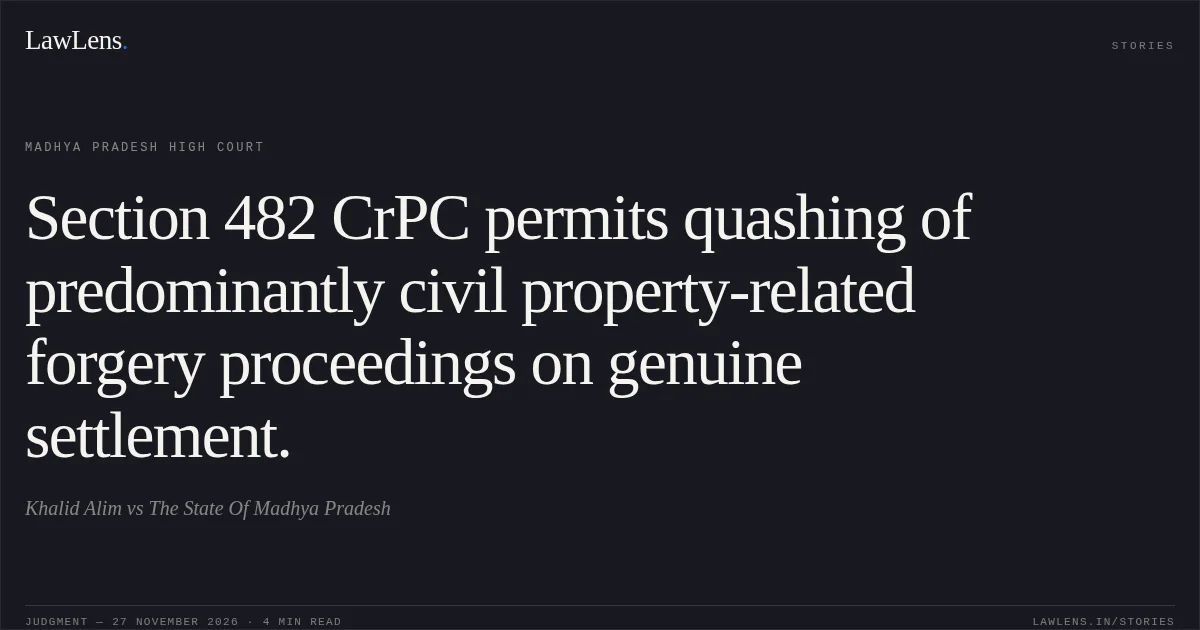
The Court held that continuation of the proceedings, arising from a predominantly private property dispute and resolved by a voluntary compromise, would amount to an abuse of process, and that this was a fit case for exercise of inherent jurisdiction under Section 482 CrPC.
¶ 13, 16Both petitions were allowed. The Court quashed, qua the petitioners, the JMFC's order dated 24.07.2018, the consequential order dated 03.08.2018 of the 21st Additional Sessions Judge, Bhopal, the FIR in Crime No. 506/2018 (P.S. Koh-e-Fiza), and all consequential criminal proceedings.
¶ 17The observations are confined to these petitions and do not adjudicate title or the genuineness of the Will or revenue entries.
¶ 18, 19Original Court PDF
Khalid AlimvsThe State Of Madhya Pradesh
Click to open original judgment
Original judgment, available to read, download and summarize on LawLens.in