Facts
The Petitioner (daughter-in-law) married the son of Respondent No. 2 (mother-in-law) in 2006
Source reference: p. 2Following matrimonial disputes and the filing of a POCSO FIR against the husband in October 2015, the husband transferred the subject property to Respondent No. 2 via GPA and Agreement to Sell on 19.11.2015
Source reference: p. 3, 7The Petitioner obtained a protection order under the DV Act on 15.11.2016
Source reference: p. 4Respondent No. 2 subsequently sought eviction of the Petitioner under the Maintenance and Welfare of Parents and Senior Citizens Act, 2007 ("Senior Citizens Act").
Source reference: no citationThe District Magistrate dismissed the eviction plea on 05.03.2018, finding no evidence of ill-treatment and characterizing it as a family dispute
Source reference: p. 18-19However, the Divisional Commissioner (Appellate Court) reversed this on 18.11.2019, ordering the Petitioner’s eviction to ensure the senior citizen's peace
Source reference: p. 19-20The Petitioner challenged this eviction in the High Court.
Source reference: no citationIssues
Whether the right of a woman to a "shared household" under the DV Act can be defeated by an eviction order obtained through summary proceedings under the Senior Citizens Act, 2007
Source reference: p. 6, 20Whether the requirements of Section 23(1) of the Senior Citizens Act were fulfilled to justify the transfer of property and subsequent eviction
Source reference: p. 8-9, 30Whether the Divisional Commissioner erred in overstepping the findings of the inquiry report regarding "ill-treatment"
Source reference: p. 32-33Law Applied
The court relied on the Supreme Court precedent in *S. Vanitha v. Deputy Commissioner, Bengaluru Urban District*, which held that the Senior Citizens Act and the PWDV Act must be harmonized; a woman’s right to reside in a shared household cannot be nullified by the summary machinery of the Senior Citizens Act
Source reference: p. 20-25It further applied *Sudesh Chhikara v. Ramti Devi*, establishing that for Section 23(1) of the Senior Citizens Act to apply, the transfer of property must be subject to the express condition that the transferee provide basic amenities/physical needs
Source reference: p. 26-27, 30The court also noted that under Rule 22, eviction requires proof of "non-maintenance" or "ill-treatment"
Source reference: p. 30Reasoning
The Court observed that the subject property was transferred to the mother-in-law only after matrimonial litigation began, suggesting a strategy to defeat the Petitioner's right to a shared household
Source reference: p. 25, 31The Court found that Respondent No. 2 was not residing in the property and failed to establish that the initial purchase or subsequent transfer was tied to a legal condition of providing her maintenance under Section 23(1)
Source reference: p. 31Following the mandate in *S. Vanitha*, the Court reasoned that summary eviction under the Senior Citizens Act cannot override a subsisting protection order under the DV Act
Source reference: p. 32The Court criticized the Divisional Commissioner for ignoring the SDM’s inquiry report, which found no evidence of ill-treatment and noted that the mother-in-law actually resided elsewhere
Source reference: p. 33Holding
The Court allowed the writ petition and set aside the impugned eviction order dated 18.11.2019
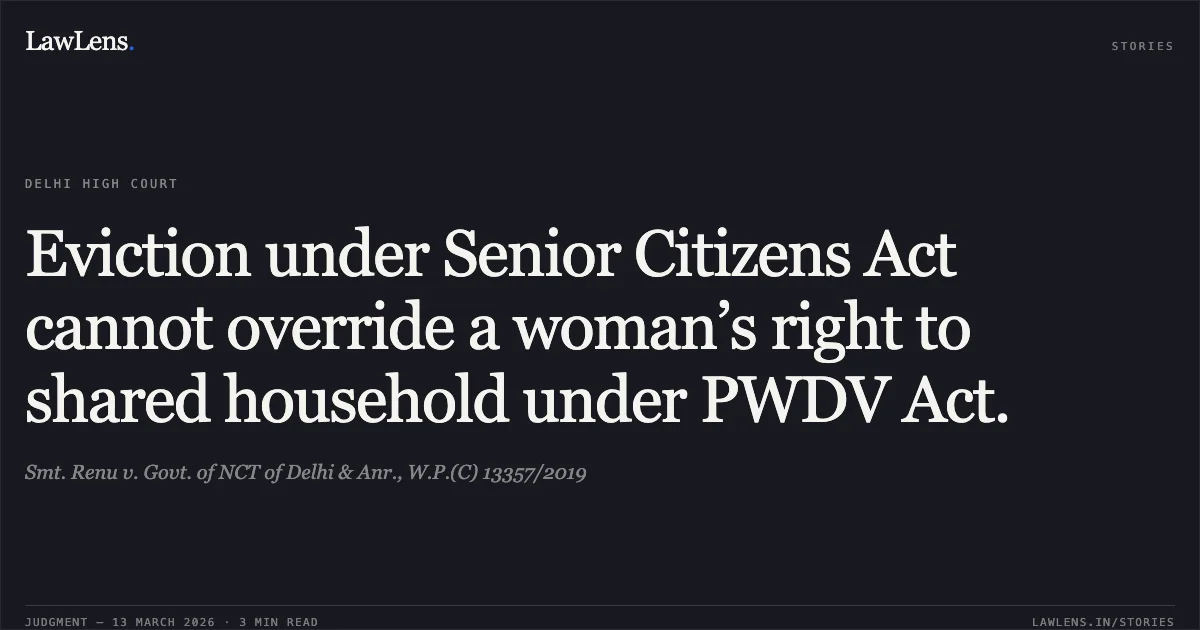
The Court held that the Petitioner’s right to a shared household under Section 17 of the PWDV Act cannot be nullified by the Senior Citizens Act
Source reference: p. 33It directed that the competing rights of the parties be determined by the pending PWDV Act proceedings, noting that if Respondent No. 2 wishes to pursue eviction, she may offer alternate accommodation under Section 19(1)(f) of the DV Act before the Metropolitan Magistrate
Source reference: p. 33Acts & Sections Cited
19 provisions across 4 statutes referred to in this judgment. Each provision opens on LawLens.
Indian Penal Code, 18601
Protection of Women from Domestic Violence Act, 2005
Protection of Children from Sexual Offences Act, 20121
Maintenance and Welfare of Parents and Senior Citizens Act, 20077
Original Court PDF
Smt. Renu v. Govt. of NCT of Delhi & Anr., W.P.(C) 13357/2019
Click to open original judgment
Original judgment, available to read, download and summarize on LawLens.in


