Facts
The assessee filed its return for Assessment Year 2012–13 declaring nil income. Assessment under Section 143(3) of the Income Tax Act, 1961 was completed on 16 March 2015, followed by revision under Section 263.
Source reference: para. 9–12In the first round of litigation, the Income Tax Appellate Tribunal remanded the matter for a de novo assessment.
Source reference: para. 9–12On remand, the Assessing Officer made additions of ₹6.27 crore under Section 68 concerning transactions with M/s Growfast Realtors (P) Ltd., ₹19.13 crore under Section 68 concerning M/s Sarda Vanijya (P) Ltd., and ₹20,33,817 towards alleged bogus trading liabilities.
Source reference: para. 13The Commissioner (Appeals) confirmed the additions.
Source reference: para. 14–15The Tribunal, upon considering documents and additional evidence produced in a paper book, deleted the additions of ₹6.27 crore and ₹19.13 crore, deleted certain trading-liability additions, and partly restricted other additions.
Source reference: para. 16–22The Revenue challenged the Tribunal’s order dated 10 September 2024 before the High Court, contending that the Tribunal had wrongly deleted the Section 68 additions and had failed to apply the principles governing accommodation entries and unexplained credits.
Source reference: para. 1–2, 6–7The Revenue’s delay of 393 days in filing the appeal was condoned.
Source reference: GA 1 of 2026, paras. 1–4Issues
Whether the Tribunal was justified in deleting the additions of ₹6.27 crore and ₹19.13 crore made under Section 68 of the Income Tax Act on the ground that the assessee had established the genuineness of the transactions?
Source reference: para. 2(i)–(iii)Whether the Tribunal erred in law by accepting additional evidence and relying upon documents produced by the assessee to establish the nature, source and genuineness of the transactions?
Source reference: para. 2(ii), 35–39Whether the Revenue’s grounds raised substantial questions of law warranting interference under the High Court’s appellate jurisdiction?
Source reference: para. 3–5, 42Law Applied
Section 68 of the Income Tax Act, 1961 permits an addition where a credit appearing in the assessee’s books is not satisfactorily explained by establishing the relevant nature and source of the credit, including the genuineness of the transaction.
Source reference: no citationIn an appeal against an order of the Income Tax Appellate Tribunal, the High Court may interfere only where a substantial question of law arises; factual findings of the Tribunal, as the final fact-finding authority, are not ordinarily disturbed absent perversity.
Source reference: no citationRule 18(4) of the Income Tax (Appellate Tribunal) Rules, 1963 permits a party to file additional evidence through a separate paper book accompanied by an application stating the reasons for filing it.
Source reference: para. 35–39The Revenue relied upon PCIT v. Swati Bajaj, PCIT v. NRA Iron & Steel (P) Ltd., and PCIT (Central)-2, Kolkata v. BST Infratech Ltd., but the Court held that the questions raised were factual and did not warrant consideration as substantial questions of law.
Source reference: para. 2(iv), 42Reasoning
The Court examined the Tribunal’s order and found that the Tribunal had considered the assessee’s supporting material, including confirmations, transaction details, payment records, an accountant’s certificate, evidence of tax deducted at source, books of account and bank records.
Source reference: para. 24–33In relation to Growfast Realtors, the Tribunal found that the amount represented payments made by the assessee and relied upon the confirmation of accounts.
Source reference: para. 25–26In relation to Sarda Vanijya, the Tribunal relied upon transaction details, the accountant’s certificate under the first proviso to Section 201(1), and evidence that TDS had been deducted, concluding that the payments were genuine business payments.
Source reference: para. 27–28The Court further held that the Tribunal was legally entitled to consider the additional evidence under Rule 18(4), particularly since the assessee explained that its earlier records had been lost, damaged or soiled and had subsequently been retrieved.
Source reference: para. 35–39The Tribunal had given reasons for accepting some transactions, confirming one addition, and restricting others to 50 per cent after evaluating the available evidence.
Source reference: para. 29–33Since these conclusions were based on evidence and were not shown to be perverse, the Revenue’s challenge involved only re-appreciation of facts and did not give rise to a substantial question of law.
Source reference: para. 40–42Holding
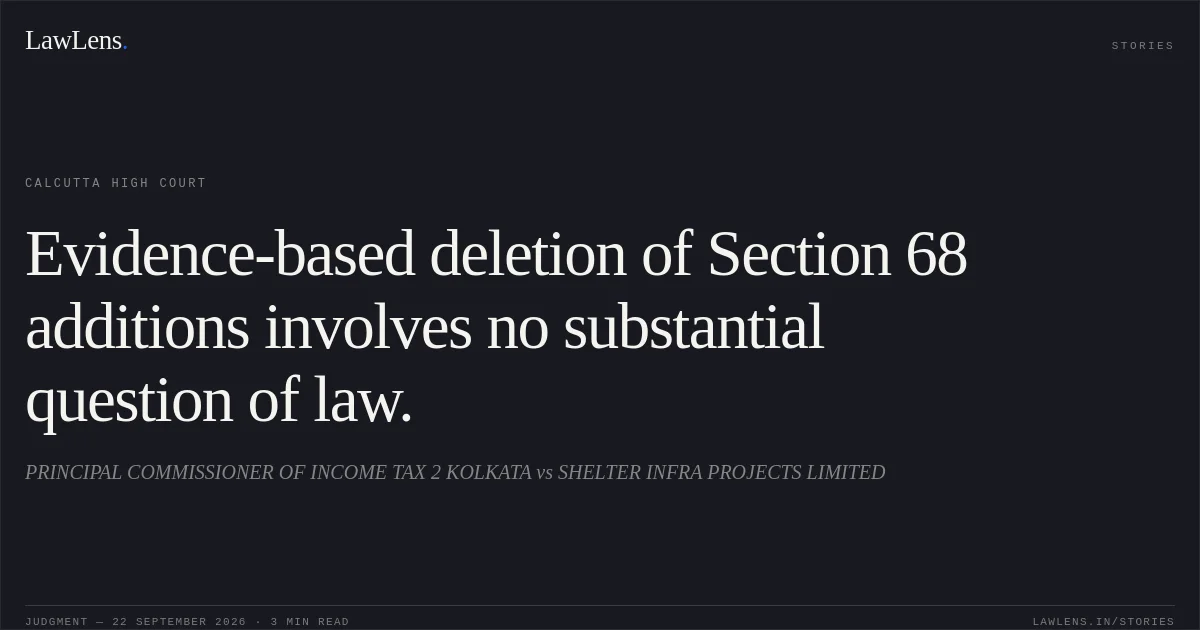
The High Court held that the Revenue’s proposed questions concerned pure questions of fact and that no substantial question of law arose from the Tribunal’s order.
The Tribunal’s deletion of the Section 68 additions of ₹6.27 crore and ₹19.13 crore, as well as its treatment of the trading-liability additions, was upheld.
Source reference: para. 42The appeal, ITAT No. 84 of 2026, was dismissed, with no order as to costs.
Source reference: para. 43–44The delay-condonation application, GA No. 1 of 2026, was allowed, and the connected stay application was disposed of accordingly.
Source reference: GA 1 of 2026, paras. 1–4Acts & Sections Cited
5 provisions across 1 statute referred to in this judgment. Linked provisions open on LawLens.
Income Tax Act, 19615
Original Court PDF
PRINCIPAL COMMISSIONER OF INCOME TAX 2 KOLKATAvsSHELTER INFRA PROJECTS LIMITED
Click to open original judgment
Original judgment, available to read, download and summarize on LawLens.in