Facts
The petitioner-husband filed a petition for nullity of marriage under Sections 11 and 12 of the Hindu Marriage Act, 1955
Source reference: p. 1After both parties concluded their evidence and advanced final arguments, the case was listed for judgment on 18.09.2025
Source reference: p. 1-2Following four adjournments at the judgment stage, the respondent-wife filed an application (Exhibit 73) under Order XVIII Rule 17 and Section 151 of the Code of Civil Procedure (CPC) to reopen evidence and examine the President of a matrimonial bureau as an additional witness
Source reference: p. 2The respondent claimed she could not contact the witness earlier due to his ill health
Source reference: p. 4The Family Court, Nagpur, allowed the application on 14.10.2025, a decision the petitioner challenged via this Writ Petition
Source reference: p. 2Issues
1. Whether a party can invoke Order XVIII Rule 17 of the CPC to reopen evidence and examine a new witness at the stage where the case is reserved for judgment.
Source reference: p. 52. Whether the lack of contact with a witness during the trial constitutes "due diligence" sufficient to permit additional evidence after final arguments.
Source reference: p. 5 / para. 9Law Applied
Order XX Rules 1 to 3 of the CPC, which dictates that once a case is heard, the court shall pronounce judgment, leaving no "hiatus" or intermediate stage for parties to exercise further rights
Source reference: p. 6-7Three-Judge Bench precedent in Arjun Singh v. Mohindra Kumar, clarifying that after hearing is completed, parties have no further privileges
Source reference: p. 7-8Order XVIII Rule 17 of the CPC as interpreted in K.K. Velusamy v. N. Palanisamy [(2011) 11 SCC 275] and Shubhkaran Singh v. Abhayraj Singh, which establish that the power to recall witnesses is discretionary, intended for the court's clarification, and must not be used by parties to fill lacunae or introduce additional evidence that could have been produced earlier
Source reference: p. 8-10Reasoning
The High Court determined that there is no procedural stage between the conclusion of arguments and the pronouncement of judgment that allows parties to lead new evidence as a matter of right
Source reference: p. 7The court observed that the respondent had already examined three witnesses and voluntarily closed her evidence in a suit pending since 2018
Source reference: p. 4, 11It held that the respondent failed to demonstrate "due diligence," as the witness was available during the trial and no attempt was made to summon him before the judgment stage
Source reference: p. 5The court reasoned that allowing a new witness at this late stage would permit the respondent to fill gaps in her case revealed during arguments, thereby causing significant prejudice to the petitioner
Source reference: p. 11-12The court emphasized that Order XVIII Rule 17 is a tool for the court to resolve ambiguities, not for parties to reopen their entire case
Source reference: p. 10Holding
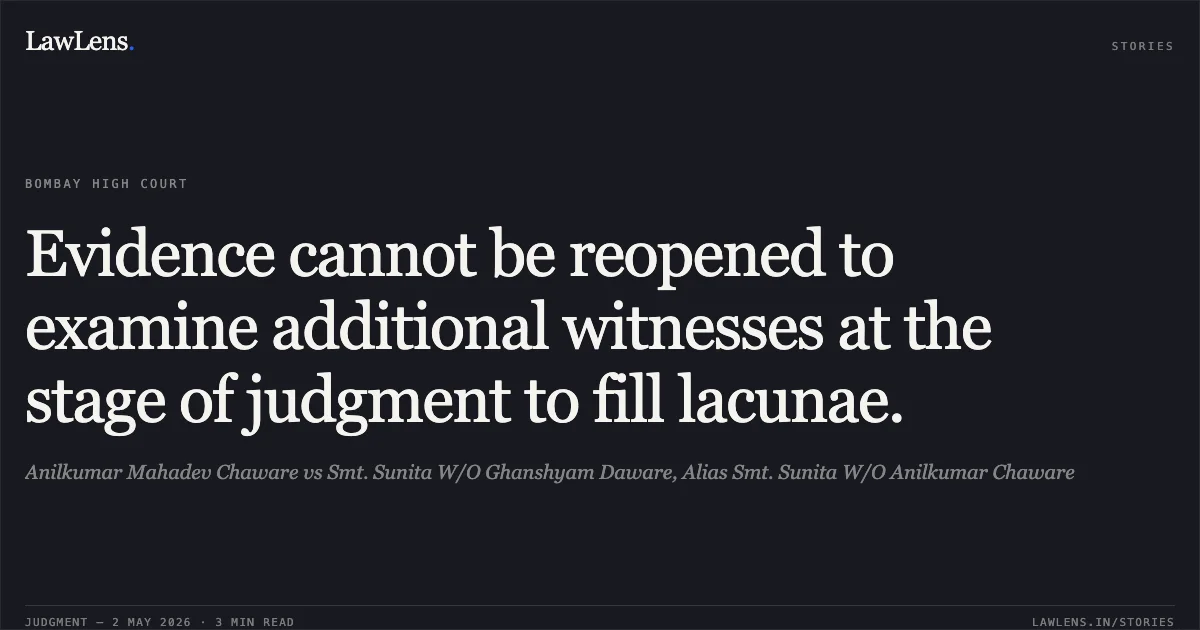
The High Court answered both issues in the negative, holding that the Family Court adopted an erroneous approach by allowing the reopening of evidence at the stage of judgment
The court concluded that the reasons provided by the respondent were insufficient to invoke inherent powers under Section 151 or discretionary powers under Order XVIII Rule 17
Source reference: p. 12Consequently, the Writ Petition was allowed, the Family Court's order dated 14.10.2025 was quashed and set aside, and the respondent's application (Exhibit 73) was rejected
Source reference: p. 13Acts & Sections Cited
6 provisions across 2 statutes referred to in this judgment. Each provision opens on LawLens.
Code of Civil Procedure, 19084
Hindu Marriage Act, 19552
Original Court PDF
Anilkumar Mahadev ChawarevsSmt. Sunita W/O Ghanshyam Daware, Alias Smt. Sunita W/O Anilkumar Chaware
Click to open original judgment
Original judgment, available to read, download and summarize on LawLens.in


