Facts
The Appellant (Plaintiff) sold a property in Ghaziabad to the Respondents (Defendants).
Source reference: no citationWhile an initial Agreement to Sell dated 14.04.2019 fixed the consideration at Rs. 1,20,00,000
Source reference: p. 2, para 2the subsequent registered Sale Deed dated 23.09.2019 recorded the consideration as Rs. 66,12,000
Source reference: p. 3, para 8The Appellant alleged the lower figure was used to avoid taxes and that the Respondents issued three cheques totaling Rs. 11,00,000 toward the "actual" balance, which were subsequently dishonored
Source reference: p. 2, para 3-4The Appellant filed a suit for recovery under Order XXXVII of the CPC. The Trial Court rejected the plaint under Order VII Rule 11, holding the suit barred by the terms of the registered Sale Deed and the Indian Evidence Act
Source reference: p. 3-4, para 10Issues
1. Whether a party can lead oral evidence to prove a sale consideration different from the amount specifically recorded in a registered Sale Deed
Source reference: p. 5, para 212. Whether the subsequent registered Sale Deed constitutes a novation of the prior Agreement to Sell under Section 62 of the Indian Contract Act
Source reference: p. 5-6, para 203. Whether the suit was liable for rejection under Order VII Rule 11 for failing to disclose a valid cause of action
Source reference: p. 7, para 26Law Applied
Section 62 of the Indian Contract Act, 1872, regarding the novation of contracts through the substitution of new terms
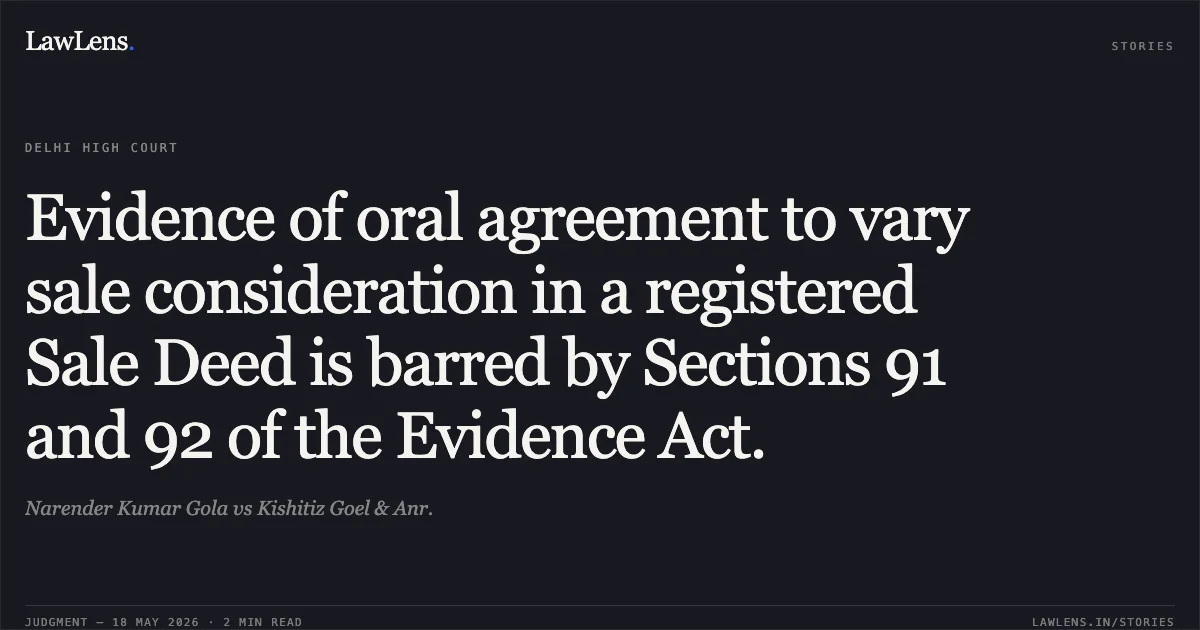
Source reference: p. 5-6, para 20Section 91 of the Indian Evidence Act, 1872, which prohibits evidence of the terms of a written contract other than the document itself, and Section 92, which excludes oral evidence that contradicts, varies, adds to, or subtracts from the terms of a proved written instrument
Source reference: p. 6, para 21-22Precedents including Om Prakash v. IOCL Officers Welfare Society and Jai Bhagwan v. Rajesh were cited to establish that once a registered deed records full payment, a recovery suit for "balance" consideration is legally barred
Source reference: p. 6, para 24-25Reasoning
The Court reasoned that the execution of the Sale Deed with a consideration of Rs. 66,12,000 superseded the earlier Agreement to Sell, amounting to a legal novation
Source reference: p. 6, para 20Under Sections 91 and 92 of the Evidence Act, the Appellant is strictly prohibited from leading any evidence to contradict the terms of the registered Sale Deed
Source reference: p. 6, para 23The Court observed that since the Sale Deed explicitly stated that the entire consideration of Rs. 66,12,000 had been paid, the Appellant’s claim that cheques were issued for a "hidden" balance of a higher amount was untenable
Source reference: p. 3, para 10Furthermore, the Court noted that the Appellant’s own admission of participating in cash transactions to avoid tax liability disentitled him from seeking judicial redress to enforce such illegal or underhand transactions
Source reference: p. 7, para 26Holding
oral evidence cannot be admitted to vary the terms of a registered Sale Deed regarding sale consideration
The final order confirmed that the suit was rightly rejected under Order VII Rule 11 as the claims were barred by the Indian Evidence Act and the principle of novation
Source reference: p. 7, para 26-27Acts & Sections Cited
5 provisions across 2 statutes referred to in this judgment. Each provision opens on LawLens.
Code of Civil Procedure, 19084
Indian Contract Act, 18721
Original Court PDF
Narender Kumar GolavsKishitiz Goel & Anr.
Click to open original judgment
Original judgment, available to read, download and summarize on LawLens.in