Facts
The plaintiff (appellant) entered into a notarized agreement to sell with the defendant (respondent) on 15.03.2011 for agricultural land in Ghogha
Source reference: p. 2The total consideration was ₹2,52,000/-, with ₹52,000/- paid as earnest money and a 180-day stipulated period for completion
Source reference: p. 2, 15The defendant cancelled the agreement via public notice on 30.11.2011, alleging breach of time limits
Source reference: p. 3, 10The plaintiff filed a suit for specific performance without seeking a declaration to set aside the cancellation
Source reference: p. 13, 23During the trial, the plaintiff did not testify; instead, her estranged ex-husband deposed as her Power of Attorney (POA) holder
Source reference: p. 11, 17Both the Trial Court and First Appellate Court dismissed the suit
Source reference: p. 4Issues
1. Whether the plaintiff proved "readiness and willingness" under Section 16(c) of the Specific Relief Act when she failed to personally step into the witness box
Source reference: p. 4, para. 3.22. Whether a Power of Attorney holder can depose on behalf of the principal regarding facts within the principal’s personal knowledge
Source reference: p. 5, para. 3.23. Whether a suit for specific performance is maintainable without seeking a declaration to set aside the unilateral cancellation of the agreement
Source reference: p. 13, para. 11Law Applied
Section 16(c) of the Specific Relief Act, 1963, which mandates that a plaintiff must aver and prove continuous readiness and willingness as a condition precedent for specific performance
Source reference: p. 11, 16Man Kaur v. Hartar Singh Sangha [(2010) 10 SCC 512] and Rajesh Kumar v. Anand Kumar [(2024) 13 SCC 80], establishing that a POA holder cannot depose for acts of which only the principal has personal knowledge, such as "readiness and willingness"
Source reference: p. 18, 22I.S. Sikandar v. K. Subramani [(2013) 15 SCC 27], which holds that a suit for specific performance of a cancelled agreement is not maintainable unless the termination is specifically challenged
Source reference: p. 13Reasoning
The High Court observed that readiness and willingness are matters of personal conduct and state of mind, requiring the plaintiff to subject herself to cross-examination
Source reference: p. 18, 22The POA holder, the plaintiff's ex-husband, lacked personal knowledge of the initial transaction and could not legally substitute for the plaintiff’s testimony
Source reference: p. 17, 19The court noted that the plaintiff failed to show any proactive steps taken within the 180-day period stipulated in the contract
Source reference: p. 16, 21Additionally, since the defendant had already cancelled the agreement via public notice, the plaintiff’s failure to seek a declaratory relief against said cancellation rendered the suit for specific performance legally untenable as the contract was non-existent at the time of filing
Source reference: p. 13, 23Holding
The High Court dismissed the Second Appeal, holding that no substantial question of law arose
The court affirmed the lower courts' findings that: (a) the plaintiff failed to prove continuous readiness and willingness; (b) the POA holder was incompetent to testify on personal matters of the principal; and (c) the suit was not maintainable without challenging the cancellation of the agreement
Source reference: p. 12, 16, 23The relief of specific performance, being discretionary, was rightly refused. Connected civil applications were also disposed of
Source reference: p. 21, 27Acts & Sections Cited
5 provisions across 2 statutes referred to in this judgment. Each provision opens on LawLens.
Code of Civil Procedure, 19083
Specific Relief Act, 19632
Original Court PDF
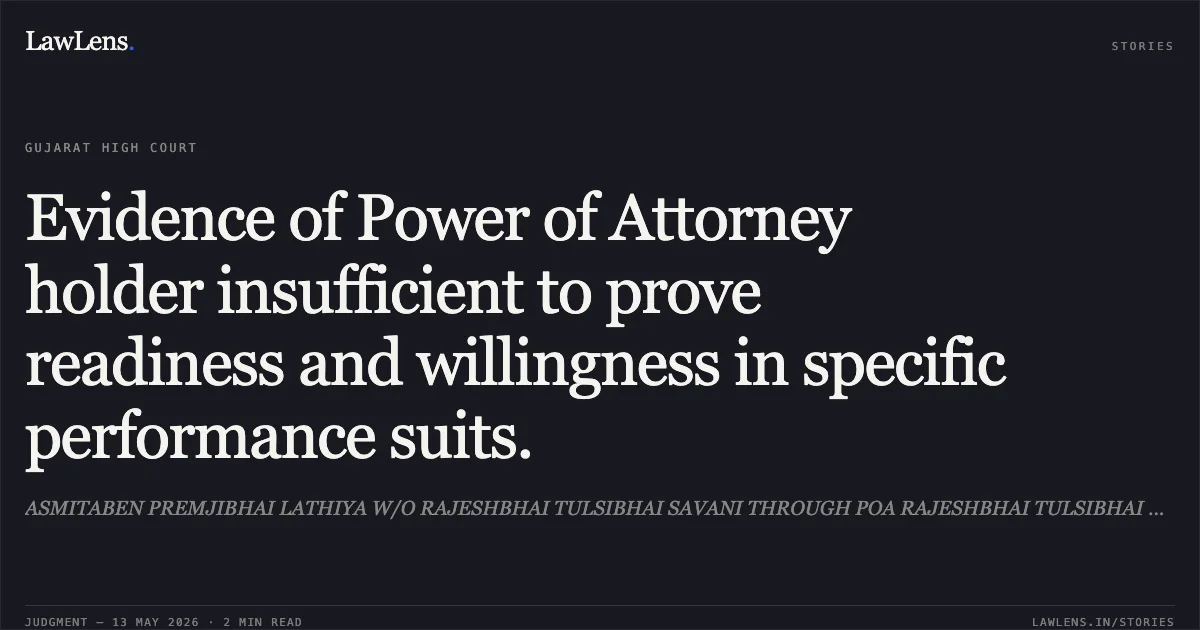
ASMITABEN PREMJIBHAI LATHIYA W/O RAJESHBHAI TULSIBHAI SAVANI THROUGH POA RAJESHBHAI TULSIBHAI SAVANIvsSANATKUMAR AMBHASHANKARBHAI BAHTT
Click to open original judgment
Original judgment, available to read, download and summarize on LawLens.in