Facts
On the night of December 26, 2003, approximately ten persons entered the house of the complainant (PW-1) in Village Thihai-para, assaulted family members, and looted cash and ornaments valued at ₹38,500.
Source reference: para. 4An FIR was registered under Section 395 IPC against unknown persons. The appellants were arrested in January 2004.
Source reference: para. 4A Test Identification Parade (TIP) was conducted nearly three months later in March 2004.
Source reference: para. 15The trial court convicted the appellants under Sections 457 (house-trespass) and 395 (dacoity) of the IPC, sentencing them to 10 years of rigorous imprisonment.
Source reference: para. 3Appellants No. 4 and 5 in CRA 216/2005 died during the pendency of the appeal, resulting in abatement of their cases.
Source reference: para. 2Issues
1. Whether the conviction of the appellants under Sections 457 and 395 of the IPC is sustainable based on the evidence of the Test Identification Parade (TIP) and Dock Identification.
Source reference: para. 112. Whether the recovery of looted items on the basis of memorandum statements under Section 27 of the Evidence Act was legally proved to fasten guilt.
Source reference: para. 24-25Law Applied
The court applied Section 391 (definition of dacoity) and Section 395 (punishment for dacoity) of the IPC.
Source reference: para. 12It relied on Section 9 of the Indian Evidence Act, 1872 regarding facts establishing identity and Section 162 of the Cr.P.C. regarding the inadmissibility of statements to police.
Source reference: para. 13; para. 22The court further applied Section 27 of the Evidence Act, which provides an exception to the ban on confessions in police custody, but only for information leading to the "discovery of fact".
Source reference: para. 27-28Precedents included Gireesan Nair v. State of Kerala on TIP safeguards and Raja Khan v. State of Chhattisgarh regarding the doctrine of confirmation by subsequent events under Section 27.
Source reference: para. 23; para. 25, 31Reasoning
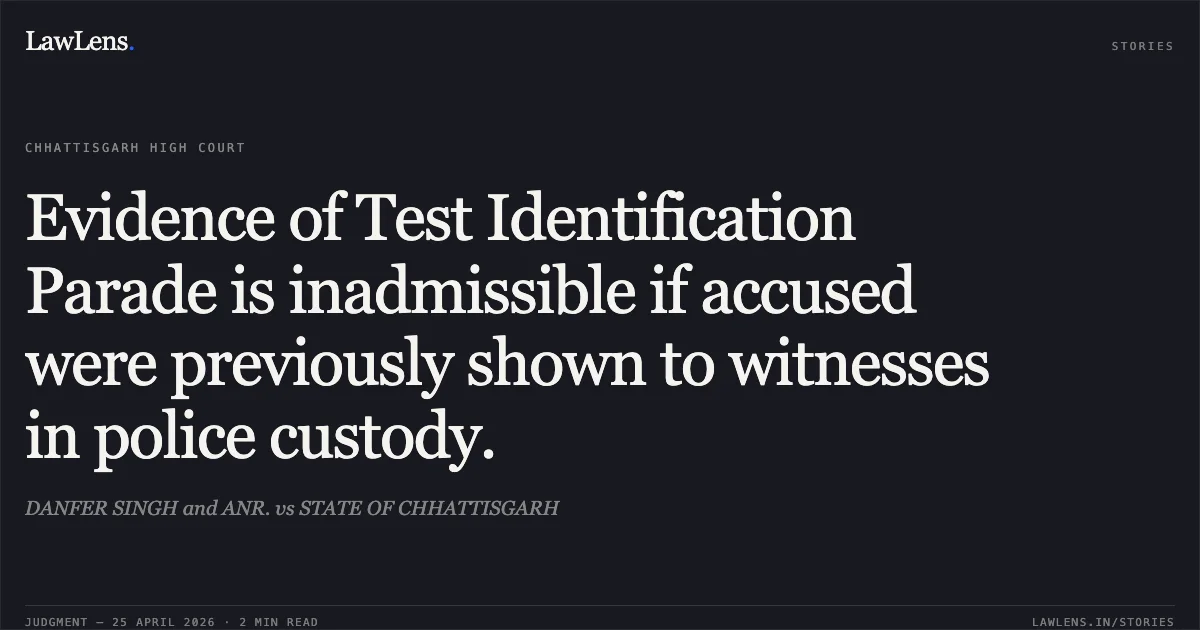
The court found the TIP evidence inadmissible because witnesses (PW-8 and PW-10) admitted to seeing the accused at the police station prior to the parade, rendering the identification inconsequential.
Source reference: para. 17, 20, 21The presence of police during the TIP violated Section 162 Cr.P.C.
Source reference: para. 22Regarding the recovery of items, the court observed that the sole seizure witness (PW-11) turned hostile, admitting he signed documents at the police station without witnessing the actual recoveries.
Source reference: para. 30-31The court noted that while Section 27 allows for the discovery of facts, the mere recovery of an object is insufficient if the link between the accused and the concealment is not proven by credible witnesses.
Source reference: para. 27, 32Since the prosecution failed to provide independent corroboration of the memorandum statements, the legal link between the appellants and the crime was broken.
Source reference: para. 32Holding
The court held that the TIP was vitiated by procedural lapses and the recovery of material was not proved beyond reasonable doubt due to the hostility of the seizure witnesses.
The High Court allowed the appeals and set aside the conviction and sentences. The appellants were acquitted of all charges under Sections 457 and 395 IPC, and their bail bonds were ordered to remain in force for six months under Section 437(6) of the Cr.P.C.
Source reference: para. 33; para. 34Acts & Sections Cited
4 provisions across 2 statutes referred to in this judgment. Each provision opens on LawLens.
Indian Penal Code, 18603
Bharatiya Nagarik Suraksha Sanhita, 20231
Original Court PDF
DANFER SINGH and ANR.vsSTATE OF CHHATTISGARH
Click to open original judgment
Original judgment, available to read, download and summarize on LawLens.in


