Facts
The petitioner (husband) filed a divorce suit against the respondent (wife) on 30.08.2023
Source reference: para 5During proceedings, the trial court decided an application for pendente lite maintenance under Section 24 of the Hindu Marriage Act (HMA) on 08.11.2024
Source reference: para 5Following this, the trial court erroneously fixed a trial program for evidence despite the fact that the wife had not yet filed her written statement and issues had not been framed
Source reference: para 6-7Upon realizing this procedural error on 09.01.2026, the trial court ordered that the respondent's written statement be taken on record, issues be framed, and previously recorded depositions of plaintiff witnesses be cancelled/expunged to allow for fresh evidence
Source reference: para 1, 9The husband challenged this order via Misc. Petition, arguing that the cancellation of evidence would cause delay and that framing of issues is a mere technicality
Source reference: para 1-3Issues
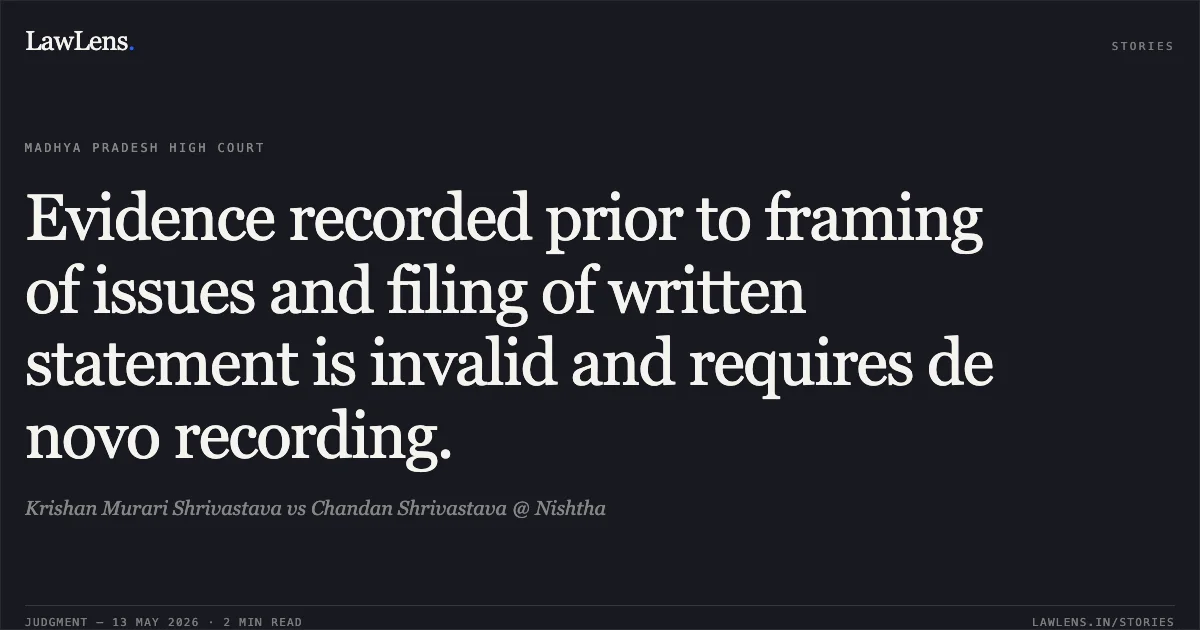
1. Whether the trial court was justified in cancelling the previously recorded evidence of the plaintiff because it was recorded prior to the filing of the written statement and framing of issues
Source reference: para 12. Whether the framing of issues and filing of a written statement are essential prerequisites to the recording of evidence in a matrimonial trial, or merely technicalities that can be overlooked
Source reference: para 3, 10Law Applied
The court examined the procedural requirements under the Hindu Marriage Act, 1955, and the Code of Civil Procedure (CPC).
Source reference: no citationIt applied the principle that a trial program cannot be fixed, nor can evidence be recorded, in the absence of a written statement and the subsequent framing of issues, as the scope of evidence is determined by the pleadings
Source reference: para 6-7The court further noted that while parties may proceed to trial without issues if they have "full knowledge of the disputes", fresh evidence is necessary once a written statement is introduced to ensure the plaintiff can address the specific defenses raised
Source reference: para 3, 10Reasoning
The High Court found that the trial court had acted under a "misconception" that a written statement was already on record when it initially fixed the trial dates
Source reference: para 7The High Court reasoned that because the defendant’s right to file a written statement had never been formally closed, the trial court was correct to accept the statement on 09.01.2026 to ensure a fair trial
Source reference: para 8-9Regarding the cancellation of evidence, the Court held that this was actually in the interest of the plaintiff; since the original evidence was recorded without knowledge of the wife's specific defenses, fresh evidence would allow the plaintiff to properly rebut those defenses
Source reference: para 10The Court dismissed the argument regarding delay, noting that only the husband's deposition had been recorded thus far, and re-recording it would not significantly impact the trial's progress
Source reference: para 11Holding
The Court held that there was no error in the trial court's order dated 09.01.2026. Taking the written statement on record and directing fresh evidence ensures that the trial proceeds on clear issues and allows both parties to address the specific contentions raised in the pleadings
The petition was dismissed
Source reference: para 12Acts & Sections Cited
1 provisions across 1 statute referred to in this judgment. Each provision opens on LawLens.
Hindu Marriage Act, 19551
Original Court PDF
Krishan Murari ShrivastavavsChandan Shrivastava @ Nishtha
Click to open original judgment
Original judgment, available to read, download and summarize on LawLens.in