Facts
The respondent-husband filed O.P. No. 329/2024 for divorce before the Family Court, North Paravur. The appellant-wife was set ex parte, and a decree of divorce was granted on 10/09/2024.
Source reference: p. 2The appellant subsequently filed I.A. No. 1/2025 to set aside the ex parte decree and I.A. No. 16/2025 to condone a 160-day delay, claiming she never received the summons and that her signature on the acknowledgment card was forged.
Source reference: p. 2Initially, the Family Court allowed her application, but on remand from the High Court (Mat. Appeal No. 816/2025), the trial court conducted a full evidentiary hearing.
Source reference: p. 2-3After examining the Postmaster (PW1), the Postman (PW2), and comparing signatures with other court records, the Family Court dismissed her applications, finding that notice had been duly served.
Source reference: p. 4Issues
1. Whether the Family Court erred in finding that the summons was personally served on the appellant, thereby justifying the dismissal of the application to set aside the ex parte decree.
Source reference: p. 42. Whether the respondent’s subsequent marriage after the appeal period impacts the consideration for condoning delay in matrimonial disputes.
Source reference: p. 5Law Applied
The court applied principles governing the setting aside of ex parte decrees under the Code of Civil Procedure and the Limitation Act.
Source reference: p. 5In matrimonial disputes, particularly dissolution of marriage, delay is "fatal" because parties may alter their status (re-marry) after the appeal period; "great care and caution" must be exercised when condoning delay after the appeal period expires to protect the rights of third parties.
Source reference: p. 5The court relied on the evidentiary value of official postal records and testimony of public officials under the Indian Evidence Act to verify service of notice.
Source reference: p. 3-4Reasoning
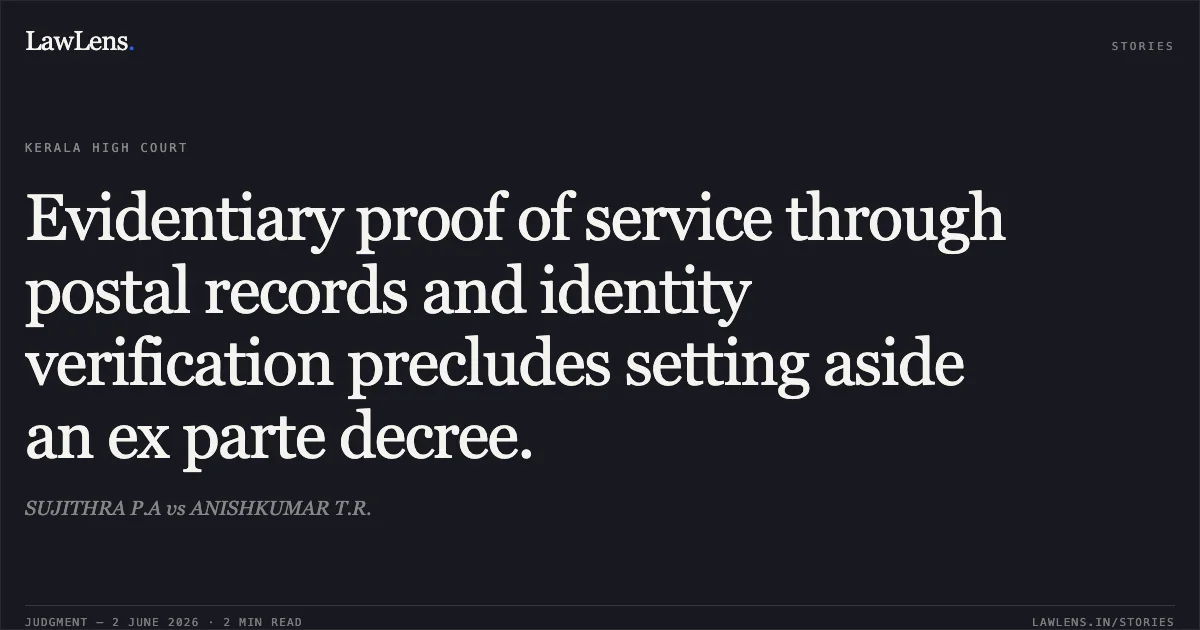
The Court analyzed the testimony of PW1 and PW2, noting that the Postman (PW2) specifically verified the appellant’s identity using her Aadhaar card before delivery, as she was not previously known to him; this Aadhaar number was recorded in the delivery manifest (Ext. X1).
Source reference: p. 3-4The Court found the Family Court’s comparison of the appellant's signature on the acknowledgment card with her admitted signatures in other vakalaths (Exts. B2 and B3) to be sound, concluding that the signatures were similar.
Source reference: p. 4The Court observed that the respondent had already remarried on 07/03/2025, after the appeal period had lapsed, and reasoned that because service was proved through "overwhelming evidence," there was no "illegality or perversity" in the lower court's refusal to reopen the case.
Source reference: p. 5Holding
The High Court answered both issues in the negative, holding that the Family Court correctly appreciated the evidence regarding the service of notice.
The Court affirmed that once the appeal period expires and a party remarries, the threshold for condoning delay is significantly higher. The Matrimonial Appeal was dismissed as devoid of merit.
Source reference: p. 5Acts & Sections Cited
3 provisions across 3 statutes referred to in this judgment. Each provision opens on LawLens.
Code of Civil Procedure, 19081
Limitation Act, 19631
Family Courts Act, 19841
Original Court PDF
SUJITHRA P.AvsANISHKUMAR T.R.
Click to open original judgment
Original judgment, available to read, download and summarize on LawLens.in