Facts
The plaintiff, a resident of Halol, fled his home during the 2002 communal riots. His residence and hotel, "Tandoor," were looted and set on fire by a mob, causing alleged damages of ₹12,00,000.
Source reference: p. 1-2An FIR was registered, and a survey was conducted by revenue officers (Talati-cum-Mantri), who assessed the damage significantly lower than the plaintiff’s claim. The plaintiff received ex-gratia compensation of ₹15,000 and ₹1,35,000.
Source reference: p. 2The trial court (Principal Senior Civil Judge, Panchmahal) partly allowed the plaintiff’s suit, awarding ₹4,00,000 with 9% interest, primarily on the grounds that the revenue report was unreliable because the Central Government had released additional relief.
Source reference: p. 1, 4The State appealed this judgment under Section 96 of the CPC.
Source reference: p. 1Issues
1. Whether the trial court erred in determining that the revenue official's survey report was false based solely on the disbursement of ex-gratia relief.
Source reference: p. 4 / para. 6.42. Whether there was sufficient legal evidence on record to assess the actual damages caused to the plaintiff.
Source reference: p. 5 / para. 6.43. Whether the judgment and decree granting ₹4,00,000 in compensation warrant interference by the High Court.
Source reference: p. 5 / para. 7Law Applied
The Court applied Section 96 of the Code of Civil Procedure, 1908, regarding appeals from original decrees.
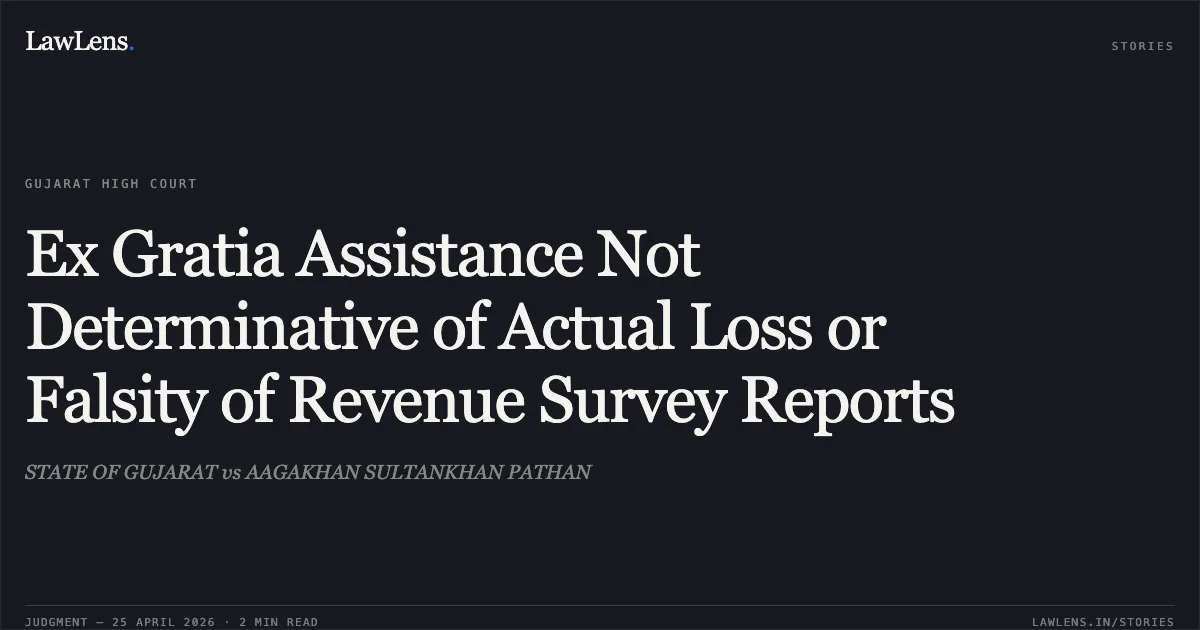
Source reference: p. 1It relied on the principle that "ex-gratia" payments are discretionary relief provided by the State or Central Government and do not constitute a specific, actual assessment of legal damages.
Source reference: p. 5The Court followed the precedent set by the Hon’ble Supreme Court in Civil Appeal No. 3249 of 2016 (and State of Gujarat v. Idgah, Himmatnagar), which accepted government schemes for ex-gratia assistance for riot victims and established the procedural framework for sufferers to approach concerned authorities.
Source reference: p. 5Reasoning
The High Court observed that the trial court’s finding—that the revenue report was "false" because higher ex-gratia amounts were paid—was logically flawed.
Source reference: p. 5The Court reasoned that ex-gratia payments are general relief measures and cannot be equated with a judicial or technical assessment of actual loss.
Source reference: p. 5The Court found that the trial court's decision was based on "surmises, conjunctures and presumption" rather than concrete evidence quantifying the actual damage.
Source reference: p. 5It held that the Civil Court essentially overstepped by sitting in judgment over the administrative assessments of Revenue Officers without a base of robust evidence to prove the ₹12,00,000 claim.
Source reference: p. 5Holding
The High Court allowed the appeal and quashed the judgment and decree of the trial court.
The Court held that the trial court failed to properly distinguish between ex-gratia relief and determined compensation. The matter was remanded to the Principal Senior Civil Judge, Panchmahal, for a fresh decision to be rendered within nine months. The State was directed to place records of the ex-gratia payments already made before the trial court for consideration during the fresh proceedings.
Source reference: p. 6Acts & Sections Cited
1 provisions across 1 statute referred to in this judgment. Each provision opens on LawLens.
Code of Civil Procedure, 19081
Original Court PDF
STATE OF GUJARATvsAAGAKHAN SULTANKHAN PATHAN
Click to open original judgment
Original judgment, available to read, download and summarize on LawLens.in