Facts
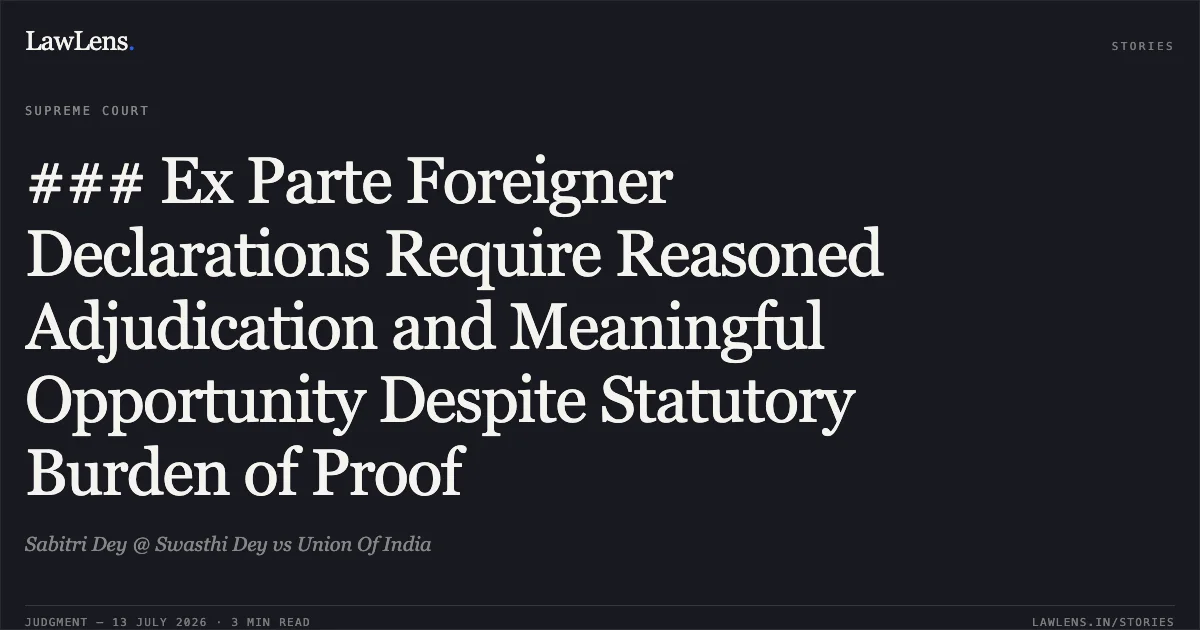
The Supreme Court heard a batch of appeals (both civil and criminal) arising from opinions rendered by Foreigners Tribunals (FT) in Assam, affirmed by the Gauhati High Court.
Source reference: para. 2In all instances, the appellants were declared foreigners in proceedings that were either ex parte or "effectively ex parte".
Source reference: para. 3Category one included persons who never appeared despite notice (e.g., Sabitri Dey, Ajbahar Ali).
Source reference: paras. 4.1, 4.2Category two involved cases where the High Court independently appreciated evidence for the first time while upholding ex parte orders.
Source reference: para. 5.2Category three included persons who appeared initially but defaulted during later stages.
Source reference: para. 5.3The appellants contended they were denied a meaningful opportunity to contest the reference.
Source reference: para. 3Issues
1. Whether a Foreigners Tribunal can mechanically declare a person a foreigner in ex parte proceedings without satisfying the minimum requirements of lawful and fair adjudication.
Source reference: para. 72. Whether the statutory burden of proof under Section 9 of the Foreigners Act, 1946, relieves the Tribunal of its obligation to conduct a reasoned inquiry and provide a meaningful opportunity for hearing.
Source reference: para. 12Law Applied
Section 9 of the Foreigners Act, 1946, which places the burden of proof on the proceedee to establish they are not a foreigner.
Source reference: para. 9Paragraph 3 of the Foreigners (Tribunals) Order, 1964, which mandates serving a copy of the "main grounds" of the allegation and providing a "reasonable opportunity" to produce evidence.
Source reference: paras. 10, 13Md. Rahim Ali v. State of Assam (2024 INSC 511), which held that Section 9 does not permit proceedings based on bare suspicion and does not exclude natural justice.
Source reference: paras. 17-18Articles 14 and 21 of the Constitution of India, affirming that the protection of life, liberty, and fair procedure extends to "any person" within India, including suspected foreigners, as established in Louis De Raedt v. Union of India and Maneka Gandhi v. Union of India.
Source reference: paras. 19-21, 23Reasoning
The Court reasoned that while Section 9 shifts the burden of proof, it does not replace the legal process with a mechanical declaration.
Source reference: para. 12A Tribunal remains a quasi-judicial body and must satisfy itself that notice was duly served and that the "main grounds" (not just formal accusations) were disclosed to the proceedee.
Source reference: paras. 13, 15Even in ex parte cases, Paragraph 3(16) of the 1964 Order requires a final order to contain a "concise statement of facts and the conclusion".
Source reference: para. 14, 32The Court found that the High Court erred in category two cases by acting as a first-instance forum for evidence appreciation, noting that evidentiary testing (ancestry, linkage documents) must happen at the Tribunal level.
Source reference: paras. 37-38For those who defaulted midway, the Court held that while they must be diligent, the Tribunal cannot dispense with the objective assessment of the State’s evidence and the question referred.
Source reference: paras. 42-43Holding
The Supreme Court set aside the impugned judgments of the High Court and the opinions of the Tribunals.
The Court held that the "serious consequence" of being declared a foreigner requires an adjudication that satisfies the constitutional mandate of fairness.
Source reference: para. 47The matters were remitted to the respective Foreigners Tribunals for fresh adjudication on merits, with directions to the appellants to appear within four weeks and a one-time opportunity to file written statements and evidence, without coercive steps being taken pending the fresh opinions.
Source reference: paras. 49, 50, 53, 54Acts & Sections Cited
5 provisions across 4 statutes referred to in this judgment. Linked provisions open on LawLens.
Foreigners Act, 19462
Foreigners (Tribunals) Order, 19641
Indian Evidence Act, 18721
Illegal Migrants (Determination By Tribunals) Act, 19831
Original Court PDF
Sabitri Dey @ Swasthi DeyvsUnion Of India
Click to open original judgment
Original judgment, available to read, download and summarize on LawLens.in