Facts
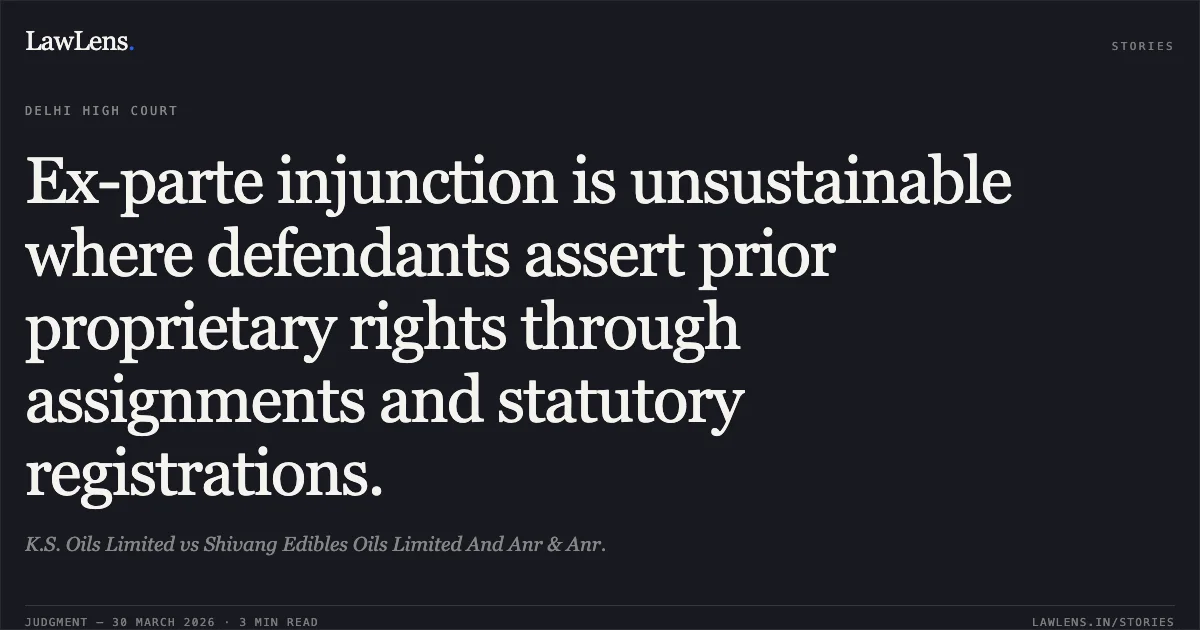
The Appellant challenged an ex-parte ad-interim injunction order dated 04.02.2026, which restrained it from using the trademark ‘KALASH’ and associated labels for edible oils
Source reference: p. 2The Respondent (Plaintiff) claimed exclusive rights via an assignment deed dated 01.01.2026 from a former director of the Appellant, Sh. Gopal Das Garg, alleging continuous use since 1974 and asserting a case of passing off
Source reference: p. 3Conversely, the Appellant (Defendant) asserted proprietary rights based on assignment deeds from 1986 and 1996, registered trademarks from 1978 and 2009, and copyright registrations from 2009
Source reference: p. 4, 8The Appellant had undergone a Corporate Insolvency Resolution Process (CIRP) from 2017 to 2025, during which the company was sold as a going concern, including its intellectual property
Source reference: p. 4, 9The Respondent alleged the Appellant abandoned the mark due to non-use and non-renewal during the CIRP
Source reference: p. 6, 10Issues
1. Whether the Trial Court was justified in granting an ex-parte ad-interim injunction without issuing notice to the Appellant, considering the competing claims of proprietary rights
Source reference: p. 13/para. 232. Whether the non-renewal of trademark registrations during a CIRP period constitutes abandonment or is protected by "special circumstances" under the Trade Marks Act
Source reference: p. 15/para. 263. Whether an appeal against an ex-parte ad-interim injunction is maintainable under Order XLIII Rule 1(r) of the CPC
Source reference: p. 23/para. 37-38Law Applied
The Court applied the principles of "passing off" and the "trinity test" (goodwill, misrepresentation, and damage)
Source reference: p. 5It referenced Section 47(3) of the Trade Marks Act, 1999, regarding "special circumstances" (such as insolvency proceedings) excusing the non-use of a trademark
Source reference: p. 15It relied on Section 48 of the Act regarding the "permissive use" of marks through licensees
Source reference: p. 8Regarding procedural law, the Court applied Order XXXIX Rules 1 and 2 of the CPC for injunctions and upheld the maintainability of the appeal based on Rajesh Batra v. M/s Grandlay Electricals (India), which affirms that an appeal lies against an ex-parte ad-interim injunction under Order XLIII Rule 1(r)
Source reference: p. 23Reasoning
The High Court found the Trial Court’s grant of an ex-parte injunction legally flawed because it failed to consider the Appellant’s deep-rooted statutory and proprietary history.
Source reference: p. 9, 14, 17Specifically, the Trial Court overlooked the 1996 assignment deed duly recorded in the Trade Marks Registry and the fact that a Coordinate Bench had previously declared the ‘KALASH’ mark as "well-known" in 2012
Source reference: p. 9, 14, 17The Court noted that the Respondent's assignor (Garg) had his own trademark applications rejected by the Registrar in 2024 and 2025, a material fact suppressed or ignored
Source reference: p. 10, 20Furthermore, the Appellant’s non-use during 2017–2025 was explained by the CIRP, which constitutes "special circumstances" under Section 47(3), rather than intentional abandonment
Source reference: p. 15Since the Appellant resumed production in October 2025 and the Respondent sued only in February 2026, the three-month delay negated the "extreme urgency" required for ex-parte relief
Source reference: p. 20, 21The Court reasoned that where both parties claim derivative rights from a common predecessor, a short-date notice was mandatory to evaluate the "balance of convenience"
Source reference: p. 21Holding
The High Court set aside the ex-parte ad-interim injunction order dated 04.02.2026
It held that the Trial Court failed to establish a prima facie case by ignoring the Appellant’s prior registrations, copyright, and the legal effect of the CIRP sale
Source reference: p. 21The Court recalled the orders for the seizure of the Appellant's goods and allowed their sale, provided the Appellant maintains audited monthly accounts
Source reference: p. 22The matter was remanded to the Trial Court to decide the injunction application afresh within one month after hearing both parties
Source reference: p. 22, 24The appeal was disposed of with directions for an expedited pleading schedule
Source reference: p. 22Acts & Sections Cited
6 provisions across 3 statutes referred to in this judgment. Each provision opens on LawLens.
Trade Marks Act, 19993
Code of Civil Procedure, 19082
Commercial Courts Act, 20151
Original Court PDF
K.S. Oils LimitedvsShivang Edibles Oils Limited And Anr & Anr.
Click to open original judgment
Original judgment, available to read, download and summarize on LawLens.in