Facts
The Appellant was convicted by the Special Judge (POCSO Act), Datia, for the kidnapping, rape, and murder of a nine-year-old girl. The Trial Court imposed multiple sentences, including the death penalty under Section 302 of the IPC and Section 5(L)/6 of the POCSO Act
Source reference: p. 2The prosecution's case rested on the recovery of the victim's body in a field and testimony from a cousin who claimed the Appellant led the victim away shortly before her disappearance
Source reference: p. 3-4During the appellate proceedings, it was discovered that a vital witness, the Investigating Officer (PW-20), had been examined and cross-examined while the Appellant was in jail and not physically present in court or connected via video conferencing
Source reference: p. 14-15The High Court heard the statutory death sentence reference alongside the Appellant's criminal appeal
Source reference: p. 2Issues
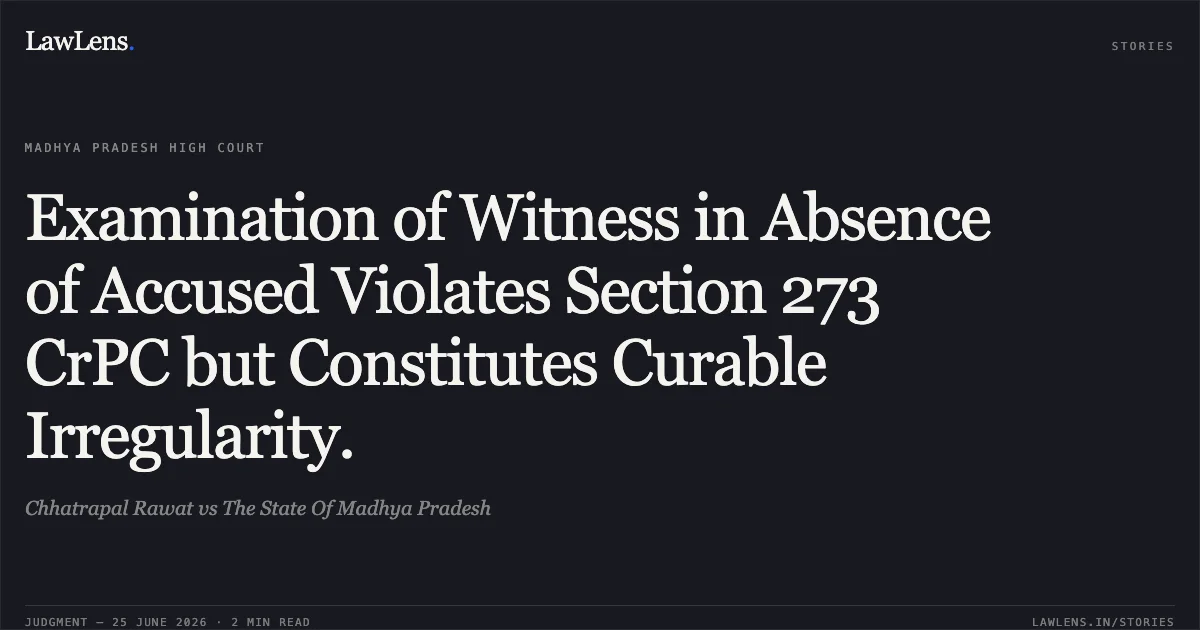
1. Whether the examination of a material witness in the absence of the accused violates the mandatory requirements of Section 273 of the CrPC
Source reference: p. 13-142. Whether such a procedural lapse necessitates an acquittal or if it is a curable irregularity under the law
Source reference: p. 16Law Applied
The court primarily applied Section 273 of the CrPC, which mandates that all evidence must be taken in the presence of the accused except where expressly exempted
Source reference: p. 14It further relied on Section 461 and Chapter XXXV of the CrPC regarding irregular proceedings and the "harmless error" doctrine
Source reference: p. 8The court heavily cited the precedent of Atma Ram v. State of Rajasthan (2019), which establishes that while the right of an accused to watch prosecution witnesses is valuable, an infringement of Section 273 is a curable defect rather than an automatic ground for acquittal, provided no inherent prejudice is left unaddressed
Source reference: p. 6-10Reasoning
The High Court observed that the Trial Court recorded the evidence of the Investigating Officer (PW-20) on two consecutive days without the Appellant being produced from jail
Source reference: p. 15The court noted that there was no application under Section 317 of the CrPC to dispense with the Appellant's attendance, nor was there any record of the Appellant disrupting proceedings or providing consent for the examination to proceed in his absence
Source reference: p. 14-15The court reasoned that the Investigating Officer's testimony is a critical component of the trial, and conducting it in the Appellant's absence caused significant procedural prejudice
Source reference: p. 16However, following the Atma Ram framework, the court determined that the trial was not fully vitiated; instead, the error could be rectified by a limited remand to re-examine the specific witness in the presence of the accused to ensure the "salutary principle" of Section 273 is upheld
Source reference: p. 16-17Holding
The High Court set aside the judgment and sentence dated 05.12.2022 and remanded the matter to the Trial Court
The High Court directed the Trial Court to re-examine PW-20 afresh in the personal presence of the Appellant. The court ordered that this process, including a supplementary statement under Section 313 of the CrPC and final arguments, must be completed within a strict timeline, with a new judgment to be pronounced on or before August 19, 2026
Source reference: p. 17-18Acts & Sections Cited
41 provisions across 3 statutes referred to in this judgment. Each provision opens on LawLens.
Indian Penal Code, 18604
Code of Criminal Procedure, 1973
Original Court PDF
Chhatrapal RawatvsThe State Of Madhya Pradesh
Click to open original judgment
Original judgment, available to read, download and summarize on LawLens.in