Facts
The petitioner was appointed as a Copyist in 2007 and was later promoted as Head Clerk.
Source reference: no citationFollowing an Internal Audit Wing objection to her pay fixation, the second respondent ordered recovery of the alleged excess payment.
Source reference: p. 2, para. 2The petitioner challenged that order under Article 226 of the Constitution, seeking to prevent recovery from her salary.
Source reference: p. 1The respondents did not establish that the petitioner had misrepresented any facts in connection with the pay fixation.
Source reference: p. 3, para. 4Issues
1. Whether the respondents could revise the petitioner’s pay fixation following an audit objection.
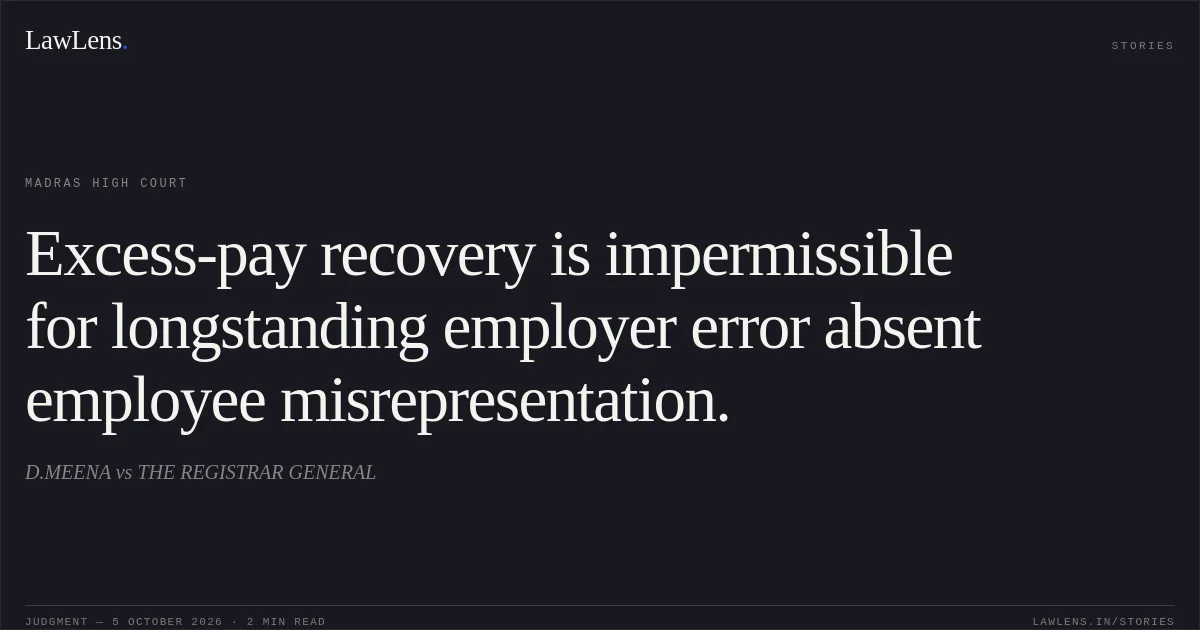
Source reference: p. 2, para. 3; p. 4, para. 62. Whether recovery of the excess salary was permissible where the error was attributable to the establishment, the petitioner had not misrepresented facts, and recovery after a long period would cause hardship.
Source reference: p. 3, para. 4; p. 4, paras. 5–6Law Applied
Under Article 226 of the Constitution, the High Court may review the legality of an administrative recovery order.
Source reference: no citationThe Court relied on State of Punjab v. Rafiq Masih, (2015) 4 SCC 334, which identifies circumstances in which recovery of mistaken excess payments may be impermissible, including recovery for payments made over a period exceeding five years and cases where recovery would be iniquitous, harsh, or arbitrary and outweigh the employer’s equitable right to recover.
Source reference: p. 3, para. 5The Court also recognised that authorities may correct an erroneous pay fixation and grant the pay properly due under the applicable rules and government orders, while distinguishing that power from recovery of past excess payments.
Source reference: p. 2, para. 3; p. 4, para. 6Reasoning
The Court found that the pay-fixation error was committed by the establishment and that the respondents had not shown any misrepresentation by the petitioner.
Source reference: p. 3, para. 4Given the lapse of many years and the hardship that recovery would cause, it held that recovery was impermissible under the principles in Rafiq Masih.
Source reference: pp. 3–4, paras. 4–6The Court nevertheless confirmed that any pay revision made in accordance with the applicable rules and government orders could stand.
Source reference: p. 4, para. 6Holding
The Court partly allowed the writ petition and set aside the recovery order dated 24 August 2026.
Any amount already recovered from the petitioner was directed to be repaid within 12 weeks of receipt of a copy of the order.
Source reference: p. 4, paras. 6–7The pay revision, if made pursuant to the audit objection, was left undisturbed.
Source reference: p. 4, paras. 6–7Original Court PDF
D.MEENAvsTHE REGISTRAR GENERAL
Click to open original judgment
Original judgment, available to read, download and summarize on LawLens.in