Facts
Pawan Kumar was appointed as a Fitter (Semi Skilled) on probation for two years, with provision for extension and consideration of confirmation only upon satisfactory completion of probation.
Source reference: para. 2Following assessments of unsatisfactory performance and substantial absence, his probation was extended on three occasions; he received warnings and was ultimately issued a show-cause notice, to which he replied.
Source reference: para. 3The appointing authority terminated his services on 30 May 2015, concluding that his probation could not be treated as satisfactorily completed.
Source reference: paras. 3, 15The Central Administrative Tribunal dismissed his challenge to the termination. Kumar then petitioned the High Court under Article 227, alleging, among other things, that the termination was stigmatic and punitive, that he had been denied a regular inquiry and relevant reports, and that his absences were covered by sanctioned or regularised leave.
Source reference: paras. 1, 4–7Issues
1. Whether the Tribunal’s decision upholding termination of Kumar’s probationary employment disclosed an error warranting interference under Article 227
Source reference: paras. 9–10, 222. Whether the termination was punitive or stigmatic in substance, such that a regular departmental inquiry was required
Source reference: paras. 14–193. Whether the petitioner was denied natural justice, or whether sanctioned or regularised leave prevented his absences from being considered in assessing his suitability for confirmation
Source reference: paras. 20–214. Whether the petitioner was deemed confirmed because of the manner or timing of the extensions of his probation
Source reference: paras. 11–13Law Applied
Article 227 confers supervisory, not appellate, jurisdiction; interference is warranted for jurisdictional error, patent error of law, perversity, or a natural-justice violation causing failure of justice, not merely because another view is possible.
Source reference: paras. 9–10Under Kedar Nath Bahl v. State of Punjab, expiry of a specified probation period does not itself result in automatic confirmation unless the appointment terms or applicable service rules so provide.
Source reference: para. 11Under Krishnadevaraya Education Trust v. L.A. Balakrishna, an employer may terminate a probationer found unsuitable; an order based on unsatisfactory suitability is not necessarily punitive merely because the employer gives reasons.
Source reference: para. 14A probationer’s overall regularity and dependability may be considered in assessing suitability even where leave has been sanctioned or regularised; a disciplinary inquiry is required where the termination is founded on proved misconduct as punishment, rather than an assessment of suitability.
Source reference: paras. 18, 21Reasoning
The appointment terms provided for possible extension of probation and did not provide for automatic confirmation; no confirmation order or applicable rule establishing deemed confirmation was identified.
Source reference: paras. 11–13The High Court read the termination order as an assessment that Kumar remained unsuitable after repeated extensions, warnings, and substantial absences—not as a finding of guilt or imposition of a penalty.
Source reference: paras. 15–19The references to workplace incidents were treated as part of the suitability assessment, while persistent absence independently supported the decision.
Source reference: paras. 15–19The unresolved Rule 14 disciplinary proceeding neither exonerated Kumar nor formed the basis of the termination.
Source reference: para. 17The show-cause notice and consideration of Kumar’s reply afforded an opportunity to respond; the Court found no demonstrated prejudice from non-supply of the Head of Section reports.
Source reference: para. 20Sanction or regularisation of leave did not preclude consideration of the extent of absence when assessing suitability.
Source reference: para. 21The Tribunal’s decision therefore disclosed no ground for supervisory interference.
Source reference: para. 22Holding
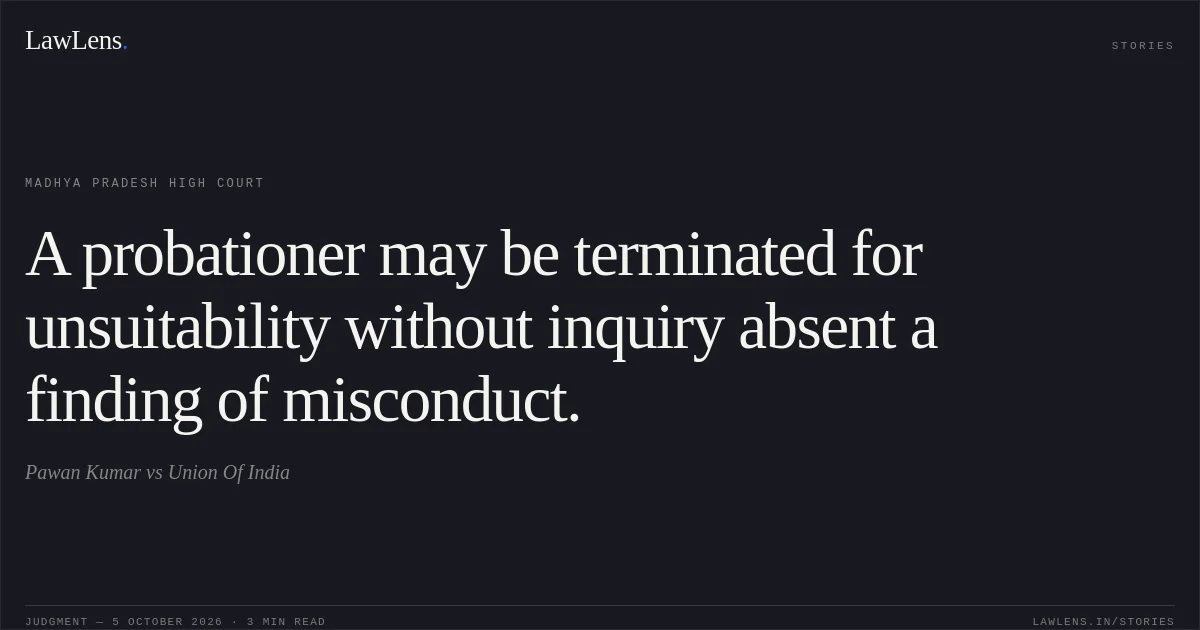
The High Court held that the petitioner remained a probationer, that his termination was an assessment of unsuitability rather than a punitive order requiring a departmental inquiry, and that no qualifying error in the Tribunal’s decision was established.
The Tribunal’s order was affirmed, the miscellaneous petition was dismissed, and there was no order as to costs.
Source reference: paras. 22–23Original Court PDF
Pawan KumarvsUnion Of India
Click to open original judgment
Original judgment, available to read, download and summarize on LawLens.in