Facts
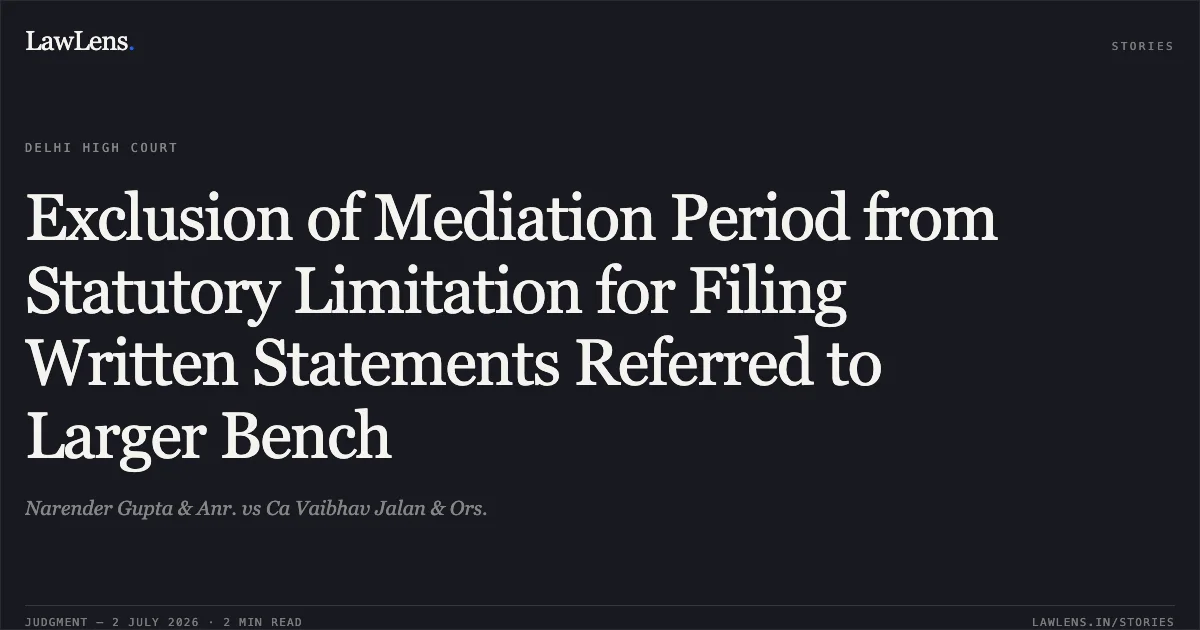
The Defendants challenged an order dated 03.09.2024 passed by the Joint Registrar, which closed their right to file a written statement for exceeding the time limit stipulated under Chapter VII of the Delhi High Court (Original Side) Rules, 2018.
Source reference: p. 1-2Summons were served on 08.12.2023, but the complete paper-book was provided only on 16.02.2024, by which time the parties had already been referred to the Delhi High Court Mediation Centre.
Source reference: p. 2Mediation ultimately failed on 27.05.2024.
Source reference: p. 2The Defendants argued that the time spent in mediation should be excluded when calculating the limitation period for filing the written statement.
Source reference: p. 2-3Issues
1. Whether the period spent in mediation by the parties can be excluded from the time specified under Chapter VII of the Delhi High Court (Original Side) Rules, 2018 for filing the written statement/replication.
Source reference: p. 3 / para. 32. Whether the mandatory nature of the 120-day outer limit for filing a written statement precludes any exclusion of time spent in mediation.
Source reference: p. 21 / para. 15Law Applied
Chapter VII, Rules 2(i) and 4 of the Delhi High Court (Original Side) Rules, 2018, which prescribe a 30-day period for filing a written statement, extendable by 90 days (total 120 days), after which the right is extinguished.
Source reference: p. 3The court noted the strict interpretation in Ram Sarup Lugani v. Nirmal Lugani, holding these timelines mandatory.
Source reference: p. 3The court contrasted the restrictive view in Amit Tara v. Deepak Tara and Harjyot Singh v. Manpreet Kaur—which state mediation does not halt the clock—against the liberal view in Bharat Singh v. Karan Singh and Sangeeta Rai Sandhu v. Charanjit Sandhu, which hold that time spent in mediation should be excluded.
Source reference: p. 4-20Section 89 of the CPC and the principles in Vikram Bakshi v. Sonia Khosla regarding non-adversarial settlement environments.
Source reference: p. 20-21Reasoning
The Court observed a sharp "divergence of judicial opinions" within the Delhi High Court regarding the calculation of limitation during mediation.
Source reference: p. 20One line of authority (e.g., Harjyot Singh) mandates that even if settlement talks are a "sufficient cause" for condonation, they cannot extend the 120-day hard limit.
Source reference: p. 4-5A more recent line of authority (e.g., Sangeeta Rai Sandhu) suggests that because mediation is a non-adversarial process encouraged by Section 89 of the CPC, the time spent therein should be entirely excluded (not just condoned) to prevent parties from being forced into adversarial filings while trying to settle.
Source reference: p. 20-21Justice Prasad noted that compelling adversarial filings during mediation "swims against the tide" of the national policy for "Vivad Mukt Bharat".
Source reference: p. 21Holding
The Court determined that an authoritative pronouncement was required to reconcile the conflicting Bench decisions and provide clarity to Joint Registrars.
Under the powers of the Single Judge, the matter was referred to the Hon’ble Chief Justice to constitute a larger Bench (of two or three Judges) to definitively answer whether the time spent in mediation ought to be excluded while computing the limitation period for filing written statements/replications under the 2018 Rules.
Source reference: p. 21-22Acts & Sections Cited
3 provisions across 3 statutes referred to in this judgment. Each provision opens on LawLens.
Code of Civil Procedure, 19081
Arbitration and Conciliation Act, 19961
Legal Services Authorities Act, 19871
Original Court PDF
Narender Gupta & Anr.vsCa Vaibhav Jalan & Ors.
Click to open original judgment
Original judgment, available to read, download and summarize on LawLens.in