Facts
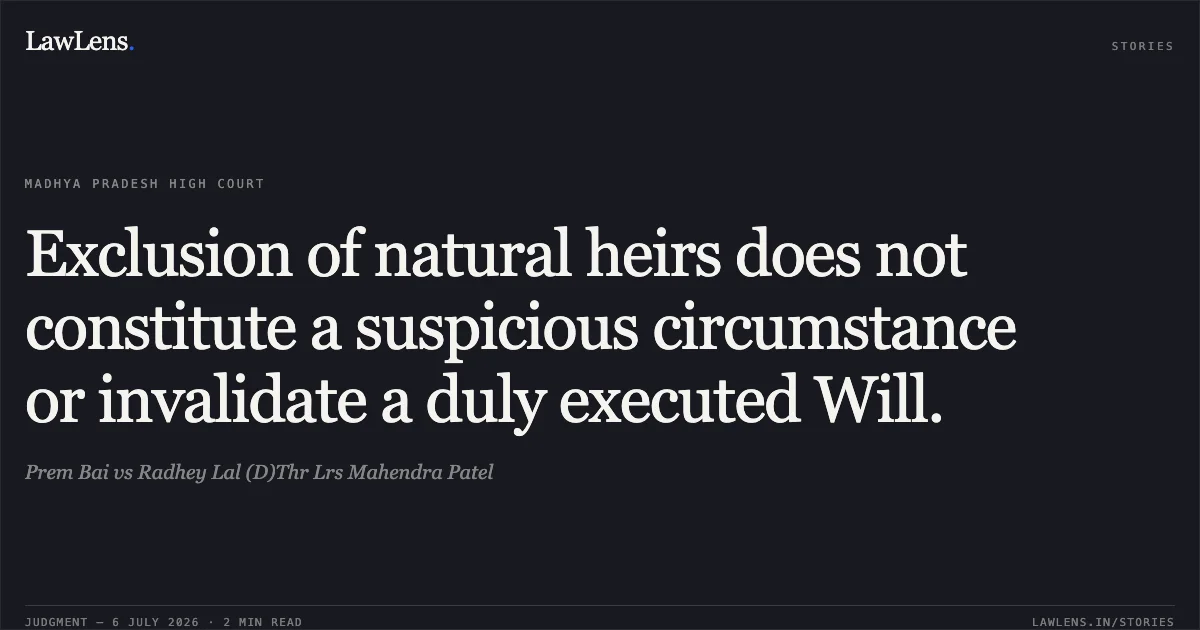
The appellants (six daughters of the deceased, Sunderlal Patel) challenged a judgment dated 01-03-2013, which dismissed their suit for a declaration that a registered will dated 17-05-1995 was forged and void.
Source reference: para. 1-2The testator, Sunderlal, bequeathed his share of agricultural lands, houses, and tractors to his brother (defendant No. 1), citing that his daughters were married and settled, and his brother was providing him care.
Source reference: para. 6The appellants argued that excluding natural heirs constituted a suspicious circumstance and sought to introduce a later document dated 15-05-1997 as the "last will" via an application under Order 41 Rule 27 CPC.
Source reference: para. 3Issues
1. Whether the exclusion of natural heirs (daughters) in favor of a brother constitutes a "suspicious circumstance" sufficient to invalidate a registered will.
Source reference: para. 3, 72. Whether a document written on a letterhead lacking attesting witnesses can be proved as a subsequent will under the Indian Succession Act.
Source reference: para. 123. Whether the propounder successfully discharged the burden of proving the execution of the will under Section 68 of the Evidence Act.
Source reference: para. 11, 13Law Applied
The court primarily applied Section 63 of the Indian Succession Act, 1925, and Section 68 of the Indian Evidence Act, 1872, regarding the mandatory requirement of attesting witnesses to prove a will.
Source reference: para. 11-12It relied on the Supreme Court precedent in Parvathi Nairthi v. Laxmi Nairthy (2026), which established that mere deprivation of natural heirs is not a suspicious circumstance as the purpose of a will is to interfere with normal succession.
Source reference: para. 7It further cited Pentakota Satyanarayana v. Pentakota Seetharatnam (2005) regarding the shifting of the burden of proof from the propounder to the party alleging undue influence.
Source reference: para. 13Reasoning
The court found that the will (Ex. D/1) was a registered document and its execution was duly proved through the testimonies of two attesting witnesses, Shyamlal (PW-1) and Achchhelal (PW-3), who confirmed the testator signed in their presence.
Source reference: para. 9-11Regarding the "suspicious circumstances," the court reasoned that the testator provided explicit justifications in the will—namely, that his daughters were settled and he was residing with his brother.
Source reference: para. 6Applying the Parvathi Nairthi doctrine, the court held that any person executing a will intends to deviate from natural succession; thus, exclusion alone cannot vitiate the document.
Source reference: para. 8Finally, the court rejected the appellants' 1997 document because it lacked signatures of attesting witnesses, making it legally impossible to prove as a will under Section 63 of the Indian Succession Act.
Source reference: para. 12Holding
The High Court answered the issues in the negative, holding that the will was genuine and the suspicious circumstances alleged were legally untenable.
The court dismissed the application for additional evidence and the appeal, affirming the trial court's decree.
Source reference: para. 12, 15The suit filed by the daughters for partition and declaration was dismissed.
Source reference: para. 1Acts & Sections Cited
2 provisions across 2 statutes referred to in this judgment. Each provision opens on LawLens.
Code of Civil Procedure, 19081
Indian Succession Act, 19251
Original Court PDF
Prem BaivsRadhey Lal (D)Thr Lrs Mahendra Patel
Click to open original judgment
Original judgment, available to read, download and summarize on LawLens.in