Facts
The petitioners, holders of mining leases for iron ore acquired through auctions post-2015, challenged the constitutional validity of the Explanations to Rule 38 of the Minerals (Other than Atomic and Hydro Carbons Energy Minerals) Concession Rules, 2016, and Rule 45(8)(a) of the Mineral Conservation and Development Rules, 2017
Source reference: p.2, para. 1These rules define "sale value" (used to calculate the Average Sale Price (ASP) for royalty purposes) to include payments made toward Royalty, District Mineral Foundation (DMF), and National Mineral Exploration Trust (NMET)
Source reference: p.3, para. 1The petitioners argued this creates a "cascading effect" where they pay royalty on royalty
Source reference: p.23, para. 30An earlier round of litigation (Writ Petition (C) No. 715 of 2024) noted that the Government was considering amending these rules to remove the "anomaly," but the Union ultimately decided against amendment to prevent significant revenue loss to States
Source reference: p.8, para. 9The petitioners re-approached the Court following the Union’s final decision
Source reference: p.9, para. 11Issues
1. Whether the Explanations to Rule 38 of the 2016 Rules and Rule 45(8)(a) of the 2017 Rules are ultra vires Section 9 of the MMDR Act and violative of Articles 14 and 19(1)(g) of the Constitution for including royalty, DMF, and NMET in the "sale value" used to compute royalty?
Source reference: p.43, para. 55Law Applied
the principle that there is a presumption of constitutionality for both plenary and subordinate legislation State of Tamil Nadu v. P. Krishnamurthy
Source reference: p.46, para. 62distinction between the "nature of a tax" (the subject matter) and the "measure of a tax" (the yardstick used for assessment), holding that the legislature possesses broad discretion to design the measure Mineral Area Development Authority v. SAIL and Union of India v. Bombay Tyre International Ltd.
Source reference: p.53-57, paras. 72-75doctrine that legislative entries under the Seventh Schedule must be liberally construed to include all subsidiary and ancillary matters, such as enactments to prevent tax evasion Sardar Baldev Singh v. CIT and Union of India v. A. Sanyasi Rao
Source reference: p.60-70, paras. 79-84Reasoning
"royalty" under Section 9 of the MMDR Act is a contractual consideration, and the Central Government has the power to prescribe the method of its computation under Entry 54, List I
Source reference: p.50, para. 66While the petitioners claimed the "cascading effect" was an anomaly, the Union successfully demonstrated that the inclusion of royalty, DMF, and NMET in the "sale value" was a deliberate regulatory measure to counter price manipulation
Source reference: p.73-75, paras. 87-91The Union provided data showing that iron ore miners often under-reported ex-mine prices or manipulated despatch quantities to depress the ASP
Source reference: p.35-39, para. 50The court found that using a "gross" sale value as the measure for royalty—even if it includes tax components—is a valid legislative choice to check evasion and ensure a fair value for the mineral
Source reference: p.71-75, paras. 85-92The court rejected the comparison with coal, noting that coal pricing is based on a transparent National Coal Index, whereas iron ore ASP depends on miner-submitted data, thus justifying different regulatory treatments
Source reference: p.76, para. 95Holding
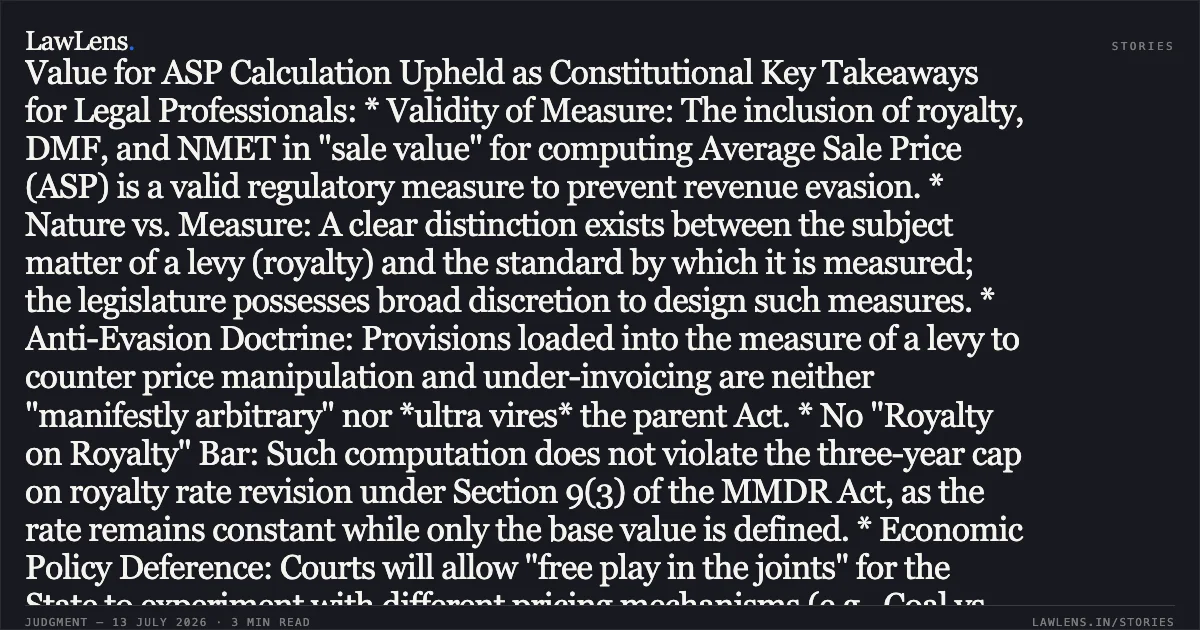
The Court dismissed the writ petition, holding that the impugned Explanations are constitutional and valid
The rules are not ultra vires Section 9 of the MMDR Act because the legislature has the power to define the measure of a levy to prevent evasion
Source reference: p.81, para. 103There is no violation of Article 14 as coal and iron ore are not "equals" in their pricing mechanisms
Source reference: p.76, para. 95There is no violation of Article 19(1)(g) as the restriction is a reasonable regulatory measure in the interest of public revenue
Source reference: p.78-79, para. 97The Court clarified that the three-year cap in Section 9(3) applies only to the rate of royalty, not to changes in the mathematical measure/ASP resulting from market data
Source reference: p.81, para. 101Acts & Sections Cited
8 provisions across 1 statute referred to in this judgment. Each provision opens on LawLens.
Mines and Minerals (Development and Regulation) Act, 19578
Original Court PDF
Kirloskar Ferrous Industries LimitedvsUnion Of India
Click to open original judgment
Original judgment, available to read, download and summarize on LawLens.in


