Facts
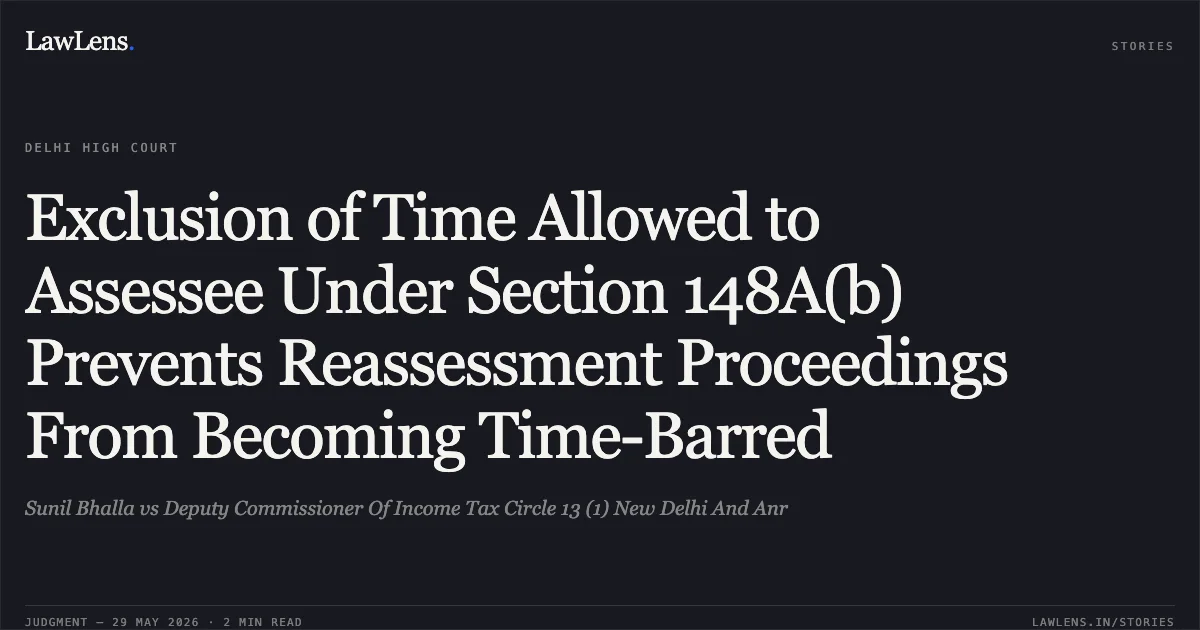
The Petitioner challenged an order passed under Section 148A(d) and a consequential notice issued under Section 148 of the Income Tax Act, 1961, dated 16.04.2024
Source reference: p. 1The Revenue had issued a show-cause notice under Section 148A(b) on 28.03.2024, providing time until 08.04.2024 for a reply
Source reference: p. 2The Petitioner sought adjournments on 05.04.2024 and 15.04.2024
Source reference: p. 2The Assessing Officer (AO) refused the second adjournment request on 15.04.2024 and proceeded to issue the impugned order and notice on 16.04.2024
Source reference: p. 4The Petitioner contended that the proceedings were barred by limitation as the initial notice period extended beyond 31.03.2024
Source reference: p. 2Issues
1. Whether the reassessment proceedings initiated via notice under Section 148 were barred by limitation under Section 149 of the Income Tax Act, 1961
Source reference: p. 12. Whether the time granted to an assessee to respond to a Section 148A(b) notice, including periods of adjournment, is to be excluded while computing the limitation period
Source reference: p. 2-3Law Applied
The court applied Section 149 of the Income Tax Act, 1961, specifically focusing on the fifth and sixth provisos to Section 149
Source reference: p. 2The fifth proviso stipulates that the time or extended time allowed to an assessee to provide an explanation under Section 148A(b) shall be excluded when computing the limitation period
Source reference: p. 3The sixth proviso further clarifies that if, after excluding such time, the remaining limitation period available to the AO is less than seven days, the limitation period shall be extended to seven days
Source reference: p. 3Reasoning
The Court relied on its concurrent judgment in Shailendra Nath Rai v. ACIT, holding that any interpretation suggesting that notices issued after March 1st are invalid due to reply periods extending beyond March 31st would frustrate the statutory purpose of natural justice
Source reference: p. 3In the present case, the notice under Section 148A(b) was issued on 28.03.2024, at which point the AO had three days of limitation remaining
Source reference: p. 4Applying the fifth proviso, the period from 28.03.2024 to 15.04.2024 (the date the final adjournment was refused and treated as the deemed reply date) must be excluded
Source reference: p. 4Under the sixth proviso, the AO was entitled to a minimum of seven days from the date of the reply/deemed reply to pass the order. Consequently, the limitation was extended to 22.04.2024 (seven days from 15.04.2024)
Source reference: p. 4Holding
The Court held that the impugned order under Section 148A(d) and the notice under Section 148, both issued on 16.04.2024, were well within the period of limitation as extended by the provisos to Section 149
The writ petition was dismissed, and all pending applications were disposed of
Source reference: p. 5Acts & Sections Cited
3 provisions across 1 statute referred to in this judgment. Linked provisions open on LawLens.
Income Tax Act, 19613
Original Court PDF
Sunil BhallavsDeputy Commissioner Of Income Tax Circle 13 (1) New Delhi And Anr
Click to open original judgment
Original judgment, available to read, download and summarize on LawLens.in