Facts
The petitioners moved the High Court under Section 482 of the CrPC to quash FIR C.R. No. I-78/2018 alleging offenses under Sections 465, 467, 468, 120B, and 114 of the IPC
Source reference: p. 2The complainant, Kantaben, claimed a right in ancestral lands and alleged that the primary accused (Laxmanji) submitted false affidavits and pedigrees with inconsistent death dates for his father, Baldevji, to usurp land
Source reference: pp. 3-4Accused Nos. 2-8 were attesting witnesses to these documents
Source reference: p. 1-2The petitioners contended that the land originally belonged to their branch of the family under the Tenancy Act since 1952, and inaccuracies in death dates in personal affidavits did not constitute forgery as the accused was not impersonating anyone else
Source reference: pp. 6-7There was an unexplained delay of approximately 10-13 years in filing the FIR
Source reference: p. 15-16Issues
1. Whether the act of an individual signing a document in his own name, even if asserting a false or incorrect claim regarding dates or lineage, constitutes "forgery" under the Indian Penal Code
Source reference: p. 182. Whether the criminal proceedings should be quashed where the dispute is primarily of a civil nature and the ingredients of forgery and cheating are not prima facie established
Source reference: p. 18-20Law Applied
Section 463 (Forgery), Section 464 (Making a false document), Section 465 (Punishment for forgery), Section 467 (Forgery of valuable security), and Section 468 (Forgery for purpose of cheating) of the Indian Penal Code
Source reference: p. 17-18It relied on the landmark precedent Mohd. Ibrahim v. State of Bihar (2009) 8 SCC 751, which established that executing a document in one's own name, even if it contains false claims of ownership, does not constitute a "false document" under Section 464
Source reference: p. 19-20It further relied on Sheila Sebastian v. R. Jawaharaj (2018) 7 SCC 581, which held that forgery requires the creation of a document by an imposter or the dishonest intent to make it appear as if the document was executed by another
Source reference: p. 18-19Reasoning
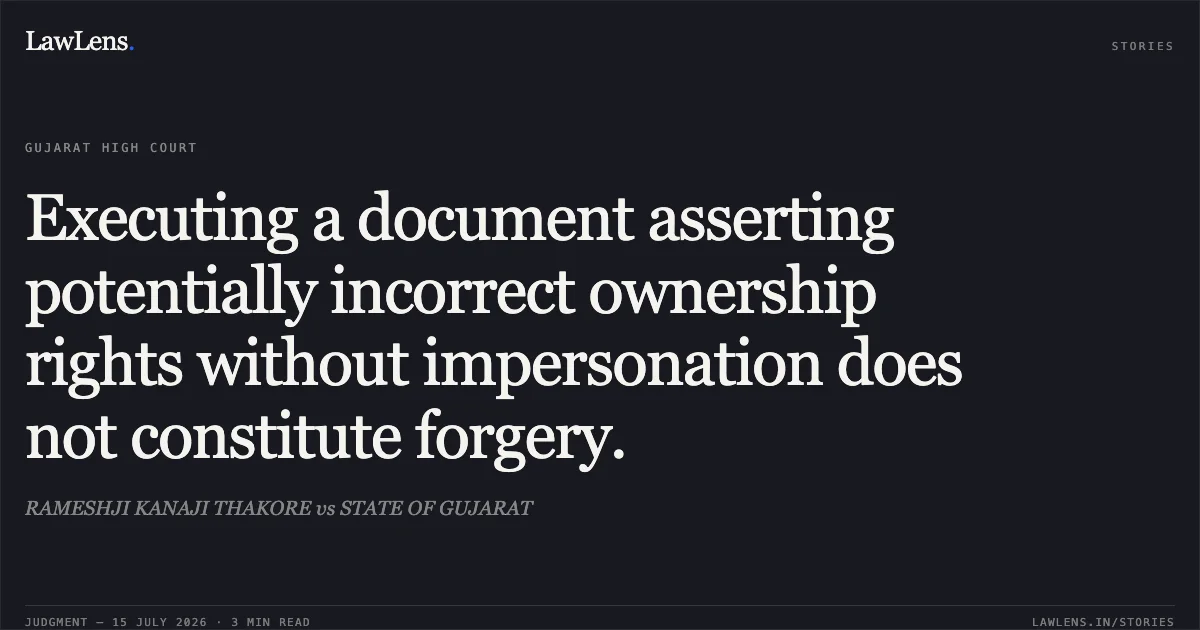
The court reasoned that for forgery to be established, there must be a "false document" as defined under Section 464 IPC. It observed that the accused, Laxmanji, signed the affidavits and pedigrees in his own capacity and did not impersonate any other person
Source reference: p. 17-18Even if the death dates of his father were incorrectly stated or if the pedigree excluded certain heirs, these acts did not meet the legal threshold for forgery because the accused was not under the guise of another person
Source reference: p. 16-18The court noted that a person asserting an unsustainable or legally incorrect claim over property via a document they signed themselves does not commit forgery
Source reference: p. 18Furthermore, the court found the 30-year delay (or 13 years since the 2005 documents) to be inordinate and unexplained, suggesting the FIR was an attempt to exert pressure in a civil entitlement dispute
Source reference: p. 15-16Holding
The court held that unless the specific ingredients of Section 464 IPC (Making a false document) are satisfied, a charge of forgery under Sections 465, 467, or 468 cannot be sustained. The court concluded that neither the primary accused nor the attesting witnesses could be held as "makers of forged documents" under the law
The court allowed the petitions and quashed FIR C.R. No. I-78/2018 and all consequential proceedings. Rule was made absolute
Source reference: p. 20-21Acts & Sections Cited
8 provisions across 2 statutes referred to in this judgment. Each provision opens on LawLens.
Code of Criminal Procedure, 19731
Indian Penal Code, 18607
Original Court PDF
RAMESHJI KANAJI THAKOREvsSTATE OF GUJARAT
Click to open original judgment
Original judgment, available to read, download and summarize on LawLens.in


