Facts
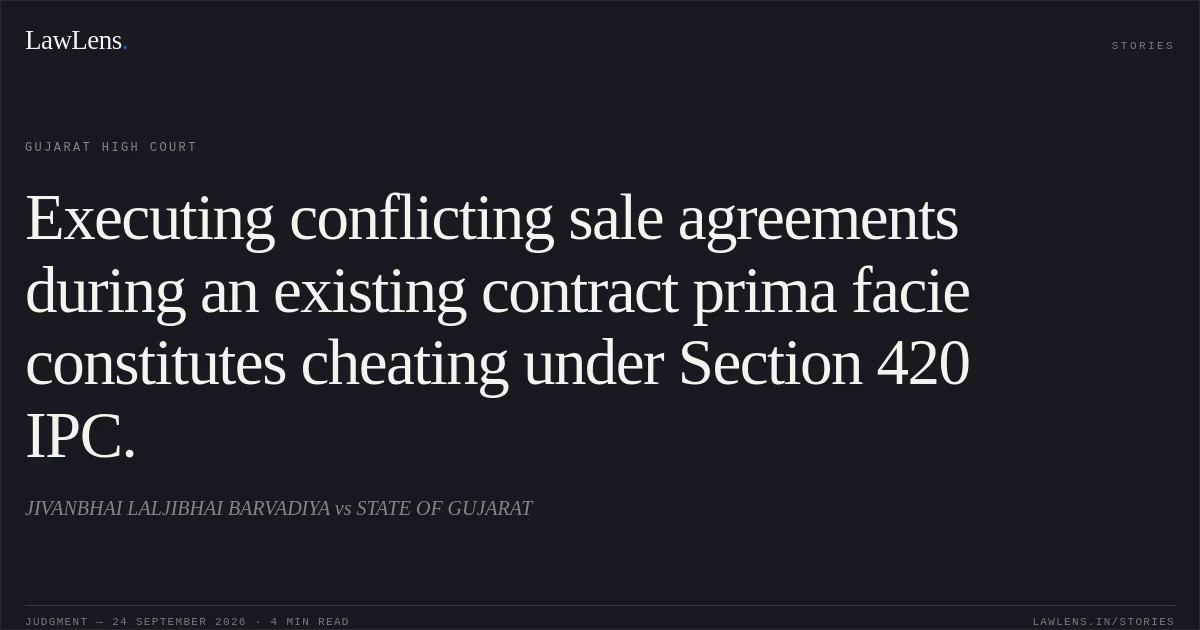
The applicant invoked Section 482 of the Code of Criminal Procedure, 1973, seeking quashing of FIR C.R. No. 50 of 2017 registered at Palsana Police Station under Sections 406, 409 and 420 IPC.
Source reference: paras. 1–2; pp. 1–4The complainant alleged that he and his partners agreed to purchase the applicant’s land for ₹4 crores, paid ₹3 crores, and obtained a possession-inclusive agreement to sell dated 13 September 2014, with the balance payable within five months.
Source reference: paras. 1–2; pp. 1–4The applicant allegedly failed to execute the sale deed, obtained non-agricultural permission, subdivided the land, and entered into further agreements with third parties during the subsistence of the complainant’s agreement.
Source reference: para. 2; pp. 2–4The applicant contended that the dispute was purely civil, that the FIR was lodged belatedly after the failure of interim relief in the civil suit, and that the FIR did not disclose dishonest intention at inception.
Source reference: paras. 3.1–3.7; pp. 4–6The complainant and the State opposed quashing, asserting that the subsequent third-party transactions disclosed a prima facie case of cheating notwithstanding the pending civil proceedings.
Source reference: paras. 4–4.3; pp. 6–7Issues
Whether the allegations disclosed the essential ingredient of “entrustment” necessary to constitute criminal breach of trust under Sections 406 and 409 IPC.
Source reference: paras. 6–8; p. 8Whether the allegations disclosed deception, dishonest intention and inducement at the relevant time so as to constitute cheating and dishonest inducement to deliver property under Section 420 IPC.
Source reference: paras. 9–13; pp. 8–10Whether the pendency of civil proceedings and the delay in lodging the FIR warranted quashing of the criminal proceedings under Section 482 CrPC.
Source reference: paras. 3.1–3.6, 16–17; pp. 4–6, 10–12Whether Sections 406/409 and Section 420 IPC could simultaneously be sustained on the same alleged transfer of money.
Source reference: para. 8; p. 8Law Applied
The Court applied Section 482 CrPC governing the High Court’s inherent jurisdiction to prevent abuse of process and secure the ends of justice.
Source reference: no citationFor Sections 406 and 409 IPC, read with Section 405 IPC, the prosecution must establish entrustment of property or dominion over property.
Source reference: paras. 6–8; p. 8Money paid as advance or part consideration under an agreement to sell ordinarily becomes the seller’s property and is not “entrusted” property required to be held or returned in specie; consequently, mere non-performance of the sale agreement does not constitute criminal breach of trust.
Source reference: para. 7; p. 8Section 420 IPC requires deception or cheating under Section 415 IPC, dishonest or fraudulent intention at the time of the representation or promise, and dishonest inducement resulting in delivery of property.
Source reference: paras. 9–10; pp. 8–9Money constitutes “property” for Section 420 IPC, as recognised in R.K. Dalmia v. Delhi Administration, AIR 1962 SC 1821.
Source reference: para. 10; p. 9The Court relied on Delhi Race Club (1940) Ltd. v. State of Uttar Pradesh, 2024 (10) SCC 690, Radheshyam v. State of Rajasthan, 2024 (0) AIJEL-SC 76335, G. Saminathan v. State, 2026 (0) AIJEL-SC 77369, and Punit Beriwala v. State of NCT of Delhi, 2025 INSC 582.
Source reference: no citationThe Court further held that the existence of civil proceedings does not bar criminal prosecution where the FIR prima facie discloses a cognizable offence, and delay in registering an FIR is not by itself a ground for quashing, particularly for offences punishable with imprisonment exceeding three years.
Source reference: paras. 16–17; pp. 10–12Reasoning
The Court held that the ₹3 crores paid under the agreement to sell represented advance sale consideration and were not entrusted to the applicant; therefore, the foundational requirement of Sections 405, 406 and 409 IPC was absent.
Source reference: paras. 6–8; p. 8However, the allegations that the applicant accepted the complainant’s money under an agreement granting five months for performance and, before expiry of that period, created third-party rights by plotting and entering into further agreements concerning the same land were sufficient, at the quashing stage, to indicate prima facie dishonest intention and deceptive conduct.
Source reference: paras. 11–13; pp. 9–10The Court distinguished cases involving only a subsequent failure to perform a contract because the present allegations included contemporaneous third-party transactions during the subsistence of the complainant’s contractual term.
Source reference: paras. 14–15; p. 10The pending civil suits, rejection of interim relief, and delay in lodging the FIR raised matters for trial and did not negate the prima facie ingredients of Section 420 IPC.
Source reference: paras. 16–17; pp. 10–12The Court also accepted that the same alleged transfer of money could not sustain criminal breach of trust where entrustment was absent, while the allegations could nevertheless support cheating under Section 420 IPC.
Source reference: para. 8; p. 8Holding
The application was partly allowed.
The FIR and all consequential proceedings were quashed qua the applicant insofar as they related to Sections 406 and 409 IPC.
Source reference: para. 18(II); p. 12The prayer to quash the FIR under Section 420 IPC was rejected, since the allegations disclosed a prima facie case of dishonest inducement and cheating; the trial was permitted to proceed for that offence in accordance with law.
Source reference: para. 18(III); p. 12The Court clarified that its observations were confined to the Section 482 proceedings and would not prejudice the pending civil suits or the criminal trial.
Source reference: para. 18(IV); p. 12The rule was made absolute to that extent, and the connected stay application was disposed of as infructuous.
Source reference: para. 19; p. 12Acts & Sections Cited
10 provisions across 2 statutes referred to in this judgment. Each provision opens on LawLens.
Code of Criminal Procedure, 19731
Original Court PDF
JIVANBHAI LALJIBHAI BARVADIYAvsSTATE OF GUJARAT
Click to open original judgment
Original judgment, available to read, download and summarize on LawLens.in