01Facts
The appellant firm entered into an agreement with the DDA for construction work at Katwaria Sarai.
p. 2Disputes arose, leading to an Arbitral Award on 23.02.1995.
p. 2The Sole Arbitrator awarded several claims, including Claim No. 8 for "loss of business for withheld money" at Rs. 6,000 per month, but did not specify interest for this particular claim.
pp. 3-4A corrigendum was issued on 04.03.1995 to correct the work completion date to 18.01.1989.
p. 5The award was made Rule of the Court on 24.09.2001, granting 12% p.a. interest from the date of the decree until realization.
p. 6The DDA paid the decretal amount in 2002 and 2004.
p. 6Subsequently, the appellant filed multiple execution petitions claiming pendente lite and future interest specifically on Claim No. 8.
pp. 7-9After a Division Bench order in 2013 adjusted the principal amount for Claim No. 8 based on the corrigendum dates, the DDA made further payments.
p. 10The appellant then sought additional interest on that claim, which was rejected by the Executing Court on 13.03.2014 and the Appellate Court on 01.06.2016.
p. 11The appellant now challenges the dismissal of their review petition dated 27.11.2018.
p. 1202Issues
i.1. Whether the appellant is entitled to pendente lite and future interest on Claim No. 8 when such interest was not specifically granted in the original Arbitral Award or the subsequent decree
p. 2, 16ii.2. Whether the present second appeal involves a substantial question of law as required under Section 100 of the CPC
p. 15, 1903Law Applied
Section 100 of the Civil Procedure Code (CPC), 1908, which restricts the jurisdiction of a High Court in a second appeal to cases involving a "substantial question of law" and prohibits interference with concurrent findings of fact.
p. 1, 20Section 114 and Order XLVII of the CPC, which limit the scope of a review to errors apparent on the face of the record.
pp. 12-13The principle from Roop Singh v. Ram Singh (2000) 3 SCC 708, establishing that a second appellate court cannot go behind a decree or re-examine findings of fact absent perversity.
p. 15, 20Section 13 of the Arbitration and Conciliation Act, 1940 (applicable due to the age of the case) regarding the arbitrator's power to issue corrigenda.
p. 5Provisions in the judgment · 6 · Linked ones open on LawLens
Delhi High Court Act, 1966 Section 10
Code of Civil Procedure, 1908 Section 96Section 100Section 114Section 21Section 47
04Reasoning
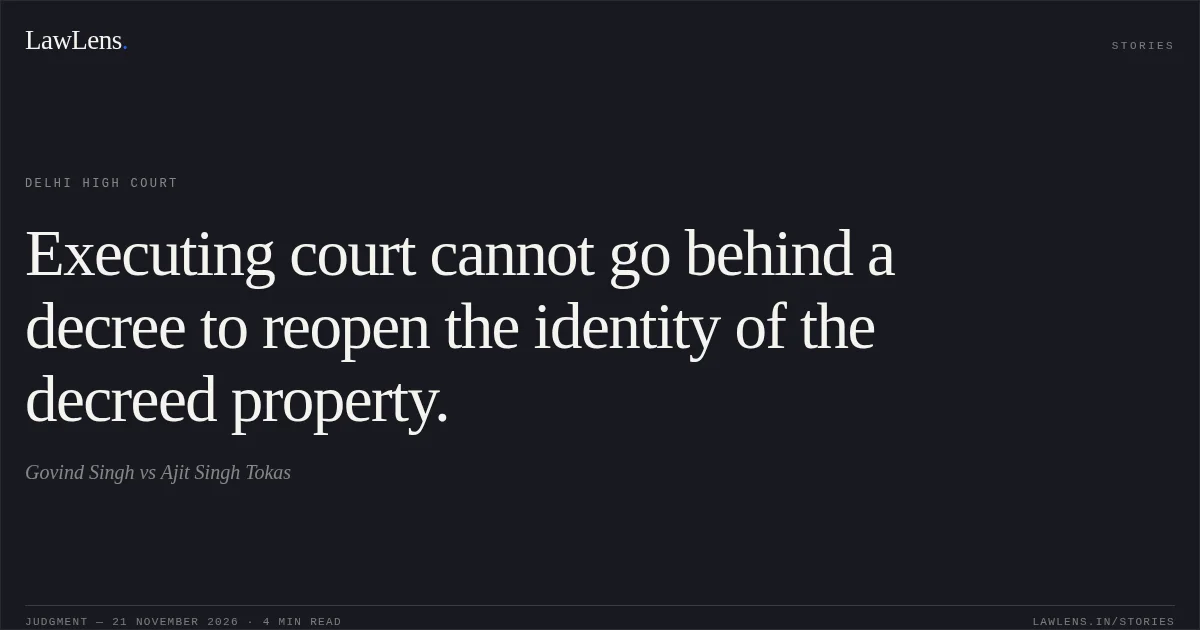
The Court reasoned that an executing court is bound by the terms of the decree and cannot grant relief, such as specific interest, that was never awarded by the Arbitrator or the decree-passing court.
p. 11, 19Upon reviewing the 1995 Award and the 2001 Judgment making it Rule of Court, the Court found that while interest was awarded for Claims 7 and 15, Claim No. 8 was conspicuously excluded from pendente lite or future interest provisions.
p. 3, 18The 2013 Division Bench order merely corrected the calculation period for the principal amount of Claim No. 8 based on the corrigendum but did not create a new entitlement to interest.
p. 10, 19The Court noted that the appellant had accepted previous payments in 2002 and 2004 without agitating these specific interest claims at that time.
p. 18The appellant's attempt to seek interest through a review of the 2001 decree had already been dismissed in 2007.
p. 17Consequently, the Court found no "error apparent on the face of the record" in the lower courts' refusal to award interest that did not exist in the decree.
p. 13, 2005Holding
The Court held that since no pendente lite or future interest was ever awarded for Claim No. 8 in the original award or the decree, the appellant cannot recover the same in execution proceedings.
pp. 18-19The Court further held that the appeal failed to raise any substantial question of law, as it was merely an attempt to re-litigate settled facts.
p. 19The second appeal was dismissed, and the impugned order dated 27.11.2018 was upheld.
pp. 20-21Original Court PDF
Brij Lal & SonsvsDda
Click to open original judgment
Original judgment, available to read, download and summarize on LawLens.in