Facts
The Petitioner (landlady) obtained an eviction decree on September 27, 2011, against the original tenant and a sub-tenant (Defendant No. 2, Kalam Khan) on grounds of unlawful subletting and bona fide need
Source reference: para. 3In 2022, during execution, Defendant No. 2 provided an undertaking to pay arrears and vacate, but subsequently defaulted
Source reference: para. 4Respondent No. 1 (Naziya), the niece of Defendant No. 2, filed Obstructionist Notice No. 43 of 2023, claiming she had an independent right to the premises because she paid Rs. 10 lakhs to the Petitioner’s agent for tenancy transfer
Source reference: para. 4The Trial Court dismissed the notice via summary inquiry, finding her claim baseless and derivative of Defendant No. 2
Source reference: para. 5, 23However, the Appellate Bench of the Small Causes Court set aside the dismissal and remanded the matter for a full trial with evidence
Source reference: para. 2, 7Issues
1. Whether the Executing Court is mandatorily required to conduct a full-fledged trial for every obstruction application filed under Order 21 Rule 97 or 99 of the CPC, or if a summary inquiry is permissible for ex-facie baseless claims.
Source reference: para. 12. Whether Respondent No. 1 established a prima facie independent right to the suit premises necessitating a trial.
Source reference: para. 24, 28Law Applied
The court applied Order 21 Rules 97, 101, and 105 of the Code of Civil Procedure, 1908, which mandate the adjudication of "all questions" arising in obstruction proceedings
Source reference: para. 1, 19It relied on the precedent of Silverline Forum Pvt. Ltd. vs. Rajiv Trust, which clarified that the adjudication under Rule 97(2) need not necessarily involve detailed evidence collection and can be based on admitted facts or averments
Source reference: para. 19The court further applied the principle from Indubai D. Kothawale vs. Laxman Balwant Chougule, holding that if an obstructor has no "semblance of right," the Executing Court can summarily reject the application to prevent the frustration of valid decrees
Source reference: para. 20Reasoning
The Court observed that Respondent No. 1 failed to show any independent title, and her claim of being in exclusive possession was contradicted by evidence showing Defendant No. 2 continued to occupy the premises
Source reference: para. 18, 24Specifically, a bailiff’s report from March 2024 and subsequent legal filings by Defendant No. 2 proved he was still the actual occupant, belying Respondent No. 1's claim of exclusive possession and collusion
Source reference: para. 18The Court reasoned that Rule 101 is intended to resolve legal disputes efficiently, not to provide an "avenue" for baseless claims meant to indefinitely delay execution
Source reference: para. 21It found the Appellate Court erred by ignoring the obvious collusion between the uncle (Defendant No. 2) and niece (Respondent No. 1) and by misinterpreting the "all questions" mandate as requiring a trial regardless of the claim’s merit
Source reference: para. 26-29Holding
The High Court set aside the Appellate Bench's order and restored the Trial Court's summary dismissal of the obstruction notice
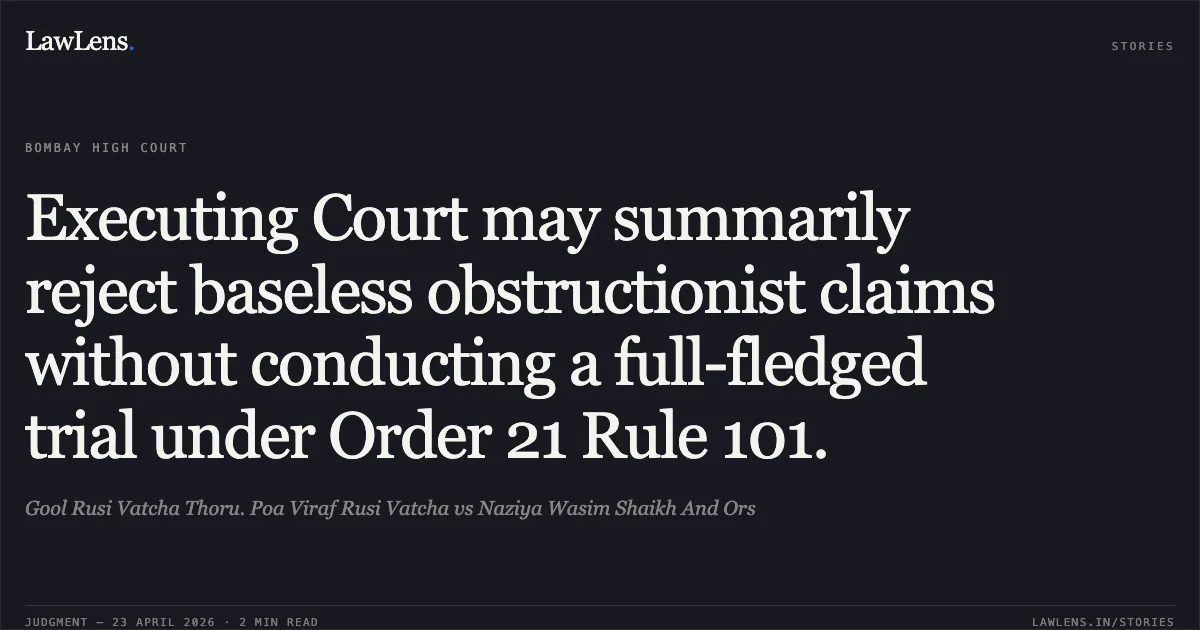
It held that a full trial is not mandatory when an obstruction is found to be ex-facie baseless or derivative
Source reference: para. 20, 22The Court concluded that Respondent No. 1 was merely a "front" for the judgment-debtor (Defendant No. 2) to obstruct the decree
Source reference: para. 30The Writ Petition was allowed, and the execution of the 2011 decree was ordered to proceed
Source reference: para. 31-32Acts & Sections Cited
6 provisions across 1 statute referred to in this judgment. Each provision opens on LawLens.
Code of Civil Procedure, 19086
Original Court PDF
Gool Rusi Vatcha Thoru. Poa Viraf Rusi VatchavsNaziya Wasim Shaikh And Ors
Click to open original judgment
Original judgment, available to read, download and summarize on LawLens.in


