Facts
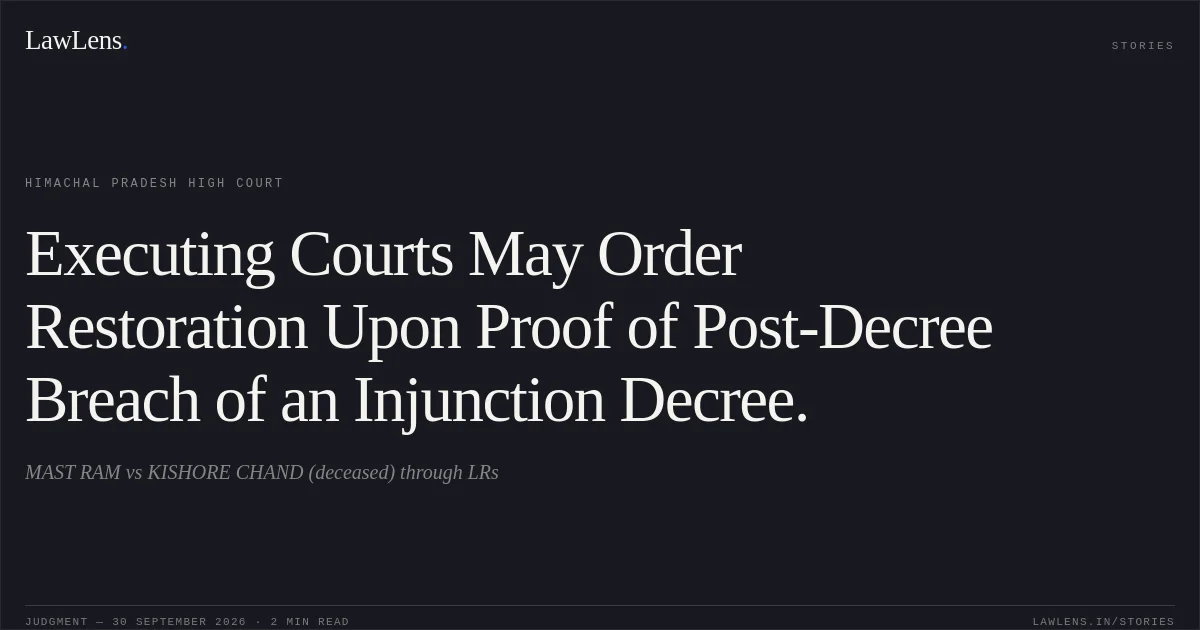
Mast Ram obtained a decree declaring his right to irrigate his land through a specified sub-water channel and permanently restraining Kishore Chand from obstructing the flow of water
Source reference: para. 3In execution, Mast Ram alleged that the judgment-debtors had dismantled the channel after the decree; the judgment-debtors denied disobedience, although they did not dispute the dismantling allegation itself
Source reference: paras. 4–8The Executing Court ordered attachment of the judgment-debtors’ property for three months but did not direct restoration of the channel.
Source reference: para. 10Mast Ram challenged the refusal to order restoration, while the judgment-debtors challenged the attachment
Source reference: paras. 11–16Issues
1. Whether the Executing Court could order restoration of the sub-water channel in execution of the decree for permanent injunction, if the channel had been dismantled after the decree.
Source reference: paras. 17–202. Whether the order attaching the judgment-debtors’ property was sustainable without first determining whether they had disobeyed the decree.
Source reference: paras. 14–17, 21Law Applied
Order XXI Rule 32 CPC provides for enforcement of injunction decrees through measures including attachment of property; as explained in Bhudev Mallick alias Bhudeb Mallick v. Ranajit Goshal, 2025 INSC 175, the rule may also permit restoration where a decree-holder has been dispossessed after the decree.
Source reference: para. 21Coercive measures require a finding that the judgment-debtor wilfully disobeyed or failed to comply with the decree.
Source reference: para. 21, quoting Bhudev Mallick, paras. 44–46The judgment also referred to Article 136 of the Limitation Act, 1963, including its proviso that execution of a decree granting perpetual injunction is not subject to a limitation period.
Source reference: para. 21Reasoning
The decree had attained finality, so the judgment-debtors could not deny the existence of the channel recognised by it.
Source reference: para. 19However, the allegation of post-decree dismantling rested only on Mast Ram’s oral statement, leaving the relevant fact unascertained.
Source reference: para. 19The Executing Court should therefore have obtained an on-site assessment by a revenue agency rather than refusing restoration without investigating the alleged change in the channel.
Source reference: para. 20Because that factual inquiry was also material to determining disobedience and the propriety of attachment, the High Court set aside the order and remitted the matter for investigation and fresh consideration.
Source reference: paras. 20–23Holding
Both petitions were allowed, and the Executing Court’s order was set aside.
The matter was remanded with a direction to appoint a Local Commissioner to ascertain whether the sub-water channel had been dismantled and then proceed in accordance with law, particularly in light of Bhudev Mallick.
Source reference: para. 23The parties were directed to appear before the Executing Court on 16 October 2026, and the execution application was directed to be decided afresh within four months.
Source reference: paras. 25–26Acts & Sections Cited
2 provisions across 2 statutes referred to in this judgment. Each provision opens on LawLens.
Code of Civil Procedure, 19081
Limitation Act, 19631
Original Court PDF
MAST RAMvsKISHORE CHAND (deceased) through LRs
Click to open original judgment
Original judgment, available to read, download and summarize on LawLens.in