Facts
The respondents, who were appointed as School Lecturers on contract between 1998 and 2000, sought parity with the employees covered by the Himachal Pradesh High Court’s judgment in State of Himachal Pradesh v. Rakesh Chand, LPA No. 105 of 2010 and connected matters, decided on 13.12.2012.
Source reference: para. 4Their writ petition, CWP No. 264 of 2013-G, was disposed of on 10.01.2013 with a direction that, if they were found similarly situated to the beneficiaries in Rakesh Chand, similar treatment be extended to them.
Source reference: para. 4The respondents thereafter initiated execution proceedings.
Source reference: no citationBy order dated 12.08.2024, the High Court directed implementation on the basis of the minimum of the revised pay scale along with admissible allowances and consequential benefits, relying also upon its decision concerning JBT Teachers in LPA No. 108 of 2012.
Source reference: paras. 3, 8The State challenged that order before the Supreme Court, contending that the respondents were fence-sitters, that they were School Lecturers rather than JBT Teachers, and that the Execution Court had travelled beyond the original order.
Source reference: paras. 5–5.4Issues
Whether the High Court, while exercising execution jurisdiction, could travel beyond the terms of the order dated 10.01.2013 and grant benefits by relying upon judgments concerning JBT Teachers and subsequent implementation practices.
Source reference: paras. 8–10, 15Whether the respondents were entitled, under the order dated 10.01.2013, to the pay benefit granted in State of Himachal Pradesh v. Rakesh Chand, namely the initial of the pay scale attached to the posts of JBT Teachers, as revised from time to time.
Source reference: paras. 9, 13–16Whether the respondents’ delayed approach to the Court, more than twelve years after the cause of action arose and only after the judgment in Rakesh Chand, disentitled them from claiming the benefit as fence-sitters.
Source reference: paras. 11–13Law Applied
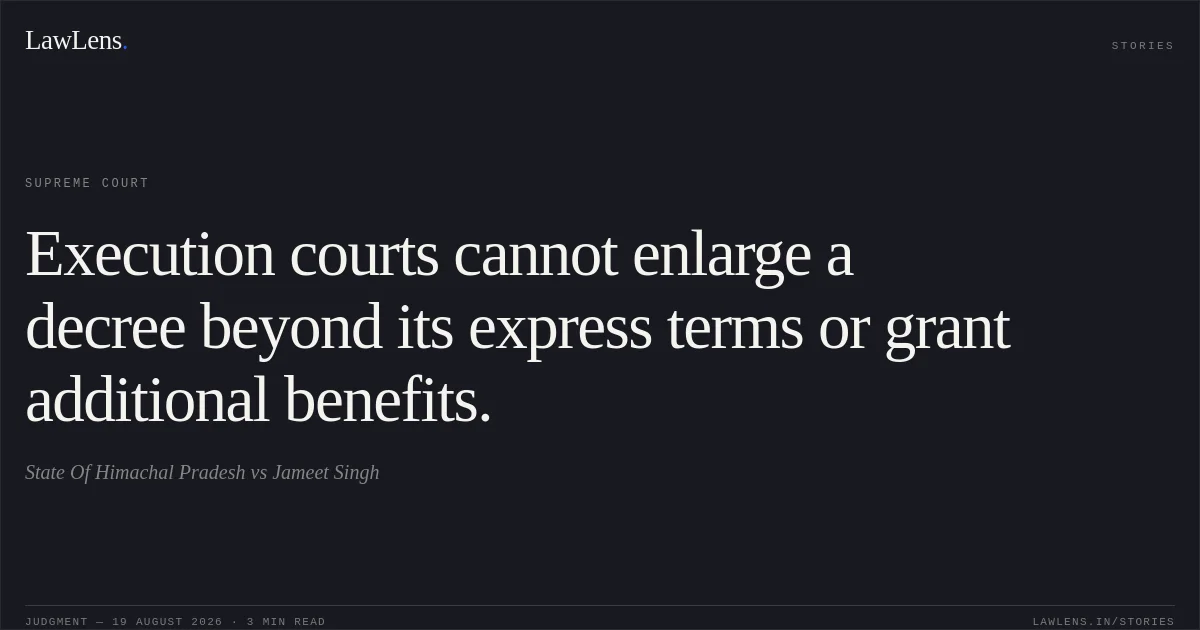
The Court applied the settled principle that an executing court must execute a decree or order according to its terms and cannot go behind it, enlarge the relief, or grant a benefit not contemplated by the original judgment.
Source reference: paras. 8, 15The operative principle from the High Court’s judgment dated 13.12.2012 in State of Himachal Pradesh v. Rakesh Chand, LPA No. 105 of 2010 and connected matters, was that eligible contract JBT Teachers were entitled to the initial of the pay scale attached to the post of JBT Teachers, as revised from time to time; the same principle had been stated to apply to contract School Lecturers.
Source reference: paras. 4, 9, 14The Court also recognised the principle that fence-sitters in service matters cannot ordinarily claim the benefit of a later judgment merely because they are similarly situated to persons who diligently pursued their claims, particularly where the delay is unexplained and substantial.
Source reference: paras. 11–13Reasoning
The Supreme Court found that the High Court had misdirected itself by relying on the implementation of the judgment concerning JBT Teachers and by treating that implementation as authorising payment of allowances and consequential benefits beyond the original order.
Source reference: para. 8The respondents were admittedly School Lecturers, whereas LPA No. 108 of 2012 concerned JBT Teachers; the High Court therefore had created confusion between distinct categories of employees.
Source reference: para. 10Nevertheless, the Supreme Court held that the order dated 10.01.2013 was clear: it adopted the benefit granted in Rakesh Chand and its analogous cases.
Source reference: paras. 13–15Consequently, implementation had to be confined to the initial of the JBT pay scale, as revised from time to time, rather than to any broader relief derived from subsequent execution proceedings or administrative action.
Source reference: paras. 13–15The Court also noted that the respondents had approached the Court only after the 13.12.2012 judgment, despite the cause of action arising in 1998–2000 and despite having no prior representation or proceedings; their conduct could not be regarded as bona fide.
Source reference: paras. 11–13The operative relief, however, was determined by the terms of the subsisting order sought to be executed.
Source reference: no citationHolding
The appeals were allowed and the High Court’s order dated 12.08.2024 was set aside.
The respondents were held entitled only to the pay scale reflected in the High Court’s order dated 13.12.2012 in LPA No. 105 of 2010 and analogous matters—namely, the initial of the pay scale attached to the posts of JBT Teachers, as revised from time to time.
Source reference: para. 16The Court specified the corresponding amounts as ₹6,400 before 31.12.2005 and ₹10,300 with effect from 01.01.2006.
Source reference: para. 14The Execution Court was held incompetent to enlarge or reinterpret the original order so as to award additional benefits beyond that entitlement.
Source reference: para. 15Original Court PDF
State Of Himachal PradeshvsJameet Singh
Click to open original judgment
Original judgment, available to read, download and summarize on LawLens.in