Facts
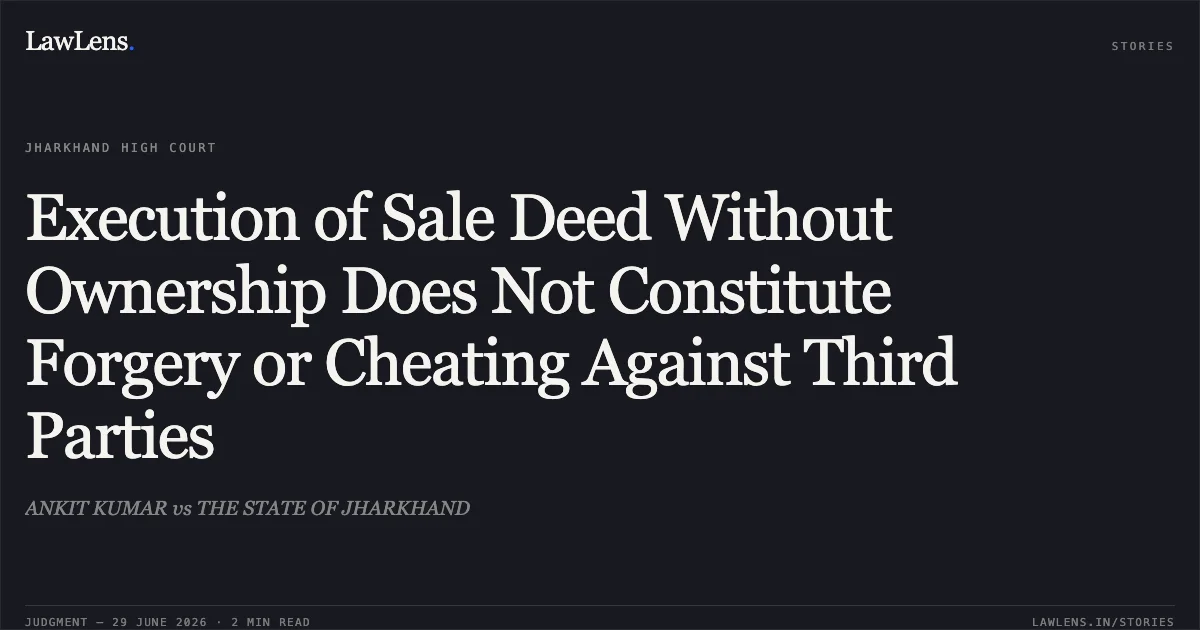
The petitioner, Ankit Kumar, was accused in Karra P.S. Case No. 32 of 2026 for allegedly purchasing land from a co-accused, Shaukat Ansari.
Source reference: p. 1-2It was alleged that Ansari sold the land using a false genealogy, claiming to be the sole heir of the original owner.
Source reference: p. 1-2The FIR was registered under Sections 316(2), 318(4), 338, 336(3), 351(2), 351(3), 61(2), and 3(5) of the Bharatiya Nagarik Suraksha Sanhita (BNSS/BNS), 2023.
Source reference: p. 1The petitioner challenged the proceedings, arguing that he was the purchaser, not the perpetrator of fraud, and that the informant had suppressed the fact of a prior pending complaint case on the same facts.
Source reference: p. 2Issues
1. Whether the execution of a sale deed by a person claiming ownership of a property that does not belong to him constitutes "making a false document" or forgery under the BNS.
Source reference: p. 2-32. Whether a third party (not the purchaser) can maintain a criminal complaint of cheating against the purchaser of such property.
Source reference: p. 33. Whether the suppression of a prior complaint case by the informant constitutes an abuse of the process of law.
Source reference: p. 4-5Law Applied
The court primarily applied the principle from Mohammed Ibrahim v. State of Bihar (2009), holding that executing a document for property one does not own is not "forgery" unless there is impersonation; the defrauded party is the purchaser, not a third party.
Source reference: p. 2-3It utilized Sections 316(2) (Cheating) and 318(4) of the BNSS regarding dishonest inducement.
Source reference: p. 6It further relied on Krishna Lal Chawla v. State of Uttar Pradesh (2021), which establishes that suppression of material facts by a litigant is an abuse of the court's process.
Source reference: p. 4Reasoning
The court reasoned that since the co-accused (vendor) claimed ownership himself and did not impersonate anyone else, the sale deed did not constitute a "false document" as per the definition corresponding to Section 464 IPC (now Section 335 BNS).
Source reference: p. 3, 6The court noted that the petitioner was the purchaser; under the Mohammed Ibrahim precedent, only a purchaser can claim to be cheated by a vendor—a third party (the informant) cannot maintain such a claim against the purchaser when no property was entrusted or delivered by said informant to the petitioner.
Source reference: p. 6Consequently, no offence of forgery (Section 338 BNS) was attracted.
Source reference: p. 6The court found the informant's failure to disclose the prior Complaint Case No. 24 of 2026 to be a "heavy-handed" abuse of process.
Source reference: p. 2, 4Holding
The court answered the issues in the negative, holding that no criminal offence was made out against the petitioner even if the allegations were taken at face value.
The court held that continuing the proceedings would be an abuse of the process of law.
Source reference: p. 7Accordingly, the Court allowed the petition and quashed the entire criminal proceeding and the FIR in Karra P.S. Case No. 32 of 2026 specifically against the petitioner.
Source reference: p. 7Acts & Sections Cited
14 provisions across 4 statutes referred to in this judgment. Each provision opens on LawLens.
Bharatiya Nagarik Suraksha Sanhita, 20231
Bharatiya Nyaya Sanhita, 20238
Indian Penal Code, 18604
Code of Criminal Procedure, 19731
Original Court PDF
ANKIT KUMARvsTHE STATE OF JHARKHAND
Click to open original judgment
Original judgment, available to read, download and summarize on LawLens.in