Facts
The Petitioner, wife of Mr. Jivan Kumar Singh (a Delhi Police Sub-Inspector), sought a direction for the issuance of a death certificate for her husband who went missing on 08.06.2005
Source reference: para. 2Despite a missing complaint filed in 2005 and subsequent police investigations, his whereabouts remained unknown for over 20 years
Source reference: para. 2, 36The Petitioner applied to the Sub-Divisional Magistrate (SDM) under Section 13(3) of the Registration of Births and Deaths Act, 1969, for delayed registration of death
Source reference: para. 5The SDM, via an RTI response, declined the request, stating that while a presumption of death exists under Section 108 of the Evidence Act, a formal declaration must be obtained from a competent Civil Court
Source reference: para. 7The Petitioner challenged this inaction, seeking registration based on the statutory presumption of death after seven years
Source reference: para. 8, 9Issues
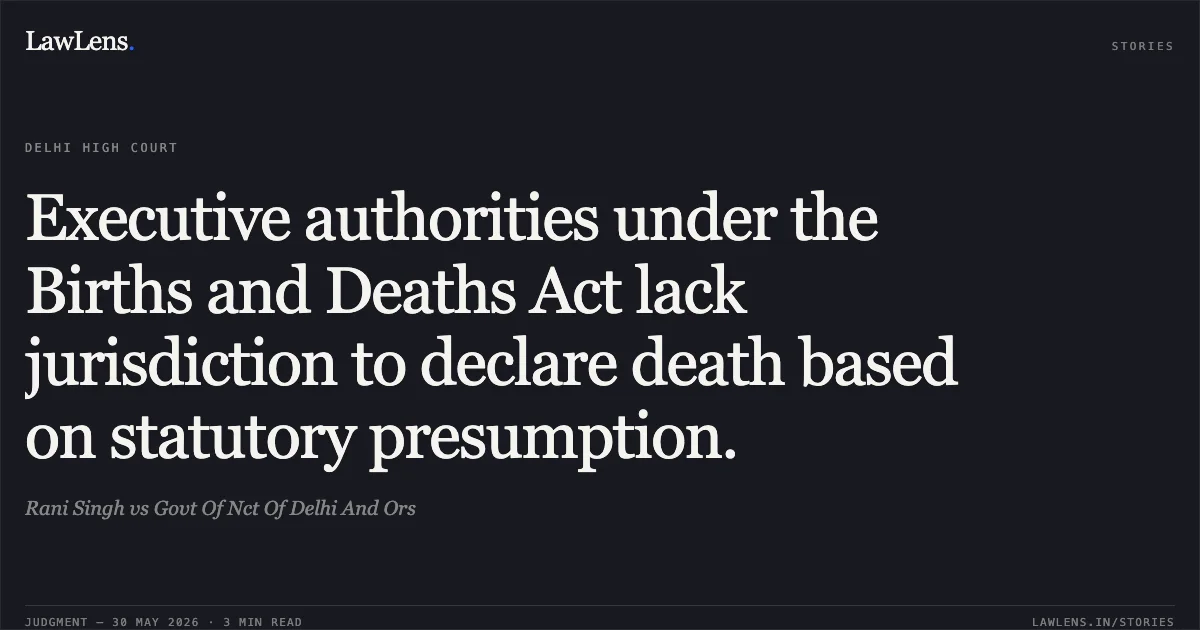
1. Whether an Executive Magistrate/SDM, exercising powers under Section 13(3) of the Registration of Births and Deaths Act, 1969, has the jurisdiction to invoke the legal presumption of death under Section 108 of the Evidence Act to register a death
Source reference: para. 132. Whether a declaratory decree from a Civil Court is a mandatory prerequisite for the registration of death in cases of missing persons
Source reference: para. 33Law Applied
Section 13(3) of the Registration of Births and Deaths Act, 1969, and Rule 9(3) of the Delhi Rules, 1999, which govern the delayed registration of births and deaths upon the order of a Magistrate after verifying "correctness"
Source reference: para. 14, 15Section 108 of the Indian Evidence Act, 1872 (and Section 111 of Bharatiya Sakshya Adhiniyam, 2023), which shifts the burden of proof to the person affirming a man is alive if he has not been heard of for seven years
Source reference: para. 20Reliance was placed on LIC of India v. Anuradha (2004), establishing that the presumption under Section 108 is evidentiary and pertains only to the factum of death, not the date or time, and typically arises in judicial proceedings before a "Court" as defined in Section 3 of the Evidence Act
Source reference: para. 24, 31Reasoning
The court reasoned that the SDM functions in an administrative capacity under Section 13(3) of the Act, intended for registering events that have already occurred, rather than adjudicating civil status
Source reference: para. 15, 27Since Section 1 of the Evidence Act limits the application of evidentiary presumptions to "judicial proceedings," the SDM—not acting as a "Court" in a lis inter partes—cannot unilaterally invoke Section 108 to declare a person dead
Source reference: para. 25-29However, the court observed that where a person has been missing for nearly 21 years (three times the statutory period), strict adherence to procedural rigours (civil suits) causes extreme hardship and "legal suspension" for the family
Source reference: para. 36-40While upholding the SDM's legal stand that they lack inherent adjudicatory power, the High Court invoked its equitable jurisdiction under Article 226 to prevent summum jus, summa injuria (extreme law resulting in extreme injustice)
Source reference: para. 41-44Holding
The Court held that while the SDM was legally correct in declining the application initially, the peculiar facts of a 20-year disappearance warranted an exceptional remedy
The Court directed the SDM to publish a public notice in English and Hindi newspapers inviting objections to the presumption of Mr. Kumar's death. If no objections are received within 30 days, the SDM is directed to pass an order under Rule 9(3) and instruct the Registrar to issue the death certificate. If objections arise, the Petitioner must approach a Civil Court.
Source reference: para. 46, 47Acts & Sections Cited
5 provisions across 3 statutes referred to in this judgment. Each provision opens on LawLens.
Registration of Births and Deaths Act, 19691
Bharatiya Sakshya Adhiniyam, 20233
Specific Relief Act, 19631
Original Court PDF
Rani SinghvsGovt Of Nct Of Delhi And Ors
Click to open original judgment
Original judgment, available to read, download and summarize on LawLens.in