Facts
The Petitioner, a private shipping service provider, owned two vessels, Jag Aabha and Jag Prerna, which were imported into India in December 2008 and July 2008, respectively.
Source reference: p. 3Upon initial entry, the vessels were granted full exemption from customs duties under Entry No. 352 of Notification No. 21/2002-CUS.
Source reference: p. 3The vessels followed the industry practice of paying duty only on bunkers and stores when converting from "foreign run" to "coastal run" status.
Source reference: p. 3-4On March 17, 2012, the Government issued Notification No. 12/2012-CUS, superseding the 2002 notification and introducing a Countervailing Duty (CVD) on vessels converted for coastal trade.
Source reference: p. 10-11When the Petitioner sought to convert these vessels for coastal operations in June 2012, Respondent No. 4 refused clearance unless the Petitioner filed a Bill of Entry and paid duty under the new 2012 Notification.
Source reference: p. 4The Petitioner challenged this, arguing the 2012 Notification could not apply retrospectively to vessels imported years prior.
Source reference: p. 6Issues
1. Whether Notification No. 12/2012-CUS dated 17.03.2012 applies retrospectively to vessels imported into India prior to the notification's effective date.
Source reference: p. 1-2, 112. Whether the act of converting a vessel from foreign-going status to coastal run status constitutes a fresh "importation" of goods under the Customs Act, 1962, thereby attracting new levies.
Source reference: p. 5, 17Law Applied
Section 25(1) of the Customs Act, 1962, regarding the power to grant exemptions.
Source reference: p. 10The language of Notification No. 12/2012-CUS, which included a savings clause for "things done or omitted to be done" before supersession.
Source reference: p. 10The principle that taxing statutes and notifications are prospective unless expressly stated otherwise.
Source reference: p. 6, 14Precedents from the High Courts of Andhra Pradesh (2020 (372) ELT 559) and Orissa (2022 (379) ELT 318), holding that vessels already merged with the mass of Indian goods do not undergo "re-importation" upon conversion.
Source reference: p. 2, 11-19Distinguishing Union of India v. Jalyan Udyog (1993 (68) ELT 9 (SC)) regarding the timing of duty liability.
Source reference: p. 19Reasoning
The Court reasoned that the 2012 Notification explicitly protected "things done" under the previous 2002 regime, and since the vessels were imported and granted exemption in 2008/2009, those were completed acts.
Source reference: p. 11Following the reasoning of the Orissa High Court in a parallel case involving the same Petitioner, the Court noted that once a vessel is imported as "goods," its subsequent movement for trade is as a "conveyance" under Section 2(9) of the Customs Act, not a fresh import.
Source reference: p. 17The Court determined that Entry 462 and Condition 82 of the 2012 Notification were intended to apply to vessels imported after March 17, 2012.
Source reference: p. 18The Court found that because the vessels were already part of the Indian fleet and had undertaken multiple coastal/foreign runs for nearly a decade, the authorities could not retrospectively apply a new duty structure to a past importation event.
Source reference: p. 19Holding
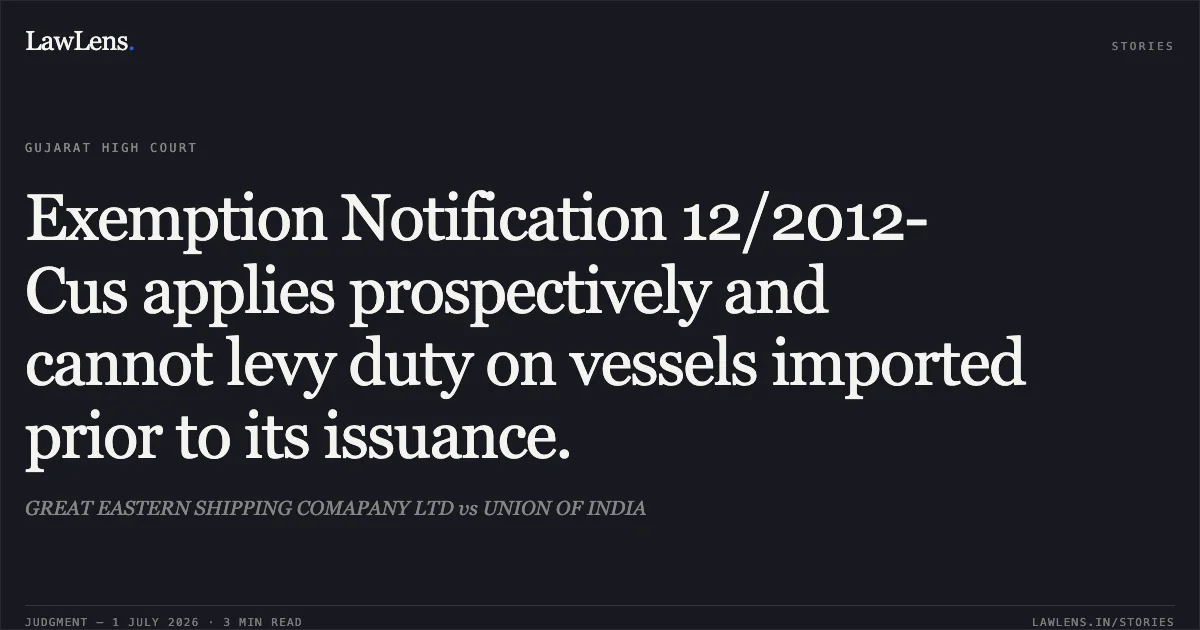
The Court allowed the writ petition, declaring that Notification No. 12/2012-CUS is prospective and does not apply to vessels imported prior to its issuance.
The Court held that the Respondents were not justified in demanding Countervailing Duty (CVD) for the conversion of the vessels Jag Aabha and Jag Prerna from foreign-going to coastal run status.
Source reference: p. 20The Court directed the Respondents to discontinue/release the Bank Guarantees (approximately ₹3.63 Crores) furnished by the Petitioner within three months.
Source reference: p. 20Acts & Sections Cited
25 provisions across 2 statutes referred to in this judgment. Each provision opens on LawLens.
Customs Act,1962
Customs Tariff Act, 19751
Original Court PDF
GREAT EASTERN SHIPPING COMAPANY LTDvsUNION OF INDIA
Click to open original judgment
Original judgment, available to read, download and summarize on LawLens.in